Showing posts with label Christianity. Show all posts

Wednesday, 13 June 2018

Darkening Preconceptions


This is a comment on the reaction to a book, rather than the book itself.

Catherine Nixey has written a new book called The Darkening Age: The Christian Destruction of the Classical World, about the transition from the ancient Roman world to a Christian world. She studied classics at Cambridge, but is now a journalist. It's clear that this book is a polemic, aimed at redressing the imbalance caused by the Christian-good, pagan-bad narrative that has (mostly) dominated since then, at least in the West, and because of that it has received very contrasting reviews.

I've not read the book yet, partly because of the polarising nature of those reviews; is it too polemical for a layman? Christians and those sympathetic to religion and the early middle ages have damned it, while classicists seem to mostly like it. It would be nice to have an objective view of this era, but the subject is emotive and the events discussed are multi-factorial, which allows prejudices and preconceptions to dictate one's interpretation of those events. Is it too glib to say that classicists defend the classical world and experts of the middle ages and Christianity defend theirs?

Here is a sample of the conflicting reviews:

Anti Nixey

Averil Cameron (professor emerita of Late Antique and Byzantine History at the University of Oxford) in Catholic magazine The Tablet: "Hearts will sink among historians of early Christianity and late antiquity, as well as medievalists and, needless to say, Byzantinists, when they see the title of this pugnacious and energetically written book. The words  ‘darkening age’ evoke everything they have been trying for years to overturn."

Levi Roach (lecturer in the early and high middle ages) in The Literary Review: “does not seek to present a balanced picture (…) this is a book of generalisations. (…) Nixey (…) is unwilling to see shades of grey.” (from here)

The most damning review comes from Tim O'Neill (anti-new-atheist-atheist historian blogger) here: "...this is a book of biased polemic masquerading as historical analysis and easily the worst book I have read in year."
"While Nixey does indeed detail several incidents of Christian violence and several more of Christian destruction, the problem is that she highlights these while neglecting or lightly skipping around other, similar incidents perpetrated by her heroes, the pagans. This makes for a good story – one with clear “good guys” and “bad guys” – but it is hopelessly biased, deliberately distorted and bad history."
"Anyone reading Nixey’s book is likely to come away thinking they know and understand more but will actually have learned things that would have to be unlearned or corrected later. Nixey’s is not a good history book. It is, as Dame Averil said so pithily, “a travesty”."

Josh Herring (Christian evangelist) for the religious think tank The Acton Institute: "The best of historical writing is accessible to educated adults of all disciplines, and it furthers our understanding of the human person; The Darkening Age is not such a work. Instead, it reveals more to us about Catherine Nixey and her understanding of history. The scholars she assembles are uniformly opposed to Christianity, presenting it as a destructive force that ended the “merry, jolly days” of pagan festivity. The prose she uses is filled with judgmental adjectives, indicating that she does not trust readers to draw their conclusion from the evidence; we must be told how to feel about the person she describes. Her book was several years in the making, but it does not reflect a clear understanding of Christianity, the complexities of Late Antiquity, or the nuances of historical craft. While this book is sold under the guise of popular history, treat it instead as an insight into how a secular journalist views Christianity in the year of our Lord 2017."

Pro Nixey

Gerard DeGroot (professor of 20th century history at the University of St Andrews) in The Times: "The Darkening Age is a delightful book about destruction and despair. Nixey combines the authority of a serious academic with the expressive style of a good journalist. She’s not afraid to throw in the odd joke amid sombre tales of desecration. With considerable courage, she challenges the wisdom of history and manages to prevail. Comfortable assumptions about Christian progress come tumbling down."

Bettany Hughes (professor of classical history) in the New York Times: "Nixey delivers this ballista-bolt of a book with her eyes wide open and in an attempt to bring light as well as heat to the sad story of intellectual monoculture and religious intolerance. Her sympathy, corruscatingly, compellingly, is with the Roman orator Symmachus: “We see the same stars, the sky is shared by all, the same world surrounds us. What does it matter what wisdom a person uses to seek for the truth?”"

Emily Wilson (Professor of Classics at the University of Pennsylvania) in The New Statesman: "Nixey is a funny, lively, readable guide through this dark world of religious oppression. She wisely insists at the start of her book that this account of cultural violence should not be read as an attack on those who are “impelled by their Christian faith to do many, many good things”. It is instead a reminder that “monotheism” (or, one could say, religion in general and Christianity in particular) can be used for “terrible ends”. The book is also an essential reminder, in the age of Brexit and Donald Trump, that intolerance, ignorance and hostility to cultural diversity are sadly nothing new."

Tim Whitmarsh (professor of Greek culture at Cambridge) in The Guardian: "But this book is not intended as a comprehensive history of early Christianity and its complex, embattled relationship to the Roman empire, and it would be unfair to judge it against that aim. It is, rather, a finely crafted, invigorating polemic against the resilient popular myth that presents the Christianisation of Rome as the triumph of a kinder, gentler politics. On those terms, it succeeds brilliantly."

It's also worth bearing in mind the experts who gave Nixey a blurb:

Engaging and erudite, Catherine Nixey's book offers both a compelling argument and a wonderful eye for vivid detail. It shines a searching spotlight onto some of the murkiest aspects of the early medieval mindset. A triumph. Edith Hall (Professor in the Classics Department and Centre for Hellenic Studies at King's College London)

Captivating and compulsive, Catherine Nixey's debut challenges our whole understanding of Christianity's earliest years and the medieval society that followed. A remarkable fusion of captivating narrative and acute scholarly judgment, this book marks the debut of a formidable classicist and historian. Dan Jones (journalist and historian)
​
Nixey's elegant and ferocious text paints a dark but riveting picture of life at the time of the 'triumph' of Christianity, reminding us not just of the realities of our own past, but also of the sad echoes of that past in our present. Michael Scott (associate professor of classics and ancient history at the University of Warwick)


Reading through the reviews it feels like they are talking about two different books, such is the discrepancy in their takes. The 'anti-Nixey' reviews make a lot of apparently valid points, and decry Nixey's bibliography. But then why would classicists and others find so much to approve of in the book? I think I know the answer: it's because it's a polemic against the presupposed goodness of the triumph of Christianity, so it's not supposed to be a balanced academic piece. In the end I guess her fans applaud that approach while her critics decry it.

I dare say one would have to study the era for some time before being expert enough to form one's own conclusion and, just as I'm not going to study cosmology to form an opinion on cosmology, I'm not going to study the history of that era either. I'm going to have to form a judgement based on scholarly consensus, and currently I lean toward the classicists. I know that science, technology and art was lost from antiquity; Christianity is prima facie culpable. The nuance that apologists for Christianity too often offer is sufficient to show other factors in play but insufficient to exculpate Christianity.

That betrays my prejudices and preconceptions too, but I've grown up in a Christian culture and have slowly realised how other cultures have been automatically and unthinkingly othered by the Christian narrative, so Nixey's book may well be a much-needed corrective.

It's interesting how the Christian persecution complex comes to the fore when there is push-back against the prevailing Christian narrative, and this push-back doesn't just come from Christians. All of us raised in a Christian culture are rather too quick to defend the atrocities committed to perpetuate our culture, and find it difficult to push against our own culture. Nevertheless, push against it we must, because we now live in a multi-cultural society and our cultures need to be reconciled. It's time to reassign the credit Christianity claims, and the blame it disclaims.

Read more »

Friday, 27 November 2015

Atran on Coyne


Jerry Coyne recently posted a piece called 'Once again, Scott Atran exculpates religion as a cause of terrorism', complaining about Scott Atran's apparent apology for religion in a recent article in the Guardian. A typical taste of Coyne's complaints:
When I read Atran’s brand of Islamic apologetics, and when I think of the terrorists’ cries of “Allahu Akbar” that accompanied their Kalashnikov fire, and when I ponder why young men out for just “a good time, a cause, and brotherhood” would do these deeds knowing they were surely going to die (and probably believing that, as martyrs, they’d attain Paradise), and when I think of the other deeds they do—the slaughter of Christians, Yazidis, apostates, atheists, and gays, and of the way they treat women like chattel, raping their sex slaves and stoning adulterers—when I think of all this, and the explicitly Islamic motivations the terrorists avow, I have to ask people like Atran: “WHAT WOULD IT TAKE TO MAKE YOU ASCRIBE ANY OF THEIR ACTIONS TO ISLAM?”
Perhaps fair enough, although I'm not sure I fully understand Atran's position; this article suggests he does acknowledge that motivations aren't entirely political:
Some officials speaking for Western governments at the East Asia summit in Singapore last April argued that the Caliphate is traditional power politics masquerading as mythology. Research on those drawn to the cause show that this is a dangerous misconception. The Caliphate has re-emerged as a seductive mobilizing cause in the minds of many Muslims, from the Levant to Western Europe.
Atran appears to have commented on Jerry's piece, saying:
I recommend some of the commentators, as well as the principal author, read some of our scientific papers inScience, PNAS, BBS, and reports of others in Nature, You might also glance at articles and editorials in the NY Times, Foreign Policy, Wall Street Journal etc. I never made an argument that “religion” is not a cause of terrorism. “Religion,” in fact, is as empty a notion (scientifically speaking) as “culture.” What I said is that the propositional content of some religious canon is not a principal predictor for may joining Al Qaeda (and now ISIS), and that, the principal predictors have to do with social network factors. Intel and military have used these finding to help break up those networks. Counter canon narratives have done absolutely nothing at all to stop violence or dissuade ISIS volunteers. In other findings, most recently reported in PNAS and NATURE, we detail how commitment to strict sharia of a form practiced by the Islamic State Caliphate, and Identity fusion (a particular type of social formation), although independent (largely uncorrelated) interact to predict costly commitment to costly sacrifices, including fighting and dying.
Mr. Coyne, like Mr. Harris, are not interested in the science, at least on this issue, but in continuing their declamations against “liberal apologetics.” Neither has ever had any dealings with volunteers or fighters from ISIS and Nusra (accepted perhaps reformed ones in safe settings), they have never been to the frontlines of combat zones to see for themselves what motivates fighters. They have never systematically interviewed or psychologically tested volunteers for such movements. And they have never tried, or been asked by those actually fighting ISIS or Al Qaeda to help in the fight because their proposals are, quite frankly, ridiculous. They are like angry children who believe that yelling at the top of their lungs will change the world. Like many politicians and pundits, willful ignorance of the science that bears on this issue is understandable (good argument is, by and large, used for persuasion and victory in social discourse, not discovery of the reason). The sad thing is that their followers believe they have scientific credentials that must give them knowledge ot support their arguments. But even Nobel prize winners have no special insight into social and political affairs, and their views should be scrutinized without passion by their peers (wishful thinking, I know).
It's again difficult to tell what his position is, because he denies that he argues that '“religion” is not a cause of terrorism" (apologies for the double negative) but goes on to describe it as an empty notion (scientifically speaking), and to cite 'social network factors' as the principal predictor of joining 'Al Qaeda (and now ISIS)', which together appear to suggest that he is arguing that religion is not a cause of terrorism. I've posted this comment:
Thanks for making this comment. I assume it’s genuinely Scott Atran! It would be helpful if you could recommend one or two links that you think particularly address the issues raised here. You say that you ‘detail how commitment to strict sharia of a form practiced by the Islamic State Caliphate, and Identity fusion (a particular type of social formation), although independent (largely uncorrelated) interact to predict costly commitment to costly sacrifices, including fighting and dying’. Apologies, but I don’t understand what that means! So bear with an interested bystander for a mo, if you can.
I think as a layman I can appreciate that a frankly perverse organisation like ISIS has multifarious causes; obviously billions of religious people don’t behave that way, so ‘religion’ is not explanatory in that sense, and might be, as you say, an ’empty’ notion. But a similar observation could be made about the term ‘politics’ and yet no-one would deny (or would they?) the political motivations of communism as an important factor in Stalin’s actions, for example. Perhaps the vast majority of communists would not have indulged in purges, so it would be correct to say that there is some other predictor of those particular actions. Nonetheless, the communism played a part, is it reasonable to say?
Furthermore, just about every theist I’ve met would not recognise their religion as an empty notion.
This suggests that saying that ‘religion’ is an empty notion in *some* sense is a weak rejoinder to anyone who argues for or against the effects of religious beliefs, and unlikely to persuade either the irreligious or the religious that religious beliefs should not be criticised (or praised).
So someone who thinks that way can accept your (no doubt firmly supported empirically) view that ‘the principal predictors [for joining Al Qaeda (and now ISIS)] have to do with social network factors’, whilst still decrying the deleterious effects of religious beliefs within the complex matrix of factors that have caused these phenomena.
For example, it seems silly to claim that religious beliefs could be used to predict who would commit acts of terrorism in the Northern Ireland troubles (both Protestants and Catholics did, of course). But it would surely be fair to point out the role that religion played in the underlying complex mix of history and culture that brought those two communities to that point.
For another example, it seems to me that one can differentiate between the attack on Charlie Hebdo and the one on Bataclan by reference to a particular religious doctrine – blasphemy. The CH attack is more obviously religiously motivated than Bataclan, prima facie. You seem to be saying that your research suggests that both attacks are predicted more by social network factors than religious ones, and I bow to your superior knowledge on that. But how could Charlie Hebdo be *singled out* for attack (amongst the enormous Western infidel media pack) if it weren’t for their particularly blasphemous (according to Islam) actions? This is surely an attack where the religious belief is ‘critical’ to the motivations of the terrorists. The Bataclan attack, less so, imo, but still an underlying, important, factor.
It is this sort of specificity of action that, again, to a layman like me, would not occur without the religious doctrine. And you perhaps acknowledge this when you say that the content of religious beliefs aren’t a ‘principal predictor’; are they a secondary one?
So the question from a complete ignoramus like me who wants to understand the differences between you and Coyne is this: Coyne suspects you would not even ‘ascribe any of [the terrorists] actions to Islam’. It’s still not clear from your comment how you respond to his question. Even if the religious doctrines aren’t a principal predictor of *who* acts, do you acknowledge that they do effect the behaviour of jihadists in Syria and in attacks on the West? If you do, and I get the impression you might, then I’m not sure what Coyne is saying that you disagree with. Is it just the emphasis he puts on ‘religion’ when these atrocities occur? He clearly cites other factors – ‘disaffection, the need to feel part of something greater than oneself, innate aggression of young males, and, yes, the mishandling of many Middle Eastern situations by the West’, so he’s not denying those other causes. Just because people bemoan one factor does not mean they discount all others.
If, on the other hand, you don’t think such doctrines have an effect on terrorist behaviour, I should like to see the papers that support that conclusion, in the (perhaps forlorn!) hope that I could understand them.
If you’ve got this far, thanks for reading, and apologies if I misconstrued your position!
It's interesting that Atran says that 'Counter canon narratives have done absolutely nothing at all to stop violence or dissuade ISIS volunteers'. This doesn't counter Coyne's complaints about religious causes, but it does perhaps point to why Atran is frustrated at 'New Atheists'; their complaints are pointless, because attempts to change religious views have not worked, according to whatever metrics Atran has used in his studies.

That may be true in Atran's studies, but the idea that societal progress cannot be made by addressing deleterious religious beliefs seems to deny the last 200 years, from the Enlightenment onwards, which has seen a secular, rational, scientific push-back against such beliefs that has had a civilising effect. Now, to be fair, many religionists would deny that this civilising effect is particularly secular, rational or scientific, but for me the evidence is pretty overwhelming.

I do wonder what 'counter canon narratives' have been attempted, because, as far as I can see, not so much has been done to counter the blasphemy narrative since CH. Indeed some western countries still outlaw it! So a meaningful counter canon narrative would have to be substantial and accord religion a lot less respect than just about every country, including in the west, does currently. Until we see this happening I suspect many of us will still see plenty in religion to complain about.

Read more »

Saturday, 19 September 2015

CFI UK Debate - Does God Exist?

God and the Bible was the title of an all day event held by CFI UK at the Conway Hall in London.

A morning talk was given by Professor Francesca Stavrakopoulou on what she called The Real Religions of the Bible, or The Uncensored Bible. The theme of this talk was those bits of the Bible that are rarely mentioned. Most likely because they are rather priapic, or, at least, that is how it seemed, as the 'penis' references moved into double figures. The God of the Old Testament used to put it about a bit, it seems, and it's not at all clear how immaterial he was. Stavrakopoulou was very articulate and, to every issue raised, thoughtful and nuanced.

In the afternoon Professor Stephen Law and Professor Keith Ward debated whether God exists. This being the CFI, it was clear where the sympathy of the audience lay, and it wasn't with Professor Ward. His presentation was familiar to many of us who have read liberal theologians; his God is a mutable, vague beast that seems to be specially designed to reify the art of goal-posting moving, so that wherever one shoots, one is bound to miss. A couple of things, at least, defined this concept: first, that his God could not do anything he felt was immoral; and second, that his God concept could not run counter to scientific facts. In this way he inoculates his belief from attack, I suppose, because his God is bound to conform to his (Ward's) moral beliefs, so no awkward silences when the Canaanite genocide is mentioned, and if science shows some aspect of his belief to be factually wrong, he will simply change his belief, so no awkward silences when talking snakes are mentioned.

The panel, with some minor celebrity spotting thrown in.

Obviously this means that as Ward's moral sensibilities change during his life, so does his God, and as science changes our view of the universe, so does his God change. I got the impression Ward is distinctly relaxed about this, seeing it as an enlightened approach. I think it is to be encouraged amongst believers, because it seems to be almost the opposite of dogmatic, and comes close to the Humean ideal of proportioning one's belief to the evidence. But I suspect that few Christians would find this Will 'o the Wisp deity satisfying, and, as Stavrakopoulou pointed out, it lacks magic.

Later, in response to the problem of evil, Ward renounced omnipotence as a feature of his God, which puzzled many in the crowd who assumed Ward was a Christian. Someone asked him outright if he were, and his reply was that he was a priest in the Anglican Church. 'Not enough information!', I shouted.

In the end it seems there is something about Ward's experience of the world that renders him a believer; a sense of the noumenal, morals and beauty were mentioned.

Stephen Law did not specifically address Ward's talk, but presented his excellent Evil God challenge, which, briefly, points out the empirical fact that no-one (? Satanists?) believes in an evil god, although practically all (if not all) the arguments for God do not give us any clue to His goodness. If a theist can see that belief in an evil god is ludicrous (and they seem to), they should likewise agree with atheists that belief in God is too, since the arguments for both are effectively the same (although often mirrored).

I think here Ward falls back on his subjective experience; in a discussion of HADD, for example, which Law was citing as a defeater for Ward's belief in a hidden agent, Ward said he thought he had HADD, but it was given to him by God so he could sense Him! How could one argue anyone out of these sorts of beliefs?

An interesting debate, but I think I would have liked to have heard more from Ward about why he doesn't give up his God's benevolence, as well as His omnipotence, given Law's Evil God Challenge (or, indeed, His existence!). Presumably he just has an undeniable intuition that this thing he senses the existence of is good. That may be, but it seems a wholly unsatisfactory response to anyone who does not have that feeling.

Read more »

Sunday, 19 July 2015

Tim Farron's Illiberal Beliefs


As a LibDem supporter I voted for Norman Lamb, but did not have too many qualms over Tim Farron's election as LibDem leader. Farron made these statements in his leadership election blog and supporting document:
I love this party because in my heart and in my soul I am a liberal.
I believe in a society in which we are all free to make our own choices and live the lives we want. But freedom means very little when the only choices we have to make are whether to feed our children or heat our homes.
Now we must be the voice for the poor and the disadvantaged, the underdog and the despised. We must defend fundamental human rights and freedoms from Tory attack; it falls to us to make the unequivocal economic and moral case for immigration; and I will proudly make the case for Europe in the forthcoming referendum.
Liberalism is about championing the individual against the powerful, that means standing firm for our Human Rights Act, against internet surveillance and illiberal extremism orders. But it’s also about protecting individuals from those giant evils that rob people of their freedom: poverty, poor housing, inequality. 
A free society that glories in diversity is a stronger society.
We believe that everyone is entitled to equal respect, whatever their income, personal characteristics, way of life, beliefs or sexuality.

This is all excellent liberal stuff, and pretty much in line with my left of centre thinking, so there seems little reason to question his position as leader of a national political party.

I was vaguely aware that Farron was a Christian, but that did not worry me; we live in a culturally Christian country where many people adopt some kind of religious belief from their family or community, so it's not front page news that the leader of a political party is a Christian. Even though many Christian beliefs strike me as odd and groundless, it's illiberal to insist on a certain way of thinking, or a certain set of beliefs.

A corollary of that, then, is that it's liberal to maintain a certain level of epistemic humility, and illiberal to display certainty in one's beliefs.

It's disturbing then to read these sorts of comments from Farron:
He thinks God knows everything. ‘Every hair on your head is numbered,’ he says, without blinking. God knows every hair on his head? ‘Yeah.’
He scoffs at the idea of a ‘half-baked distant God – either he created every bloomin’ atom in the entire universe or he didn’t’. He derides those who believe in ‘some kind of part-time, low-wattage God’.Similarly, he believes Heaven and Hell really exist. Heaven is ‘a place where there’s no more tears, no more crying, no more pain, no more suffering, no more death’.
It exists as a physical entity? ‘Yeah. It’s what the Bible tells me.’
Such certainty strikes me as illiberal. His conversion to Christianity sounds ill-considered:
He became a Christian at 18, when marooned in a house in rainy Singapore on a trip with his mum. ‘There was nothing to blinkin’ read and I read this weird-looking book on God. It was life-changing,’ he explains.
For something so 'life-changing' you would hope that a deep thinker would need more than one book.

As John Sergeant writes, these things suggest a fundamentalism to Farron's Christianity that should disturb any liberal:
There are past statements of his...which strongly suggest he holds fundamentalist views regarding the Christian faith...
Such peculiar but (too?) strongly held views can lead to bizarre political actions. He signed a letter to the ASA saying:
...unless you can persuade us that you have reached your ruling [that the Healing On The Streets ministry in Bath are no longer able to claim, in their advertising, that God can heal people from medical conditions] on the basis of indisputable scientific evidence, we intend to raise this matter in Parliament.
He subsequently conceded that this was silly, but still maintained the ASA 'really aren’t appointed to be the arbiter of theological matters, I think they’ve overstepped their remit.' and admitted:
As a Christian I believe that prayer helps – although my belief is that God mostly heals through medicine, surgery and human compassion and ingenuity.
So he does believe in prayer-healing, which is pretty daft on evidentiary grounds, and completely daft on scientific grounds.

He said 'the ASA decision offends my Liberalism far more than it bothers me from a Christian perspective'. This appears to be based on his appeal to freedom - 'an organisation that makes a faith based claim that is clearly subjective (in the same way that a political party makes subjective claims) should be able to make those claims within reason.' But prayer-healing is not a subjective claim; it is that prayers heal people ('God can heal people from medical conditions'), not that they make them feel better. It is a statement about reality, not a value judgement.

Farron's religious beliefs have here led him to a confused position. CAP code 12.1 clearly sees medical claims as objective, so there is no sense in which the ASA have overstepped its bounds; instead Farron would have to campaign for a rewrite of the CAP code. Any such rewrite would leave us all open to advertising claims that could not be objectively adjudicated.

Perhaps Farron is appealing to my principle of epistemic humility, arguing that we should never discount the possibility of prayer-healing? Perhaps, but the ASA is not saying that prayer-healing does not work; just asking for justification of any advertising claims to protect consumers in an environment where snake-oil salesmen will exaggerate the efficacy of their products. And would Farron like us to take his statements about the world with a similar pinch of salt? Like this one?
Christianity, I am convinced, is not ‘a bit’ true. It is either not true, or it is so compellingly utterly true, that almost nothing else matters … There is no middle way.
...which he apparently made at a National Parliamentary Prayer Breakfast in 2013.

One would hope that Farron's liberalism would lead him to a more liberal view of  touchstone issues, but fundamental religious beliefs like these, not held lightly or humbly, naturally cause Farron difficulties on the question of SSM and abortion, on which he said:
Abortion is wrong. Society has to climb down from the position that says there is nothing morally objectionable about abortion before a certain time. If abortion is wrong, it is wrong at any time.
The worry from his response to the prayer-healing debacle is that he will mould his liberalism in the light of his religious beliefs, not mould his religious beliefs in the light of his liberalism. As Catherine Bennett writes:
It seems only fair to ask that, when ethics are debated, [MPs] disclose which supernatural affiliation has dictated their response, along with any penalties for disobedience.
(Photo "Tim Farron 2014" by West Berkshire Liberal Democrats from Newbury, England - IMG_1781. Licensed under CC BY 2.0 via Wikimedia Commons - https://commons.wikimedia.org/wiki/File:Tim_farron_2014.jpg#/media/File:Tim_farron_2014.jpg)

Read more »

Tuesday, 15 January 2013

Christian Bias in the Media

Some Christians occasionally claim they are being persecuted; Andrew Copson of the BHA pointed this out on the BBC this morning when discussing the ECtHR cases:
[Christian lobby groups] have used [these cases] to whip up a narrative, a very false narrative, of Christian persecution in this country...
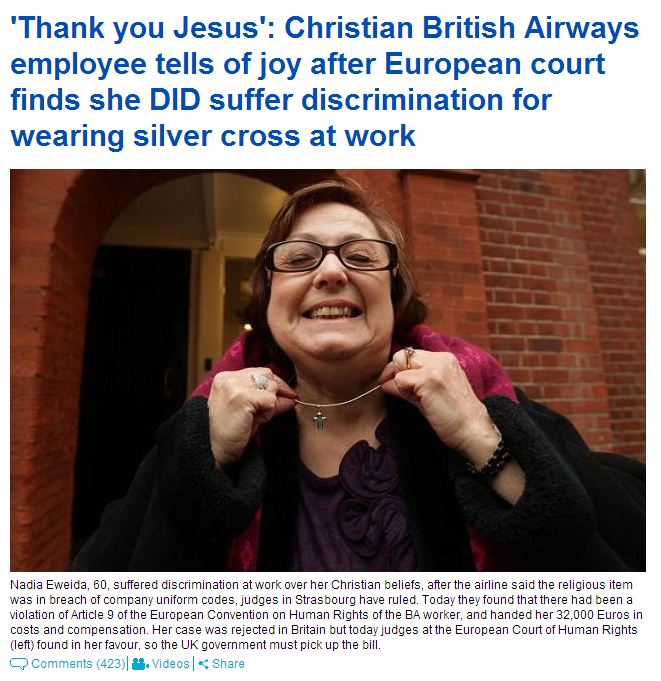
The media in the UK continues to report issues with a pro-religion, pro-Christian bias. To illustrate, consider the reporting of these cases today. Despite Christians losing three out of four, the BBC headline is BA discriminated against Christian:


It's all about the exception to the rule. This despite the analysis inside of Robert Pigott, their religious affairs correspondent, who correctly identified the real significance of the judgements:

His words:

It's perhaps more significant that Shirley Chaplin's case was dismissed, along with those of Gary McFarlane and Lillian Ladele. Today's judgement sets the legal seal on years in which traditionalist Christians have tried, and failed, to defend their values against secular ones in British courts.
The message coming from Strasbourg is that although people are entitled to hold religious views, that right is severely limited in the workplace when it comes into conflict with the rights of other people. The judgement also hands considerable discretion to employers to set reasonable policies and then insist that employees follow them whatever their religious beliefs.
Quite.

And this is not an isolated incident; Christian bias in our media is legion. Here is how this case has been reported across the UK media online:

ITN: Christian wins 'cross' battle
The Guardian: Cross ban 'infringed worker's rights'
The Daily Mail: 'Thank you Jesus'!
The Telegraph: Christians face 'lawful exclusion' from jobs
Interestingly, The Telegraph does highlight the Christian losses, but does not frame this in a context of plurality and tolerance for all, but feeds the Christian persecution complex.

It really is too much for Christians, in a country where the media continue to report religious matters like this, where there is an established church, with unelected representatives in Parliament, whose leaders are given many a soapbox from which to preach, to complain about persecution. They have their religious freedom, but balanced judgements have to be made for the good of all (not just Christians) when competing rights come into conflict with each other. That is all that has happened in the UK courts in these recent matters, as the ECtHR ruling confirms.


Read more »

Thrown to the Lions?


That Christians are being persecuted was the rather hysterical tenor of an article by Paul Diamond in the Telegraph a couple of days ago - Christians' rights: Martyred on a cross of secular liberalism. The martyr he cites is Harry Hammond, an unfortunate, but homophobic, street preacher who maybe was the victim of some injustice, back in 2002. That goes no way to showing anything more, however, than that one man was treated unfairly by the authorities in one instance. This is not an attack on religion, says Diamond, but on Christianity:
And this is not an erosion of rights for people of faith - Muslims, Hindus and Sikhs continue to be protected by the law - but for people of one particular faith: Christianity.
The assertion is that the British legal system is now antipathetic, to say the least, to Christianity:
It seems that the British legal system is intent on removing the Judeo-Christian foundation of our laws, which have served us for a thousand years, replacing them with a secular, liberal worldview which dispenses tolerance to all those who agree with it and relentless hostility, or even persecution, to those who do not.
Hmm. This hardly seems supported by the facts. But today the ECtHR has ruled on four cases of supposed discrimination against Christians, so we should have some more evidence to judge this by.

The Court's assessment starts with an excellent summary of the issues at stake:
79. The Court recalls that, as enshrined in Article 9, freedom of thought, conscience and religion is one of the foundations of a “democratic society” within the meaning of the Convention. In its religious dimension it is one of the most vital elements that go to make up the identity of believers and their conception of life, but it is also a precious asset for atheists, agnostics, sceptics and the unconcerned. The pluralism indissociable from a democratic society, which has been dearly won over the centuries, depends on it (see Kokkinakis v. Greece, 25 May 1993, § 31, Series A no. 260-A).
I rather like that reference to 'the unconcerned', an often over-looked constituency, and the recognition that freedom of thought and conscience are also a 'precious asset' for atheists et al is important. The first case they rule on is that of Nadia Eweida; British Airways refused to allow her to wear her cross visibly. Did the ECtHR consider that she had been persecuted by domestic law? In Para 92 they considered the question, and concluded:
The Court does not, therefore, consider that the lack of specific protection under domestic law in itself meant that the applicant’s right to manifest her religion by wearing a religious symbol at work was insufficiently protected.
So that's a No, then. However, they did consider that the domestic courts had made the wrong decision in this case. It's worth quoting the three paragraphs on the subject to get a sense of the balancing of competing interests involved:

93. When considering the proportionality of the steps taken by British Airways to enforce its uniform code, the national judges at each level agreed that the aim of the code was legitimate, namely to communicate a certain image of the company and to promote recognition of its brand and staff. The Employment Tribunal considered that the requirement to comply with the code was disproportionate, since it failed to distinguish an item worn as a religious symbol from a piece of jewellery worn purely for decorative reasons. This finding was reversed on appeal to the Court of Appeal, which found that British Airways had acted proportionately. In reaching this conclusion, the Court of Appeal referred to the facts of the case as established by the Employment Tribunal and, in particular, that the dress code had been in force for some years and had caused no known problem to the applicant or any other member of staff; that Ms Eweida lodged a formal grievance complaint but then decided to arrive at work displaying her cross, without waiting for the results of the grievance procedure; that the issue was conscientiously addressed by British Airways once the complaint had been lodged, involving a consultation process and resulting in a relaxation of the dress code to permit the wearing of visible religious symbols; and that Ms Eweida was offered an administrative post on identical pay during this process and was in February 2007 reinstated in her old job.
94. It is clear, in the view of the Court, that these factors combined to mitigate the extent of the interference suffered by the applicant and must be taken into account. Moreover, in weighing the proportionality of the measures taken by a private company in respect of its employee, the national authorities, in particular the courts, operate within a margin of appreciation. Nonetheless, the Court has reached the conclusion in the present case that a fair balance was not struck. On one side of the scales was Ms Eweida’s desire to manifest her religious belief. As previously noted, this is a fundamental right: because a healthy democratic society needs to tolerate and sustain pluralism and diversity; but also because of the value to an individual who has made religion a central tenet of his or her life to be able to communicate that belief to others. On the other side of the scales was the employer’s wish to project a certain corporate image. The Court considers that, while this aim was undoubtedly legitimate, the domestic courts accorded it too much weight. Ms Eweida’s cross was discreet and cannot have detracted from her professional appearance. There was no evidence that the wearing of other, previously authorised, items of religious clothing, such as turbans and hijabs, by other employees, had any negative impact on British Airways’ brand or image. Moreover, the fact that the company was able to amend the uniform code to allow for the visible wearing of religious symbolic jewellery demonstrates that the earlier prohibition was not of crucial importance.
95. The Court therefore concludes that, in these circumstances where there is no evidence of any real encroachment on the interests of others, the domestic authorities failed sufficiently to protect the first applicant’s right to manifest her religion, in breach of the positive obligation under Article 9. In the light of this conclusion, it does not consider it necessary to examine separately the applicant’s complaint under Article 14 taken in conjunction with Article 9.

So that's a Yes, the domestic authorities failed to protect Ms Eweida's right to manifest religion. I think it's plain that this is still seen as a judgement call, weighing the competing rights, but the Court decided 'there is no real encroachment on the interests of others'. Certainly it seems to me that there is very little encroachment on the interests of other individuals, although clearly the interests of the company were affected. I must say, this conclusion seems reasonable to me, and the BA relaxation of rules should really have come a lot sooner after Ms Eweida objected to her treatment. I can't even imagine what was going through the minds of her superiors when they insisted she hide her cross, displayed as unobtrusively as it was.

The second case is Shirley Chaplin. She was a nurse who had been asked to remove a cross and chain she was wearing:
The evidence before the Employment Tribunal was that the applicant’s managers considered there was a risk that a disturbed patient might seize and pull the chain, thereby injuring herself or the applicant, or that the cross might swing forward and could, for example, come into contact with an open wound. There was also evidence that another Christian nurse had been requested to remove a cross and chain; two Sikh nurses had been told they could not wear a bangle or kirpan; and that flowing hijabs were prohibited. The applicant was offered the possibility of wearing a cross in the form of a brooch attached to her uniform, or tucked under a high-necked top worn under her tunic, but she did not consider that this would be sufficient to comply with her religious conviction. (Para 98)
Here we see very clear evidence that there is no Christian persecution going on at all; other religion's manifestations were also the subject of health and safety measures.
The Court considers that, as in Ms Eweida’s case, the importance for the second applicant of being permitted to manifest her religion by wearing her cross visibly must weigh heavily in the balance. However, the reason for asking her to remove the cross, namely the protection of health and safety on a hospital ward, was inherently of a greater magnitude than that which applied in respect of Ms Eweida. Moreover, this is a field where the domestic authorities must be allowed a wide margin of appreciation. The hospital managers were better placed to make decisions about clinical safety than a court, particularly an international court which has heard no direct evidence. (Para 99)
A clear ruling that the domestic authorities in such a case must be allowed a wide margin of appreciation, so that's a No:
It follows that the interference with her freedom to manifest her religion was necessary in a democratic society and that there was no violation of Article 9 in respect of the second applicant. (Para 100)
The third case is Lillian Ladele:
She believed that same-sex unions are contrary to God’s will and that it would be wrong for her to participate in the creation of an institution equivalent to marriage between a same-sex couple. Because of her refusal to agree to be designated as a registrar of civil partnerships, disciplinary proceedings were brought, culminating in the loss of her job. (Para 102)
The Court noted that her objection was religious, and:
The Court recalls that in its case-law under Article 14 it has held that differences in treatment based on sexual orientation require particularly serious reasons by way of justification (see, for example, Karner v. Austria, no. 40016/98, § 37, ECHR 2003-IX; Smith and Grady, cited above, § 90; Schalk and Kopf v. Austria, no. 30141/04, § 97, ECHR 2010). It has also held that same-sex couples are in a relevantly similar situation to different-sex couples as regards their need for legal recognition and protection of their relationship, although since practice in this regard is still evolving across Europe, the Contracting States enjoy a wide margin of appreciation as to the way in which this is achieved within the domestic legal order (Schalk and Kopf, cited above, §§ 99-108). Against this background, it is evident that the aim pursued by the local authority was legitimate. (Para 105)
Some interesting notes there, on the same-sex marriage issue as the Court sees it. They conclude:
In all the circumstances, the Court does not consider that the national authorities, that is the local authority employer which brought the disciplinary proceedings and also the domestic courts which rejected the applicant’s discrimination claim, exceeded the margin of appreciation available to them. It cannot, therefore, be said that there has been a violation of Article 14 taken in conjunction with Article 9 in respect of the third applicant. (Para 106)
So that's another No. It's worth reading the preamble, though, to see that they are concerned that Ms Ladele lost her job over her religious beliefs, a heavy price to pay. Such consequences should not be taken lightly, and we should applaud all courts that weigh these matters conscientiously.

The fourth case is Gary McFarlane:
Employed by a private company with a policy of requiring employees to provide services equally to heterosexual and homosexual couples, he had refused to commit himself to providing psycho-sexual counselling to same-sex couples, which resulted in disciplinary proceedings being brought against him. His complaint of indirect discrimination, inter alia, was rejected by the Employment Tribunal and the Employment Appeal Tribunal and he was refused leave to appeal by the Court of Appeal. (Para 107)
Again the Court agrees that these are beliefs motivated by his religion. It's important to note that Christians are using their religion specifically to ground their homophobia. This should not be forgotten when some dismiss the evil wrought by religion through dogma.

The Court concluded:
However, for the Court the most important factor to be taken into account is that the employer’s action was intended to secure the implementation of its policy of providing a service without discrimination. The State authorities therefore benefitted from a wide margin of appreciation in deciding where to strike the balance between Mr McFarlane’s right to manifest his religious belief and the employer’s interest in securing the rights of others. In all the circumstances, the Court does not consider that this margin of appreciation was exceeded in the present case. (Para 109)
It should be noted that this is allowing that the state had not exceeded its margin of appreciation; they expressed serious concerns over the consequences suffered by Mr McFarlane. Nevertheless:
110. In conclusion, the Court does not consider that the refusal by the domestic courts to uphold Mr McFarlane’s complaints gave rise to a violation of Article 9, taken alone or in conjunction with Article 14.
So we have another No, there is no violation of Article 9:

Article 9 – Freedom of thought, conscience and religion
1. Everyone has the right to freedom of thought, conscience and religion; this right includes freedom to change his religion or belief and freedom, either alone or in community with others and in public or private, and to manifest his religion or belief, in worship, teaching, practice and observance.
2. Freedom to manifest one's religion or beliefs shall be subject only to such limitations as are prescribed by law and are necessary in a democratic society in the interests of public safety, for the protection of public order, health or morals, or for the protection of the rights and freedoms of others.

So we have a picture building that does not support the sentiments expressed by Paul Diamond in his Telegraph article. Certainly there are provisos; one case out of four shows a fault in the domestic courts, but we see from them all that these are difficult judgement calls - consider the dissenting decision on Ladele, for example (final page of judgement):
She never attempted to impose her beliefs on others, nor was she in any way engaged, openly or surreptitiously, in subverting the rights of others. (Para 7)
A person can be homophobic (that is their right), so long as it does not encroach on the interests of others.

I think it will always be the case that mistakes will be made by courts when weighing competing rights - this is the price we pay for living in a pluralistic, democratic society. But to conclude from such marginal cases that Christians, in particular, are being persecuted is simply not supported by the details of this judgement.

Read more »

Monday, 24 September 2012

William Lane Craig advises Gay Man to stay on the Straight Path


A gay Catholic has written to William Lane Craig asking: What Should Homosexual Christians Do?

I'm not sure if this is an example of WLC's humour, but he includes in his reply that:
You [Haydn, from the UK] need to stay on the straight and narrow path to avoid disaster.
He distinguishes between the desire, which is not sinful, and the act, which is:
I agree with you that it’s no sin to have a homosexual orientation. That’s probably something you didn’t choose and aren’t responsible for. But you can choose and are responsible for how you act.
But he then appears to contradict this concession that Haydn didn't choose his orientation nor is he responsible for it:
Second, I’d encourage you to seek Christian counseling to help you deal with your homosexual orientation. You may never completely shed your homosexual desires, but the testimony of many persons like yourself who have sought help is that one can reshape one’s orientation to a considerable degree. There is hope of change.
Well, is he responsible for his orientation or not? Advocating change to something as fundamental as one's sexual orientation is a reprehensible thing to do, and perpetuates the view that there is something wrong with homosexuality. WLC's homophobia is confirmed after he advises Haydn to find a Christian girl to marry and have sexual relations with:
Forget the unbiblical idea of finding some other man with whom you can build a monogamous love relationship. Not only is that a fantasy that will lead you only to heartache and profound disappointment, but, more importantly, it is contrary to God’s will for your life, as we know from Scripture.
It's a terrible thing to say that a homosexual monogamous love relationship is a fantasy that will lead 'only to heartache and profound disappointment'. I personally know gay couples who are very happy in their monogamy. I certainly see no evidence that they are any more likely to lead to disappointment than heterosexual couples and, more importantly, I see no reason to even assess this difference, to deny them marriage, just as I wouldn't assess it for different races, religions or social classes.

I hope Haydn sees the error of his ways and re-considers his religious beliefs in the light of their effect on the harmless lives of so many.


Read more »

Friday, 4 November 2011

Help!


Read more »