Showing posts with label P.Z. Myers. Show all posts

Wednesday, 25 January 2012

Are Atheists Bullies?


The recent kerfuffle at UCL prompted by overly sensitive religious sentiment has caused a number of folk to say that atheists are bullies, often comparing them to religious fundamentalists. At RichardDawkins.NET there was a rather incoherent poster called Griswold Grim who made the 'bullying' claim, but he never substantiated it, beyond railing against ridicule.

I witnessed a Twitter spat (which I want to call Twat, but had better not) between P.Z. Myers and a statistician called Andrew Dalby. P.Z. had posted a video depicting dreadful intimidation of Irshad Manji by Muslim fundamentalists, pointing out the deep distinction between militant theists and militant atheists. Incredibly, blind to the evidence of his own eyes, Dalby tweeted this:

Once again, my gast is flabbered by someone in the ongoing debate between believers and non-believers. Displaying breathtaking bigotry against a whole raft of people, Dalby says that P.Z.'s post shows that 'the atheists are just the same sort of bullies as the fundamentalists'. So that post is the equivalent of instigating a riot, or demanding someone be executed, or demanding that a book be banned. It's a remarkable claim, and Dalby doesn't appear to be a theist, so much as someone who thinks he's found a way to be superior to both atheists and theists. P.Z. called his lack of critical assessment stupid, to which he replied:


...which made me giggle. Never a good thing to proclaim one's own genius, I find. Or perhaps that's just me, since my inability to 'out intellectual' and 'out science' people has been proved regularly! He followed up with this gem:

That deserves a ROFL. Does he mean lecturers in statistics at Oxford University are automatically correct in any discussion, regardless of the subject? I mean, sure, in a discussion on statistics, P.Z. should probably defer, but in this discussion? It's not clear what relevance this factoid has to Muslim fundamentalism, or handbagging for that matter! Anyway, back to the Twitter spat, and Dalby offers:

So apparently Santayana (and only Santayana?) is foundational to humanist principles? Santayana is all well and good, and wrote much that modern day atheists would agree with, but he was famously sympathetic to Catholicism (presumably because of his background) and few modern day atheists would agree with him on that score. Of course, many theist thinkers would disagree with him on that score too! A pointless appeal to bogus philosophical authority, then. Toleration of religious belief does not entail its immunity from criticism.

I wasn't sure what had upset Dalby so much about P.Z.'s post, but it became clear in his follow up tweets:


The bit that Dalby does not like appears to be this:
...there might be much to admire in her [Manji's] work, as she’s another theist who has taken a step away from the dogma and tribalism of fundamentalism, but she hasn’t yet had the courage or intellectual integrity to take another step and free herself of the folly of faith.

So the accusation of a lack of courage and intellectual integrity is beyond the Pale, Dalby thinks, and it's wrong to tell people what to believe and that they are inferior or wrong. You will notice that he is pragmatically self-refuting here, since, among other things, he is telling P.Z. it's wrong to tell people they're wrong. Of course it's not, and we would not have morality if it were, since our morals not only guide us in our behaviour but we also feel they have a prescriptive effect on others, as Dalby demonstrates. It then becomes clear how this muddle headed thinking arises:


Oh dear; radical scepticism rears its ugly head and we're heading for the barren plains of relativism, where no-one is right and no-one is wrong. Because he's not sure what's true, nothing is true. This would be a strange philosophy if anyone lived by it, but of course no-one does.
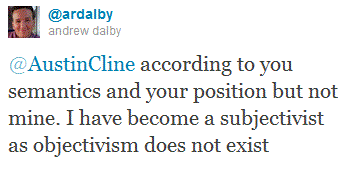
Well, obviously objectivism exists as much as any idea does - he presumably means there is no objective truth. An unsustainable pomo position, as the exchange demonstrates, since his own entreaties would have no weight, if it were true. A tweeter called Austin Cline calls him out:


To which, of course, he has no answer, other than 'thinking is always bad for us'! It's lucky we're not all lecturers in statistics at Oxford University, else none of us would think. The ultimate source of his anger is clear, I think, from this tweet:

If there's one thing that new atheists have achieved, it's a wider acceptance that religion and faith are not privileged over other beliefs. Folk such as Dalby demonstrate that even many non-believers cling to an unthinking acceptance of this privilege that religion and faith demand. Of course we tell each other what to think about many things, and there is no good reason to exclude religion and faith from that list of things.

But finally, the outrageous equating of good faith criticism from atheists with genuinely extreme religious bullying has to be called out for the bogus comparison it is. When these sorts of befuddled accusations stop, then it might be that we're getting somewhere in reducing religious privilege.

Read more »

Tuesday, 3 January 2012

The Tall Tales of Hoffmann

"Hic!"
I'm not sure if this Hoffmann's first love was Olympia, the automaton, (or was it Ophelia? She's certainly no automaton.) or if his further loves were Antonia and Giulietta, but there is more than a whiff of the old Hoffmann about this New Oxonian. It's as if some gnu atheist Lindorff has gone off with his Stella,  leaving him drunk in the tavern crying into his beer, "Muse whom I love, I am yours!". I've been that drunk too, though in humbler company than Hoffmann. He certainly loves the Muse, but perhaps he has spent too long musing while nimbler, more successful courtiers of Stellar Street have taken the plaudits and bouquets. That seems to be part of the complaint (h/t Screechy Monkey):
Part of that has to do with (as I suggested) a record that goes back long before most Americans had heard of Richard Dawkins. Some of us older and old atheists remember what a lonely battle that was. Many who came to the movement since 2000 will not. And that is precisely the pojnt. Without saying jealousy is involved, there are many (not just me) who know that the Dawkins revolution could not have taken place without th almost invisible work of many of my associates in and out of the academy over many many years. On the one hand, we need to be grateful that the New Atheists have been successful in garnering support; on the other hand, and I know this from experience, nothing ensured the death of a book in this country before 1995 like putting the word atheism or humanism in the title. So, there were laborers in the trenches.
But in his latest offering he is far from a-musing, letting off at every gnu he can think of, like a drunk sending texts to former lovers. He starts off with the usual suspects and regurgitates well-worn non-arguments against the Four Horsemen (three of whom he might call Gnu Oxonians?). Interesting that he seems to admire Hitchens the most ("the only true intellectual and by far the best-read of the group"), since Hitch's arguments were always the worst of the four, even if his polemics were the best. More ire is aimed at the gnu bloggers who dare to offer an opinion on religion that has not been informed by years of study in the Divinity School at Harvard. He starts with Jerry Coyne, quoting him comparing religion to leprechauns in their compatibility with science, to which he responds:
Just a flash: While leprauchauns didn’t copy the books that were turned into the books that led to the science Dr Coyne eventually studied, monks and rabbis did. Why does the perfectly reasonable opposition to religious craziness have to descend to this caricaturing of the history of religion?
Strange, isn't it, that religion has morphed into the history of religion? What a befuddled argument. It's difficult to know what Hoffman's point is here. Is it that a deep and complex history justifies an ontology? But Coyne doesn't deny religion's history. It's as if he thinks the involvement of religious people in the history of science invalidates the Conflict Thesis, but none could be that dumb. Leprechauns don't exist so they couldn't have copied early science books, so Hoffmann's comparison doesn't work. Coyne, on the other hand, is pointing out that religion is a superstition, like leprechauns, not that religion doesn't exist, or, even more foolishly, that the history of religion doesn't exist or isn't complex. Hoffmann's argument wouldn't pass muster at infant school, sadly, let alone any philosophy department.

A Gish Gallop of mud-flinging follows, aimed at PZ Myers ("If ever atheism got dumber and less impressive, it is in the work of this dissolute insult- monger"), Greta Christina ("She sees everything as a weird sexual joke"), Ophelia Benson ("...has turned her once-interesting website (I used to contribute regularly) into a chat room for neo-atheist spleen"), Eric MacDonald ("doesn’t seem to know bloody anything about the academic study of religion") and Jason Rosenhouse ("I sometimes wonder why people whose only contribution to blogdom consists of sentences like “Most religious rituals leave me beyond cold,” find themselves titillating?"). Like one or two other misguided critics of new atheism, Hoffmann is often pragmatically self-refuting!

But Hoffmann has an illustrious history, if not an illustrious future, so I do wonder what has got under his skin so much about people who aren't guilty of the things he thinks they're guilty of. Apart from the self-confessed jealousy above, he gives a clue to one of his concerns in a comment below his latest rant:
The new atheists don’t oppose the study of religion. Not true: in fact the famous “Pinker Intervention” at Harvard in 2006 prevented religion from becoming a part of Harvard’s core curriculum, on the premise there was no difference between theology and religion-studies, though Harvard was the first university in America to introduce such study in the 1930′s, apart from its Divinity School. Read all about it here: http://www.somareview.com/godandmanatharvard.cfm Stephen Pinker (who is far more considerate of religion in general) is not the issue here, btw; a number of the newbies have gone on record as saying that the study of theology does not belong in a university, though in some places like Harvard, Yale, and Chicago, this would mean closing down their divinity schools where the study of religion is alive and well. That’s half the problem: the other half is that rank amateurs like the newbies have already pronounced their verdict on such study by mixing up the objectives. Frankly if this confusion is any indication of the state of their information, they’d better hold off on the God thing for a few years. If you want to see the nadir of this imbecilic conversation, here you go:http://www.newstatesman.com/2011/06/dawkins-myers-religion-faith

Interesting. The New Statesman piece compares religion to knitting, which is presumably what upsets Hoffmann, but this is nothing more than Myers's view of what religion's status should be in society, not a judgement of its historic worth, I think. Despite people like Dawkins and Hitchens regularly supporting the study of religion, he genuinely believes they don't, and his evidence is the "Pinker Intervention" and a throw away remark from one of the more strident new atheists. I'm not familiar with the background to the Pinker story, so it would be good to hear some more about this other than what Hoffmann's written, cloaked in dense references as it is ("Pinker Intervention" throws up just one link on Google, to Hoffmann's piece).

So maybe his concern is that divinity schools should not be closed down? But opposition to divinity schools is not opposition to the study of religion, so it's still not clear why he is so exercised about this. In the piece he links to, about the study of religion at Harvard, he says:
In short, all the wrong reasons for studying religion—because it is popular, widespread, and personally significant—triumph over the good reasons for studying it.
I confess, though, that I'm not clear from the piece what the good reasons are for studying it. I could guess at a few. Hoffmann does say earlier:
But religion puts itself forward as something that ought to be studied in its own right, not because in doing so the student learns to value its influence or validate its claims, but so that the student will be able to evaluate it within a particular analytical frame of reference. And it is in providing that context that Harvard excels.
This may be true, but it does not go any way to justifying separate divinity schools - religion can still be studied in its own right without that - so I'm still left struggling to understand the nature of Hoffmann's complaint, once again. Unless he thinks that the only frame of reference that is sufficient for good religious study is in divinity schools? Maybe, but he would have to be clear why he thinks this, or it's just special pleading for religion; something that new atheists are (obviously) against.

I dare say he has other complaints; if only he could write clearly, without so many distracting straw men and errors of fact, then we might have a better chance of understanding them. Maybe one day he'll sober up and tell us fellow drunkards what he means.

Read more »