Wednesday, 6 October 2010

Theo-Science

Livre DraperImage via Wikipedia


The criteria for the £1,000,000 Templeton Prize are laid out as:
The qualities sought in a Templeton Prize nominee include creativity and innovation, rigor and impact. The judges seek, above all, a substantial record of achievement that highlights or exemplifies one of the various ways in which human beings express their yearning for spiritual progress. Consideration is given to a nominee's work as a whole, not just during the year prior to selection. Nominations are especially encouraged in the fields of:

Research in the human sciences, life sciences, and physical sciences.
Scholarship in philosophy, theology, and other areas of the humanities.
Practice, including religious leadership, the creation of organizations that edify and inspire, and the development of new schools of thought.
Commentary and journalism on matters of religion, virtue, character formation, and the flourishing of the human spirit.

So, anyone who writes about science and religion could receive a £1,000,000 prize. Quite an incentive. What impact would that have? I wonder.

Science and religion have fundamentals at odds with each other. Science attempts to draw models of the world based on the best evidence that human methodology can uncover. In principle it is contingent, and never a complete explanation, since it's always open to variation based on new evidence. Religion settles arbitrarily on some preconceptions, vows never to examine those and proceeds to draw inferences about reality based on those preconceptions. In principle it is not contingent but a complete explanation; no evidence could gainsay its preconceptions.

Much has been written about their compatibility, including by me, which, considering the above, is surprising. It's understood that *people* can be scientific and religious, happily, but that's not the same. People can be adulterous whilst thinking it's wrong to be adulterous too. People can hold contradictory positions; it's a 'feature' of our thinking. But it's trivially true that science and religion contradict each other as world views at the above fundamental level. A test of someone's theism would be to ask them if they would revise their beliefs if evidence came in to shake their preconceptions; if they say they would revise their beliefs, they aren't really theistic, but scientific. If they say no, they wouldn't, then Don't Pass Go, go Straight to Jail; they're not scientific.

So why is there so much 'science and religion' talk going on? Consider this:

Ophelia Benson talks about some strange developments, including...

The Cambridge Companion to Science and Religion, by Peter Harrison, from the Ian Ramsey Centre at Oxford University. The Ian Ramsey Centre has links with Templeton.

A BBC program on science and religion by historian Dr Thomas Dixon, which suggests more harmony than there is. His published work includes Science and Religion: A Very Short Introduction, with this blurb:

As Thomas Dixon shows in this balanced and thought-provoking introduction, many have seen harmony rather than conflict between faith and science.

Harmony? What does that mean? It means religion before science, so science doesn't get to tell religion it's wrong. As Ophelia points out, both Harrison and Dixon are members of the The International Society for Science & Religion, a Religion in Science organisation, founded by Anglican priest and Templeton Prize recipient, Sir John Polkinghorne. Dixon's also contributed to Science and Religion, New Historical Perspectives, with fellow ISSR members Geoffrey Cantor and Stephen Pumfrey, which has this blurb:

The idea of an inevitable conflict between science and religion was decisively challenged by John Hedley Brooke in his classic Science and Religion: Some Historical Perspectives (Cambridge, 1991). Almost two decades on, Science and Religion: New Historical Perspectives revisits this argument and asks how historians can now impose order on the complex and contingent histories of religious engagements with science.

Great, no conflict between science and religion, because they disallow science as an arbiter of religious claims. So who else belongs to this Society?

Michael Reiss, who recently wrote about Creationism in the classroom:

Effective teaching in this area can help students not only learn about the theory of evolution, but also better appreciate the way science is done, the procedures by which scientific knowledge accumulates, the limitations of science and the ways in which scientific knowledge differs from other forms of knowledge.
Oh yes, the *limitations* of science and those other forms of knowledge. Not really science *and* religion then. Religion, then science.

Here's another article, by Cathy Lynn Grossman; she's connected to Templeton too. She asks:

Do you think a baby conceived in test tube is still a child in the eyes -- or mind or hands, depending on your theology/philosophy -- of God? Does the science behind this merit the Nobel Prize for Medicine or condemnation in the realm of faith and ethics?

This sickening question doesn't seem to be about science and religion, but religion, then science.

As Jerry Coyne notes as well, there's a lot of accommodationism about. Elaine Ecklund has conducted a survey of scientists and religion that shows that scientists aren't very religious, but against her own data she says:

As we journey from the personal to the public religious lives of scientists, we will meet the nearly 50 percent of elite scientists like Margaret who are religious in a traditional sense...
So religion, then science again. Her work was funded by Templeton, you'll not be surprised to hear.

Not be outdone, at Cambridge we have The Faraday Institute for Science and Religion, funded by Templeton. One of their aims is, supposedly:

Scholarly research and publication on science and religion, including the organisation of invited groups of experts to write joint publications.

Let's have a look; here's a paper called Nothing but a Pack of Neurons? by Dr Stuart Judge, a physiologist and neuroscientist. Scientific, is it? Well, there's a lot of expert science and intelligent discussion of the problems of dualism and non-dualism. But towards the end, Judge says:

What then of Jesus’s saying: ‘be afraid of the One who can destroy both soul and body in hell’? This certainly reminds us that our Maker has the sovereign authority to do more than destroy our present embodiment. But does this use of the word soul (psyche) imply a separate kind of non-physical stuff that attaches to our bodies when we are alive and detaches from them at death, or can it be read as a way of indicating that from the point of view of the Creator our identity extends beyond space and time?
He's begging the question. So, we again have religion, then science. Perhaps that's a one-off? Well, no; here's Human genomics and the Image of God; and Creation and Evolution Not Creation or Evolution (the author gets this the right way round for a change!). It's all a travesty of science.

So, now, let it be known that wherever you see the words 'Science and Religion', what you'll actually be getting is 'Religion, then Science', and, more than likely, a link to the Templeton Foundation somewhere in the background.
Enhanced by Zemanta

Read more »

Friday, 24 September 2010

Nouvelle Atheism

Eurobarometer Poll 2005 Percentage of those wh...Image via Wikipedia
Caspar Melville followed up his poorly argued piece on new atheism with a report on the debate that took place between Marilynne Robinson, Roger Scruton and Jonathan Rée, with Laurie Taylor chairing. I'm reproducing here the comment I made on RD.NET.


What a waste of an evening that sounds. Accommodationists sitting round chundering about tone whilst slagging off new atheists in an even worse tone. Maybe one day they will actually come up with some action points that aren't self-defeating.
I presume Melville misspelled accommodationist because someone here did? I realise this is pedantic, but can we please get this right? M & M, like the chocolates, not one M.
I suppose it [accommodationist] means that I am prepared to debate with people who have views that are different from mine, including those who have religious belief and those who liked the film Amelie. If this is what it means, then I am, and proud of it.
No, that's not what it means, else Dawkins would be one and everyone who posts on this board. Sheesh; how do these people get paid employment? There are two meanings:
  1. An advocate of NOMA.
  2. A tone troll; someone who waffles on about tone (which is important), but doesn't present any evidence to back up why the tone they prefer is the best one, and constantly falls foul of her own tone rules. For an example, see the You're Not Helping debacle.
I suppose if you think that this really is some kind battle [sic] – between religious believers (all in one camp) and atheists (all in another) you could believe that, but I don't (in fact I think this is very dangerous view).
Plainly not, with milquetoasts about!
I'm suspicious of arguments that sound like they have discovered the Truth. They always sound too much like dogma for my taste, and if the non-believing gang is against anything, surely it's dogmatism?
Exactly; the problem with accommodationists is they are telling people what to do, based on nothing but, well, dogma, apparently. That doesn't go down well amongst genuine sceptics.
Subsequently Steve Zara made this point:
For people like Melville to moan because the arguments of theology aren't addressed in detail by people like Richard is like someone saying that complaints about the UK's national eating habits are absurd because the fine and rare dishes served at The Savoy aren't being considered. The "fine dishes" (actually a form of homeopathic cuisine - the plates look empty) of theology aren't what the vast majority consume. When people want to try and understand and deal with religion, they have to confront the everyday reality of religion.
Very true, but the problem with faitheists, accommodationists is their lack of substantive argument. It is perhaps only to be expected. Atheism itself is pretty empty, being a lack of belief; attacking it from another atheistic viewpoint has always seemed a pretty pointless occupation. So this allusion suggested to me another for those of an accommodationist bent - that of Nouvelle Atheism - a tiny serving of the right ingredients that doesn't satisfy.
Enhanced by Zemanta

Read more »

Monday, 20 September 2010

Press Ganged Up

The visit of a dictatorial absolute monarch telling the plucky Brits how to behave would normally, you would think, bring howls of outrage from the famed 'free' press of the United Kingdom and its politicians. But they, and the television media, have been falling over themselves to fawn sycophantically over one of the most harmful men alive in the world today. Armies are mobilised to track down Bin Laden, who has a few thousand deaths to his name, admittedly, but this dealer in the death of millions gets an audience with the Queen and the thumbs up from all our political leaders! Ironic, then, that Pope Benedict XVI should start by saying, in a speech where he blamed Nazism on atheism:
Today, the United Kingdom strives to be a modern and multicultural society. In this challenging enterprise, may it always maintain its respect for those traditional values and cultural expressions that more aggressive forms of secularism no longer value or even tolerate.
Secularism is the idea that *religion* be kept separate from government. It's difficult to see how this could get 'aggressive'. Secularism would protect Catholics in theocracies like Iran, if only the Mullahs believed in it.
Secular opposition to the Islamist government of the Islamic Republic of Iran has been active in the country up until 1984, afterwards they were branded heretics and apostates by the clerical hierarchy, and eventually jailed and executed, or exiled.
So it would seem the Pope isn't too keen on something that would actually help some of his sheeple. Strange man. So, is the UK a hotbed of aggressive secularism? Look at this from the Daily Mail Comment page:
Doesn’t the Pope make a timely point when he warns against the march of ‘aggressive secularism’?
And this after lily-livered comments like this from the Daily Heil:
Yes, as Benedict humbly admits, the ‘unspeakable crimes’ of Catholic priests have brought ‘shame and humiliation’ on the church, while his own handling of the scandal has been lamentable.
And yes, millions find it impossible to accept the Vatican’s continuing opposition to the use of condoms in tackling Aids.
He's *so* humble, with his demands to be heard and followed, *so* humble. The Comment wibbles on:
But who can doubt that the Pope’s central theme deserves a hearing in a society increasingly devoted to instant self-gratification?
And yet what else have we seen from the Catholic hordes in the past few days but an appallingly self-indulgent festival of instant self-gratification? The fatuous Peter McKay in the same paper on the same day makes the point for me:
But those who turned out to protest about Benedict's visit, on the grounds that he held incorrect views on homosexuality, women and condoms, seemed shrill and ill-mannered alongside the hundreds of thousands of people who received obvious pleasure from seeing and hearing the Pope in Britain.
What does the Telegraph think?
In his speeches, His Holiness has shown a clarity of thought to shame the woolly utterances of Britain’s politicians, throwing down the gauntlet to our overly secularised society and insisting – as this newspaper has on many occasions – that religion still has a vital role to play within our culture.
More of that aggressive secularism the Pope was warning about? No, just more sycophantic chundering about how wonderful this professional harbourer of child abusers is:
Before the Pope’s arrival, there was one particular issue that concerned many: the vile abuse of children perpetrated in several different countries by members of the Church’s hierarchy over several decades, and the efforts that had been made to conceal those crimes. Here, the Pope has shown great moral courage. As well as meeting some of the victims, he has addressed the topic on repeated occasions, expressing his “deep sorrow” about these “unspeakable crimes”, which have caused “immense suffering”, and brought “shame and humiliation” to the institution that he leads.
What good are a few weasel words to the thousands of child abuse victims around the world? Words are not enough. And why should others care about *his* institution? It's time for the Pope to *act*, and it should also be time for journalists who have a conscience to speak up. But it seems we have very few of those. Here's the Guardian Editorial:
If the pope has not done much reconciling, then neither have his militant opponents. The thousands who traipsed through London chanting "he belongs in jail" may not see any connection between themselves and the anti-papist mobs of the past, but there is a failure to afford sincere faith the respect it is due.
So every time someone wants to protest against the Catholic Church they are automatically linked to anti-papist mobs of the past? What a disgraceful thing to say about people with *genuine* grievances.

In the Sunday Times (behind a paywall) faitheist extraodinaire Bryan Appleyard was at it again with his boring framing of the Protest the Pope demonstration:
It was noisy. A truck led the way manned by two chanters leading a quasi-religious call-and-response ritual
....
The crowd shrieked back in unison. It was a bizarre coalition of unreconstructed hippies, feminists, gays, condom users and all-purpose angry folk. And then there were the suddenly child-protecting zealots.
Wow; another disgusting thing to say, as if the people protesting were Johnny come latelys only interested in child abuse for politically expedient reasons. And what's bizarre about feminists, gays and hippies forming coalitions? Has Appleyard attacked the bizarre (and doomed) attempts at ecumenical coalition?

Our Prime Minister said of the visit:
The Holy See can also be a partner for us with great influence across the world and we have incredibly important work to do together on fighting poverty and disease, on winning the argument to get to grip with climate change, and on promoting a multi-faith dialogue and working for peace across our world.
Can it be a partner? Can it really? And how does one reconcile the beliefs of people who believe in things just because they do? This Conservative seems very welcoming to this absolute monarch telling us what to do, but doesn't seem so keen on the EEC doing the same:
The steady and unaccountable intrusion of the European Union into almost every aspect of our lives has been made worse by the Lisbon Treaty.
Oh for a similar injunction against this meddling Pope.

Atheist Deputy PM Nick Clegg said:
It was very exciting. Whatever your views of Catholicism, he is the leader of one of the great world religions. I can understand all the debates that are raging but we should be giving a very, very warm welcome to him.
Should we be giving a 'very, very warm welcome' to anybody responsible for the cover-up of crimes around the world, and one who hides behind state immunity to ensure he's safe from prosecution? Or just those with a significant percentage of the electorate hanging on their every inanity? Blimey, the mind boggles.

And I haven't even started on the wall-to-wall coverage of this evil man's visit by the TV networks. So forgive me for thinking that the UK is a long way from being anything like the sort of secular society that would actually *safeguard* the beliefs of lunatics like Benedict XVI.

Read more »

Friday, 3 September 2010

Philosophy is Dead; Long Live Philosophy?

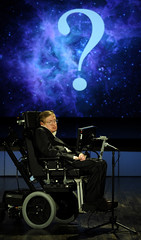
Stephen Hawking NASA 50th (200804210008HQ)Image by nasa hq photo via Flickr

Stephen Hawking writes in his new book, The Grand Design:
Where did all this come from? Did the Universe need a creator?
...
Traditionally these are questions for philosophy, but philosophy is dead. Philosophy has not kept up with modern developments in science, particularly physics. Scientists have become the bearers of the torch of discovery in our quest for knowledge.

The philos won't like that. I'm also not sure that it's quite fair. I think there's still a place for philosophising, but, as with Dennett, it must be anchored in as good an understanding of modern science as can be managed by one person. That is the challenge for modern philosophy, IMHO.
Enhanced by Zemanta

Read more »

Friday, 27 August 2010

Bishop of Durham doesn't believe in command from on high


This made me giggle; in an interview with Jim Naughtie, Tom Wright said, in response to a question about the problems the CofE were having sorting out their views on sex:
We don't believe, as some churches do, in saying, right, the big man at the top has decided, now bang, that's it, you've all got to come into line.
So, there you have it, no commands from on high; these liberal Bishops are certainly coming round to the secular way of doing things, aren't they?

Enhanced by Zemanta

Read more »

Saturday, 21 August 2010

More Accommodating

Part of Image:Planetary society.jpg Original c...Image via Wikipedia


I discussed Massimo Pigliucci's attack on Jerry Coyne in my last blog, and coincidentally listened to Pigliucci's talk from last month on Conversations from the Pale Blue Dot, discussing his new book Nonsense on Stilts. It includes a lot of interesting stuff on his speciality, the Philosophy of Science, and most of it seems eminently sensible.

He and the interviewer unfortunately go off the rails at the end when talking about the new atheists; a problem too many people have, it seems! Here's what is said, starting at 47:20:
...I find myself, on the one hand, being put into the so-called accommodationist camp - those are people who actually think that science and religion are compatible, and I don't. I absolutely do not think that they're compatible (....)
...I don't think they're compatible as a matter of approach, as an intellectual approach.
This surprised me a *little* since Pigliucci had said that Coyne was wrong to call theist scientists 'philsosophically inconsistent'. I guess if he had called them 'intellectually inconsistent', that would have been fine, since that is clearly what Pigliucci is calling them here. And he reinforces this by explaining that scientists should change their mind as the evidence comes in, whereas religion is about faith; in his book, believing things regardless of the evidence.

[Incidentally, accommodationism has come to have two meanings:
1) That science and religion are compatible worldviews.
2) The tactical view that religious believers being treated with civility at all times will achieve a better result in the public sphere for science and reason.
Pigliucci has denied he's one of the first, but I think agrees with the second stance.]

He points out that there is nothing new about the new atheism, which I certainly agree with. Their arguments are often centuries old. What makes it new is the social impact, which, he says, may be a fluke. This seems to me to be quite possible - such social movements are emergent phenomena. Pigliucci continues:
The thing that I really don't particularly care for is the strident tone (...) you can be firm about your criticism of somebody else without necessarily calling them a bunch of idiots. I think that once you start calling people names, you lost the high ground, the high moral ground. And so when Dawkins goes around saying that every religious person is stupid, er, that doesn't help.
Well I'm *pretty* sure Dawkins has never said that every religious person is stupid. He's friends with religious people who are demonstrably clever, for goodness sake. On the whole he thinks they are mistaken, although inevitably many of them are also stupid. Inevitably lots of atheists are stupid too. So Pigliucci identifies name-calling as losing the moral high ground, but is happy to misrepresent Dawkins' view of religious people. An insight into his moral standards, I suppose. It's not clear also what he means by 'the strident tone', other than name-calling - so perhaps that is all he means. But that isn't *tone*, but *abuse*. Curious. And, as I've pointed out before, Pigliucci has been called out on his tone too - "Tone matters. And sarcasm is not science.". Which leaves one wondering just what it is he wants of the new atheists, and thinking that he needs to chillax a bit over insults. For all I know it's possible that a good insult could oil the wheels of discourse, and he doesn't produce any evidence to disabuse me of this. Further, I don't like his tone! But a sarcastic, sneering tone is simply not the sort of thing that puts theists off atheism, that much should be obvious. Anyway, he moves onto another concern:
...I think that Dawkins and more recently Jerry Coyne are epistemologically naive (...) they fall into something that is called 'scientism', that is the idea that science is equated with reason, that the two are one and the same thing.
This is his accusation, but it doesn't seem to stand up, to my mind. I don't interpret Dawkins' and Coyne's comments as equating reason and science. Reason is surely part of science, and surely you can reason without doing science. But the best method of understanding the world around us is through the use of reason and evidence, which is commonly identified with the scientific outlook. If Pigliucci wants to draw an arbitrary demarcation line between philosophy and science to allow philosophers a lot more reason, and scientists a lot less, then fine; who's stopping him. But to call out Coyne and Dawkins based on his own demarcation (or, to be fair, the demarcation posited by philosophers of science) is pretty self-indulgent and, er, pointless. Well I say pointless, but it comes over as point-scoring frankly. It doesn't change the fact that the best way to discover what *is*, is through reason and evidence, and this is commonly known as the scientific outlook.
I do think that science, for very good epistemological reasons, has nothing to say about the supernatural; it can dismiss specific claims that supernaturalists make, but it cannot dismiss the God hypothesis.
This is Hume - "...it cannot dismiss the God hypothesis" is just what Dawkins has always said (including in The God Delusion), and Coyne, as far as I know, so one wonders what his beef is with them.
... so those are my disagreements.
But the second is patently not an area of disagreement; Dawkins and Coyne would surely agree to that statement? One has to assume he concludes that because science can say nothing about the supernatural, that somehow means it's not incompatible with the supernatural.

So I think he draws the wrong conclusions from this sensible statement; as I've said before, the reason science has nothing to say about the supernatural is because the whole notion invalidates the scientific method. Therefore, the supernatural is incompatible with science. I cannot see how it could be anything else; obviously Pigliucci doesn't think they're compatible ("I absolutely do not think that they're [science and religion] compatible"), but he also seems to be saying they're not incompatible. so he seems to be angling for some kind of agnostic compatibility status midway between compatible and incompatible; well, I have no idea what he's angling for.

The interviewer, Luke Muehlhauser, then says:
...a lot of people have said that not only could the new atheists take a different approach and not name-call everybody, but also maybe they're not really putting forward the best intellectual case for atheism or naturalism that they could, and that wouldn't be that surprising because none of them are scholars of religion or these arguments, but I wonder if you might say a few words on how you think atheists in general might make a better intellectual case for atheism or naturalism.
A high error count; First, Pigliucci has already pointed out that the new atheists are only using the old arguments, so how could they *not* be putting forward the best intellectual case? The matter's been settled for the vast majority of intelligent thinkers. Second, again, they *don't* name-call everybody. Third, they plainly *are* scholars of 'these arguments', as much as anyone, including Pigliucci, is. How much theology does one have to suffer before one is allowed to say 'enough, already'? There's no evidence for it, so any theology is *arbitrary*.

It's disappointing to see this; these assertions seem to have become an article of faith amongst accommodationists - they simply don't entertain the idea that they might be mistaken, and glibly carry on as if they're a given.

And indeed, Pigliucci does glibly carry on, overlooking the contradiction to his earlier statement.
... I don't think that religion is the root of all evil, as Dawkins famously said., that's another example of an exaggeration that doesn't help anybody...
Well, quite the opposite, actually, so ...'that's another example of an exaggeration that doesn't help anybody':
(Dawkins - "I do not believe that religion is the root of all evil, thank you Channel 4. Religion is the root of quite a lot of evil, but that didn’t make for a catchy title.")
Pigliucci then goes on to make the bogus comparison between atheistic Stalinism and Maoism 'group-think' and religious ideologies, which makes one question how much he's really thought about this subject. He then  makes vague accusations that some atheists aren't very clever or thoughtful, which seems to be stating the obvious, as well as irrelevant. Oddly, he then points out, correctly, that atheism isn't a positive thing, but an absence of belief, which renders his previous ramble about atheist group-think incoherent. And this is confirmed when he compares atheism to a-unicornism.

So he points out the positive *philosophies* that arise from the evidence based worldview, such as secular humanism and naturalism, but is keen to emphasis that they are *philosophies*, even if they are informed by science. But the whole point of them is that they are informed by science; that is their defining feature, and why they're *compatible* with science, and other philosophies aren't. And we are back wondering again, just what his beef is, and how such a scholar could make such basic errors.

Enhanced by Zemanta

Read more »

Saturday, 7 August 2010

Nature and Supernature


There is a common disjunct between scientists, philosophers and theologians about the purview of science; can science pass judgement on matters religious? Massimo Pigliucci has attacked Jerry Coyne in a blog post comparing a comment of Coyne's from 2007 to a more recent one:
Science simply doesn't deal with hypotheses about a guiding intelligence, or supernatural phenomena like miracles, because science is the search for rational explanations of natural phenomena. We don't reject the supernatural merely because we have an overweening philosophical commitment to materialism; we reject it because entertaining the supernatural has never helped us understand the natural world.
A typical acknowledgement of Hume's analysis Of Miracles; that no evidence *could* be presented that a reasonable person *should* accept for a miraculous event. Compare with:
Anybody doing any kind of science should abandon his or her faith if they wish to become a philosophically consistent scientist.
Pigliucci considers this 'naive and pretentious', perhaps because of the 'philosophically' that Coyne has added. Coyne is a scientist and not a philosopher, like Pigliucci. He thinks Coyne is overreaching too, I think. And he also sees a contradiction with the first statement. So is there a contradiction? It's something that has given me some trouble over the years, so I'm hoping to be able to organise my thoughts on the subject in this piece.

Philosophical naturalism is almost *forced* onto non-theists, since there appears to be nothing else for them to adopt, but I don't really like it; it's an unhelpful concept. In fact, Hume's point renders *naturalism* unfalsifiable, just as much as supernaturalism, for if one could prove naturalism false one would presumably have to provide some evidence for supernature which, as Hume shows, we cannot. I see no great need for a *philosophical commitment* to materialism either; I would think immaterialism *could* be part of reality - we just have no evidence for it, but could have, surely? I think Carrier argues quite convincingly along these lines. But he defines the supernatural as immaterialism, which doesn't seem right to me either; consider these points by commenter bart_klink:
In fact, multiple studies on the effect of intercessory prayer have been published in respected journals, for example this one. What if this study showed a (huge) effect of prayer? And what if other studies confirmed these results? A naturalistic explanation would be very improbable indeed. The most reasonable conclusion would be that some supernatural force, probably (a) God, did interfere in our world.
Other examples could easily be given. What if, after saying some Christian prayer, water could be really turned into wine? This also could be scientifically demonstrated, one could even do chemistry experiments. Again a natural explanation is very unlikely and a supernatural one, presumably the Christian God, is likely. Or what if it could be scientifically demonstrated that the mind could function in separation form the brain, as many people of faith claim? The experiment is not hard to set up, but the results would be hard to explain naturalistically, and a supernatural explanation would be reasonable.
But this is very problematic; if prayer showed a huge effect, a naturalistic explanation would be very improbable? Compared with what? If water was turned to wine, would a natural explanation be very unlikely? Compared to what? Even if one did accept a supernatural explanation as reasonable (again, how??), why would one then 'presume the Christian God'? If one is accepting a magical effect, then one is allowing for *anything* to be possible, in principle, so there could be any number of magical explanations, regardless of the Christian God.

Last Thursdayism is often cited as an example of something that science cannot pronounce on, and that's true. But the reason it's true is because methodological naturalism would be invalidated, since evidence would be meaningless. But what would that mean? Simply that we would have *no way* of determining the nature of reality, and this would apply to theists as much as atheists. We would all simply have literally no reason to believe anything.

So I think if someone is claiming that the supernatural exists, in the way that it is commonly claimed to work -that is, a separate realm that can interface with the natural and allows for the breaking of the accepted laws of nature - that, to me, is simply self-refuting, because it disallows the possibility of establishing any reason to believe. I mean, if you believe that, you will believe anything can happen, so you have no reason to prefer *any* explanation to any other. One's beliefs are therefore arbitrary.

However, going back to my dislike of naturalism as an ontology; I really don't see why one has to commit to a particular ontology just because you accept that evidence is required to believe something - quite the opposite, in fact. One's ontology is necessarily a moveable feast because of that. So, for example, I think it's possible to imagine a reality which includes gods within it, and allows for their interaction with us. And of course that's partly what theists believe in. And we can test for *that*. So far the tests show there aren't any of these much vaunted gods interacting with us.

I don't see these ideas as a contradiction; just two different scenarios for what actually exists. I see Coyne's second statement as saying something along the lines of:

1) A scientist will use evidence to determine what *is*.
2) If a scientist posits the supernatural, he is disallowing that evidence can be used to determine what *is*.
3) So, he would have no reason to believe.

Alternatively,

1) A scientist will use evidence to determine what *is*.
2) If a scientist posits the God as part of reality, interacting with us, then tests would show what *is*. None show the existence of God, or gods.
3) So, he would have no reason to believe. 

Either way, if a scientist believes despite not having any reason to believe, he's being philosophically inconsistent. I think!

UPDATE: A lot of interesting further discussion has arisen from Pigliucci's post, in the comments section.


I think Pigliuci's position is a natural (whoops) follow-on from Hume's observation that a reasonable person *cannot* accept evidence for the supernatural, therefore, as he keeps saying, science can have no position on it. This seems fair enough, but I think this natural follow on needs more analysis, in line with what I say above.

If a person posits a worldview including a supernatural realm, which effectively means they think it's possible for *anything* to happen in the natural world, they are positing a world where evidence is meaningless, because:

1) Magic could happen at any time, rendering laws, regularity and induction unreliable, and
2) Re supernatural events - belief in these *must* be arbitrary, since there is no way to distinguish between supernatural claims.

I think it's hard to argue that these beliefs are *compatible* with the scientific project, and as such a scientist who believed them would be philosophically inconsistent. At the risk of putting words in his mouth, Pigliucci would probably agree that they're incompatible with science but not 'philosophically' inconsistent, since the supernaturalist will ignore the above when being scientific - iow, assume science is just a tool to determine the putative *natural* world. *If* that's his position, I think it's wrong, just because the above two consequences render the use of the tool of science problematic, as well.

One more thing; a number of commenters have made the assertion that certain things are supernatural, because they violate the laws of nature; e.g. Pigliucci "Ghosts can be thought of as supernatural entities (they violate the laws of nature), so they are no different from gods, in my book.". To my mind, this is unhelpful. We don't *know* all the laws of nature, so we can never say this about a discovered phenomenon. Obviously, if someone says "Imagine something that violates the laws of nature.", then one could assign that to the supernatural, but that is not about something real.

Read more »