Showing posts with label Brexit. Show all posts

Friday, 16 August 2019

The No Deal Argument


One of Nick Robinson's 10 things that stopped Brexit happening was "No deal was an empty threat". I wrote about that article here, but I am extracting the No Deal argument from that blog here.

The idea prominent among Brexiteers is that unless the UK shows the EU that it is serious about leaving without any deal at all then the UK's negotiation position would be weakened in some way. But, my thinking goes, if this is correct then the argument applies to the EU's negotiating position, but more so.

The Leave argument goes something like this:

P1) To effectively push one's demands in a negotiation, one needs to demonstrate that the consequences for the proponent of not getting those demands are worse than the consequences for the proponent of walking away from the deal.

P2) Not getting the backstop removed from the Withdrawal agreement is worse for the proponent than No Deal.*

C) No Deal must remain a credible consequence to effectively push the proponent's demands.

There are at least three problems with this.

P2 is clearly false from the economic point of view for both sides. Leavers would probably argue that the politics trumps the economics here, with the principle of freedom overriding the economics, but I doubt a majority of the country would agree.

P2 also contradicts another, connected, Leaver narrative: that No Deal is overridingly bad for the EU.  This leads to Leavers claiming that No Deal will be great for the UK, whilst simultaneously bad for the EU. But the economic effect of No Deal is smaller on the EU than the UK (proportionately, and maybe in toto) while the politics of the situation do seem to overwhelm the economic consequences from the EU point of view.

This leads to a more important objection, to my mind, and one that I've not seen raised explicitly (although I may have missed it). It is that this argument (if accurate and sound) would apply to the EU side too. To effectively push their demands, they could threaten a No Deal. And it seems to me, this is a much more credible threat coming from the EU. A No Deal will cause much less disruption to the EU than to the UK, so their P2* (Getting the backstop removed from the WA is worse than No Deal)  has a much lower bar to pass than the UK's P2. Removing the backstop threatens the integrity of the Single Market and the Good Friday agreement. True, No Deal threatens the Good Friday agreement too, but it doesn't threaten the integrity of the Single Market.

The Single Market is the cornerstone of the EU, so it's hard to see any consequence outweighing a threat to that, so of course the EU would prefer a No Deal to dropping the Backstop. And see also the point made by Frans Timmermans:
If the only goal of the EU is this market obviously you could think that the German car industry could force the German government to comply with the demands coming out of London, but for Germany the EU is much, much more than a market. It's their destiny, it's not revisiting the horrors of history so even the car industry itself understands that this is fundamentally more important than selling cars to the United Kingdom.
So, in fact, according to Leaver logic, the EU should threaten the UK with a No Deal!

I think it's a measure of how well the EU has treated the UK during Brexit negotiations that it has not seriously done this yet (maybe Macron has floated it?), but it may just be a matter of time. I'm sure they are worried about the political consequences of 'inflicting' No Deal on the UK.

*There are other problems with the WA, but let's assume for simplicity that the backstop is the only one.

Read more »

Friday, 19 July 2019

Britain's Brexit Crisis


Nick Robinson made a reasonable program on the disastrous post-Brexit period that has delivered the UK a constitutional crisis like no other. What it showed was a catalogue of errors by the Tories and others, which Robinson helpfully documented here. For convenience I repeat the list here, with brief notes from me:

1. The UK had no plan for Brexit

Leavers had no detailed plan for Brexit, just vague aspirations. Vote Leave, the official campaign, claimed we could have our cake and eat it, by retaining access to the Single Market while forging our own trade deals and not paying contributions as members of the EU. Leave.EU were less keen on the Single Market, but Farage talked up the possibility of pursuing the 'Norway' option; Norway are in the EFTA/EEA.

This highlights one of the major problems with the 2016 referendum. In normal democratic votes whoever wins is authorised to implement what the public voted for, subject to parliamentary scrutiny, with the possibility of voting out those who do the implementation if things don't turn out as promised. The man who arranged the referendum jumped ship immediately after the referendum and many leading Leave campaigners were not part of the Government nor likely ever to be included. In other words, any promises made during the campaign could be made with impunity, and without any democratic correction.

2. The EU did have a plan - a plan for its own survival

Of course. Brexit represents an existential threat to the institution. But there is a tension between making Brexit difficult (to dissuade Frexit, Grexit etc) and the need to minimise disruption to the EU. So they were always bound to be helpful, but not too helpful. This, it seems to me, has been borne out throughout the negotiations.

3. "Brexit means Brexit" but what on earth did that mean?

This is similar to no. 1, but highlights Theresa May making the exact same mistake the Leavers made: having no detailed plan for leaving.

4. The first rule of politics - you have to be able to count

Theresa May should never have called a General Election.

5. The clock was always ticking

Parliament should not have triggered Article 50 until the UK had agreed a detailed plan for leaving. This seems so obvious now one wonders how Parliament could have been so naive. Once the clock was ticking without an agreed plan, any problems with agreeing a plan internally would take time away from negotiating with the EU. And, sure enough, most of the 2 years after Article 50 has been spent with the various Leave factions with access to Theresa May - the ERG, the DUP, and the more moderate wing of the Tory party (she has refused to listen to anyone else) - squabbling about the detailed plan for leaving.

6. No deal was an empty threat

The Leave argument goes something like this:

P1) To effectively push one's demands in a negotiation, one needs to demonstrate that the consequences of not getting those demands are worse than walking away from the deal.

P2) Not getting the backstop removed from the Withdrawal agreement is worse than No Deal.*

C) No Deal must remain a credible consequence to effectively push one's demands.

There are at least three problems with this.

P2 is clearly false from the economic point of view. Leavers would probably argue that the politics trumps the economics here, with the principle of freedom overriding the economics, but I doubt a majority of the country would agree.

P2 also contradicts another, connected, Leaver narrative: that No Deal is overridingly bad for the EU.  This leads to Leavers claiming that No Deal will be great for the UK, whilst simultaneously bad for the EU. But the economic effect of No Deal is smaller on the EU than the UK (proportionately, and maybe in toto) while the politics of the situation do seem to overwhelm the economic consequences from the EU point of view.

This leads to a more important objection, to my mind, and one that I've not seen raised explicitly (although I may have missed it). It is that this argument (if accurate and sound) would apply to the EU side too. To effectively push their demands, they could threaten a No Deal. And it seems to me, this is a much more credible threat coming from the EU. A No Deal will cause much less disruption to the EU than to the UK, so their P2* (Getting the backstop removed from the WA is worse than No Deal)  has a much lower bar to pass than the UK's P2. Removing the backstop threatens the integrity of the Single Market and the Good Friday agreement. True, No Deal threatens the Good Friday agreement too, but it doesn't threaten the integrity of the Single Market.

The Single Market is the cornerstone of the EU, so it's hard to see any consequence outweighing a threat to that, so of course the EU would prefer a No Deal to dropping the Backstop. And see also the point made by Frans Timmermans in no. 10 below, regarding the historical backdrop of the EU.  So, in fact, according to Leaver logic, the EU should threaten the UK with a No Deal!

I think it's a measure of how well the EU has treated the UK during Brexit negotiations that it has not seriously done this yet (maybe Macron has floated it?), but it may just be a matter of time. I'm sure they are worried about the political consequences of 'inflicting' No Deal on the UK.

*There are other problems with the WA, but let's assume for simplicity that the backstop is the only one.

7. The Irish border issue just wouldn't go away

In discussion with one or two Brexit friends, it's clear to me that the English aren't that bothered about the Good Friday agreement. They would rather break up the Union than not Brexit.

I think this is a grave mistake because, whilst I think a united Ireland is inevitable ultimately, we don't want to disturb the fragile peace that rules in Northern Ireland currently. A disorderly Brexit would probably mean a disorderly break up of the Union, with all the terrible consequences that might bring.

8. The EU dreamed that the UK might change its mind

This doesn't seem to me to be a 'thing that stopped Brexit happening', so I won't comment on this.

9. MPs couldn't agree on anything

This leads directly from no. 1 and no. 3. Without a defined mandate from the 2016 Referendum chaos reigned!
"Parliament is and has been deadlocked for one simple reason," says Julian Smith. "Large groups of MPs have been prepared to gamble that they could force the outcome they wanted - a harder Brexit or another referendum or a general election - rather than backing Theresa May's deal."

10. It was all a terrible misunderstanding

Leavers consistently misunderstood what the EU was about; ironically (given recent claims that Brexit isn't about the economics) they said that economics would force the EU to give us a good deal ("Within minutes of a vote for Brexit the CEO’s of Mercedes, BMW, VW and Audi will be knocking down Chancellor Merkel’s door demanding that there be no barriers to German access to the British market.", as David Davis wrote). But as Frans Timmermans says:
If the only goal of the EU is this market obviously you could think that the German car industry could force the German government to comply with the demands coming out of London, but for Germany the EU is much, much more than a market. It's their destiny, it's not revisiting the horrors of history so even the car industry itself understands that this is fundamentally more important than selling cars to the United Kingdom.


I have thought for some time now that we are heading for a No Deal exit, and the change of Prime Minister makes that possibility even more likely. My hope is that some fudge is eventually agreed upon, because No Deal is the ultimate Lose Lose as far as I can see, and almost any fudge is preferable!

Read more »

Thursday, 21 March 2019

3rd Message to Jeremy Quin

Dear Jeremy

Parliament is in paralysis and as such a no deal Brexit appears to be the most likely outcome on 29th March.

This would be very damaging to the UK economy, according to most economists and the Government's own forecasts. If Mrs May's deal cannot be agreed by parliament and no extension is forthcoming from the EU, I ask you to vote for a revocation of Article 50 rather than let the UK destroy what little credibility it has left by leaving the EU in the most disorderly way imaginable.

A revocation would not necessarily mean an end to Brexit - we could reconsider our options and establish a more pragmatic approach to this difficult subject. But I think it's possible that a no deal Brexit would be the end of a Brexit that works, and, as such, would result in years, probably decades, of instability and strife. I have no doubt that Remainers will immediately start to campaign to re-enter the union, and no doubt hard and soft Brexiters will spend the next few years arguing about the precise relationship we should have with our nearest trading bloc. The country will be split like never before, and I fully expect the United Kingdom to break up. Anyone who is complicit in bringing about such a sorry state of affairs would have to answer for it.

I hope that this is a similar message you are getting from your other constituents,

Kind regards

Mark Jones

UPDATE:

The EU have offered the Prime Minister an unconditional extension to 12th April (or an extension to 22nd May in the unlikely event her deal is passed). This doesn't change the issues as far as I can see, and we still face a no deal Brexit on 12th April, rather than 29th March.

Read more »

Saturday, 2 February 2019

A Little Bit of Bread and No Cheese


Operation Yellowhammer is the codename given to the UK government's no deal preparations. Sam Coates of The Times has leaked details of the plan. Some extracts from his tweets:
- “Operation is potentially enormous”
- “Impacts ... could grow exponentially as issues impact upon each other and capabilities of responders at all levels decrease or become overwhelmed”
Government creates war-like structure with 24 hour, 3 shift a day “battle rhythm” all reporting to cabinet office / Cobr
Government admits it only has facilities to cope with “two concurrent events to be managed”
Just a reminder: this is something the UK Government is planning to inflict on its own population simply because a marginal non-binding vote was returned from an illegal campaign.

Apparently the song of the Yellowhammer is "a little bit of bread and no cheese".

Cheese-eaters better stock up.


Read more »

Saturday, 12 January 2019

The BBC and its Continuing False Balance Problem

http://www.shchambers.com/

"'Freedom for the pike is death for the minnows" - Isaiah Berlin

"What I'm asking of the world's oldest public broadcaster is an understanding of the difference between impartiality and balance. What I mean is your nonsense bloody quota of giving equal coverage no matter what...we put up a Nobel prize winning economist to highlight the negative impact on Sterling if we leave, and then you feel you have to give equal weight to some batty backbencher who's just there to parrot "not true, project fear, take back control"" - Words put into Craig Oliver's mouth, played by Rory Kinnear, speaking to the BBC, in Brexit: The Uncivil War

I've written before about Isaiah Berlin's concept of positive liberty, a surfeit of which is really a prerequisite for a  properly functioning democracy. I previously described it as "the freedom to choose the ideal life; ideal, that is, according to informed reason". "Informed reason" is the key phrase here. Berlin contrasts this with negative liberty, which I described as "the freedom to conduct our lives without obstruction from other people or groups of people, including the state".

Firstly, positive liberty is a prerequisite because in a free market economy we need participants who are as well informed as possible to ensure that the market operates as well as it can.A market ignorant of derivatives, amongst other things, caused the credit crunch.

Secondly, we need citizens who are as well informed as possible to ensure they make the best choices when acting politically, either as representatives of the population, or as voters.

Unfortunately the rise of Trump and the emergence of far right narratives in the UK which have resulted in the vote to leave the European Union show that our society is in a dangerous place. The currency of facts is flowing very slowly, thanks to decades of misinformation and attacks on science and expertise. Many of these attacks are documented by Naomi Oreskes and Erik M. Conway  in Merchants of Doubt. They sum it up very well:
Our story began in the 1950s, when the tobacco industry first enlisted scientists to aid its cause, and deepened in the 1970s when Frederick Seitz joined forces with tobacco, and then with Robert Jastrow and Bill Nierenberg to defend the Strategic Defense Initiative. It continued in the early 1980s as Fred Singer planted the idea that acid rain wasn’t worth worrying about, and Nierenberg worked with the Reagan White House to adjust the Executive Summary of his Acid Rain Peer Review Panel. It continued still further, and turned more personal, in the 1990s as the Marshall Institute, with help from Singer and [Dixy Lee] Ray, challenged the evidence of ozone depletion and global warming and personally attacked distinguished scientists like Sherwood Rowland and Ben Santer.
Why did this group of Cold Warriors turn against the very science to which they had previously dedicated their lives? Because they felt—as did Lt. General Daniel O. Graham (one of the original members of Team B and chief advocate of weapons in space) when he invoked the preamble to the U.S. Constitution—they were working to “secure the blessings of liberty.” If science was being used against those blessings—in ways that challenged the freedom of free enterprise—then they would fight it as they would fight any enemy. For indeed, science was starting to show that certain kinds of liberties are not sustainable—like the liberty to pollute. Science was showing that Isaiah Berlin was right: liberty for wolves does indeed mean death to lambs. - Oreskes, Naomi. Merchants of Doubt: How a Handful of Scientists Obscured the Truth on Issues from Tobacco Smoke to Global Warming (p. 238). Bloomsbury Publishing. Kindle Edition. 
Later:
...the idea that free markets produce optimum allocation of resources depends on participants having perfect information. But one of several ironies of our story is that our protagonists did everything in their power to ensure that the American people did not have good (much less perfect) information on crucial issues. Our protagonists, while ostensibly defending free markets, distorted the marketplace of ideas in the service of political goals and commercial interests. The American belief in fairness and the importance of hearing “both sides” was used and abused by people who didn’t want to admit the truth about the impacts of industrial capitalism. - Oreskes, Naomi. Merchants of Doubt: How a Handful of Scientists Obscured the Truth on Issues from Tobacco Smoke to Global Warming (p. 250). Bloomsbury Publishing. Kindle Edition, my emphasis
On the issue of media balance they say this:
“Balance” had become a form of bias, whereby the media coverage was biased in favor of minority—in some cases extreme minority—views. In principle, the media could act as gatekeepers, ignoring the charlatans and snake oil salesmen, but if they have tried, our story shows that at least where it comes to science they have failed. As we have seen, it wasn’t just obviously right-wing outlets that reported false claims about tobacco and these other subjects; it was the “prestige press”—indeed, the allegedly liberal press—as well. - Oreskes, Naomi. Merchants of Doubt: How a Handful of Scientists Obscured the Truth on Issues from Tobacco Smoke to Global Warming (p. 243). Bloomsbury Publishing. Kindle Edition. 
This false balance has been, and continues to be, a serious problem in the BBC's coverage of the news. In 2011 Steve Jones wrote a report on the BBC's treatment of science and said this:
Equality of voice calls for a match of scientists not with politicians or activists, but with those qualified to take a knowledgeable, albeit perhaps divergent, view of research. Attempts to give a place to anyone, however unqualified, who claims interest can make for false balance: to free publicity to marginal opinions and not to impartiality, but its opposite. Conflicts of interest and outright dishonesty exist in science and these must be exposed, but not at the cost of an over‐literal interpretation of the guidelines. The BBC has tried to find a solution to this problem but has not entirely succeeded. It must accept that it is impossible to produce a balance between fact and opinion. The notion of due impartiality in science should be treated with more flexibility. The central criterion of the new Guidelines,  that the BBC should seek to achieve “due weight” in its coverage of  perspectives and opinions and that minority views should not necessarily be given equal treatment,  may do something in this regard although proof of that has yet to emerge. (my emphasis)
This recommendation has clearly gone unheeded by many in the corporation. Consider this tweet by Rob Burley, Editor of BBC Live Political Programmes. Politics Live, Andrew Marr Show, This Week, Westminster Hour & Newswatch:
No, no, no, this is not proof of impartiality. In response I tweeted:
The point being that simply giving a hearing to all sides of a debate will give rise to the false balance Steve Jones warned about and which has blighted our media ever since the 'merchants of doubt' started to wage their propaganda war against the truths that threaten their interests.

And it's not like some don't understand the issue. Last year BBC journalist Nick Robinson's views were reported in The New Statesman:
In Robinson’s view, the BBC doctrine of “due impartiality” should, when properly observed, enable his colleagues to “take account of how much support someone has and the evidence underlying his or her arguments before deciding how much coverage he is entitled to. We need to move beyond ‘he said, she said’ and ask ‘what is?’” Neutrality should not, indeed, deny the proper function of journalism.
And yet the BBC still don't do it. In 2017 the BBC had to apologise for putting the unqualified climate change denier Nigel Lawson up against a climate change expert in Robinson's own Radio 4 Today programme:
The Today programme rejected initial complaints from listeners, arguing that Lawson’s stance was “reflected by the current US administration” and that offering space to “dissenting voices” was an important aspect of impartiality.
This is the line pursued by Rob Burley in his tweet from December 2018, but it is wrong, wrong, wrong, as Bob Ward, the policy director of the Grantham Research Institute on Climate Change at the London School of Economics explained:
“There needs to be a shift in BBC policy so that these news programmes value due accuracy as much as due impartiality.
“As well as taking account of the rights of marginal voices like Lord Lawson to be heard, the BBC should also take account of the harm that its audiences can experience from the broadcast of inaccurate information,” said Ward. “His inaccurate assertion that there has been no change in extreme weather was harmful to the programme’s listeners because they may have been misled into believing that they do not need to take precautions against the increasing risk of heatwaves and flooding from heavy rainfall in the UK.”
So we're back to the quote from Brexit: The Uncivil War; Craig Oliver's cry of anguish when talking to the BBC. Oliver was the leader of the Remain campaign:
What I'm asking of the world's oldest public broadcaster is an understanding of the difference between impartiality and balance. What I mean is your nonsense bloody quota of giving equal coverage no matter what...we put up a Nobel prize winning economist to highlight the negative impact on Sterling if we leave, and then you feel you have to give equal weight to some batty backbencher who's just there to parrot "not true, project fear, take back control"
I believe it is this false balance, in the BBC and elsewhere, that has reduced the positive liberty of UK citizens, and led them to make fateful errors when voting in the referendum and pursuing their political goals in other ways. In Berlin's terms, we have a surfeit of negative liberty (freedom for the pike), but a deficit of positive liberty.

It has been such a campaign of misinformation that I really think this is an existential threat to Western democracy. It is hard to see how, if we continue to pursue misinformed policies uncorrected, we can survive in the form we are now. I fear a breakdown of law and order as demagogues take power. Trump is a demagogue, as are Bolsonaro and Gündoğan; who will be ours?

I previously shared Stephen Pinker's optimism in the upward trend of humanity, but now I'm not sure those angels will save us :-(.

For further reading on the causes of Brexit, see:

Peter Jukes - A Duty to Inform as Well as Entertain: The BBC on the Edge of an Abyss

Chris Grey - Britain is on the brink of an historic strategic decision

Simon Wren-Lewis - Experts and Elites

Ian Dunt - Backstop breakdown is a product of the oldest Brexit lie


Perfect knowledge is impossible, of course, but disinformation will tend to corrupt the operation of a free market economy. And we must accept that humans are not a perfectly rational animal, even if they were omniscient, so we can only aspire to perfect reason.

Read more »

Wednesday, 19 December 2018

2nd Letter to Jeremy Quin

This is the text of another email I have sent to my MP, Jeremy Quin:

Parliament is at an impasse and cannot raise a majority for *any* course of action. In such a circumstance there is only one legitimate route our representatives can take: ask the people to choose their preferred option.

If people vote to remain we can revoke Article 50, and we can start working on the damage done to this country by this wholly unnecessary episode.

The 2016 referendum only sanctioned the UK leaving the EU, not Mrs May's deal specifically. As we have seen, this has left MPs a wide range of possible 'leavings' to choose from, which has resulted in stasis. If people vote for Mrs. May's deal, then the naysayers in Parliament cannot legitimately vote against it, because it will have been *explicitly* sanctioned by the people. She can implement the deal with the full backing of Parliament.

Therefore the only sensible approach an MP can follow currently is to campaign for a new People's Vote to remove the logjam. I urge you to follow the only sensible path, away from the cliff edge.

Yours sincerely

Mark Jones

Read more »

Wednesday, 5 December 2018

Letter to Jeremy Quin

This is the text of an email I have sent to my MP, Jeremy Quin:

Dear Mr Quin
I am writing to urge you to vote against Prime Minister May's proposed Withdrawal Agreement.
I voted Remain in the referendum, but accepted the result. People voted Leave for many reasons, but perhaps the most fundamental one was to reclaim the sovereignty we had given up to the EU. 
But I had not fully appreciated all the difficulties that would arise in achieving a satisfactory Brexit. In particular, I had not appreciated the importance of our current frictionless trade with the continent, the Good Friday Agreement and the many EU agencies that would all need their own separate arrangements, such as the Galileo project and the EASA.
The more *sovereignty* we reclaim from the EU, the less we can participate in the *benefits* of the EU; that much is obvious. Leave voters, I presume, placed a higher value on the sovereignty we would reclaim than the benefits we would lose, whilst I, as a Remain voter, valued the benefits more than the dilution of sovereignty. 
But now we have a much clearer estimation of the sovereignty we are reclaiming and the costs of departure. Mrs May's deal means we will have *no* say in the rules of the EU, which rules we will still have to closely observe, since it is our closest trading bloc. We will lose our ability to travel and work freely in the EU. We will lose frictionless trade, which will hit our GDP hard, according to the Government's own forecasts. We endanger the Good Friday Agreement, with all the dark possibilities that would entail.
So, in fact, the best deal on offer (according to the government), actually means *less* sovereignty than we currently enjoy within the EU, and vastly increased costs to leaving. We also threaten the peace in Northern Ireland. These matters were not apparent at the time of the referendum - the Leave campaigns suggested there would be a Brexit dividend, that we were taking back control and there would be solutions to the Northern Ireland border issue.
Since the population is now much clearer about the reduction in sovereignty that will arise under Mrs May's deal, the vast costs of leaving, and the threat to peace in this country, the democratic thing to do would be to have another vote to confirm the public are in favour of paying these costs, suffering this reduction in sovereignty and threatening our own peace.
I hope you will therefore agree to vote against the deal and instead insist on another referendum to clarify the views of the electorate in the light of these now-known consequences of Brexit.
Kind regards
Mark Jones

Read more »

Saturday, 12 May 2018

Brexit and Xenophobia


Professor Tendayi Achiume, the UN special rapporteur on racism, has said:
The environment leading up to the [Brexit] referendum, the environment during the referendum, and the environment after the referendum has made racial and ethnic minorities more vulnerable to racial discrimination and intolerance...
..and:
Many with whom I consulted highlighted the growth in volume and acceptability of xenophobic discourses on migration, and on foreign nationals including refugees in social and print media.
It would be wrong to dismiss the entire Brexit movement as xenophobic; I know a number of Brexiters who are certainly not xenophobic and voted against the EU for reasons such as its institutional failings or for its support for globalisation. So there are two half-decent reasons to vote Leave, even if in the end I disagree with them. Ian Dunt analyses the left-wing 'Lexit' movement here. Some on the left see the EU as a barrier to certain left wing aims, but I agree with this assessment from Dunt:
The EU is basically a social democrat project, based along German or Scandinavian lines. That's probably too right-wing for some people, and it's certainly too left wing for others. But it has a lot of space there for a wide range of political arrangements, covering the vast majority of political views in the UK. It doesn't always get the relationship right between abiding by EU rules and workers' rights, but you have to be a very stern observer to conclude from these fairly limited problems that we should take the massive risk of leaving the EU altogether, especially under such a right wing government. But still, we shouldn't write off left wing criticisms of the EU. Many of them are perfectly valid. Remainers would do well to address them, rather than dismiss them.
I doubt there are many xenophobes amongst the Lexiteers.

However, I think it’s fair to say that xenophobes are more likely to have voted Brexit. Why do I think this is fair to say? Well, more than one survey has concluded that Brexit is strongly linked to xenophobia. Furthermore, more Brexit voters self report as racist.
The Institute of Race Relations said “‘Brexit means Brexit’ is already being translated for BAME and migrant communities into ‘Brexit means racism’ – not just on the ground but also in the repressive proposals already emanating from politicians and government departments in October 2016”.

Now, to be fair, the statistics aren’t completely clear; analysis of Yougov’s surveys for the Campaign Against Antisemitism in 2015 and 2017 shows a reduction in anti-semitic attitudes in that period (and, by the way, show a reduction in antisemitism amongst Labour voters, pace the recent accounts of antisemitism in that party).

Nevertheless, the weight of the evidence suggests a link between the Brexit vote and xenophobia, and at the very least existing xenophobes were more vocal about their xenophobia after Brexit.

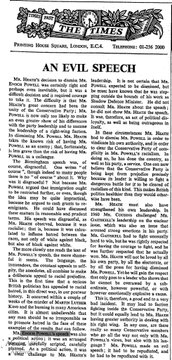
And it comes to something when Jacob Rees Mogg effectively tweets that Enoch Powell’s famous speech was racist and gets a load of abuse for it from other right-wingers; click on this link and check out the abuse JRM gets for supporting his father's view that Enoch Powell's 'rivers of blood' speech was 'racialist':

If JRM is too moderate for some people, then the right wing really is heading in a bad direction!

Maybe the increase in reported xenophobia around the Brexit vote is just a temporary blip, and I am being too pessimistic; I certainly hope so.


Read more »

Friday, 3 March 2017

Theresa May Sings the Benefits of Economic Union


Some ironic quotes from Theresa May's speech to the Scottish Tory party:
One of the driving forces behind the Union’s creation was the remorseless logic that greater economic strength and security come from being united. Not the transient and shifting benefits of international alliance, but the fundamental strength of being one people. Those enduring economic strengths are obvious. Our wholly integrated domestic market for businesses means no barriers to trade within our borders. That has always been of immense value to firms here in ?.
They think independence is the answer to every question in every circumstance, regardless of fact and reality. It simply does not add up and we should never stop saying so.
The broad shoulders of ? provide enviable security for businesses and workers alike.
Ten years ago, banks headquartered in Edinburgh and London, which employ tens of thousands of people and look after the savings of millions, were rescued by the ?. Action that was only possible because of the size and strength of the ? economy.
In the oil and gas sector – a vital industry on oureast coast, from Aberdeen to Lowestoft – the broad shoulders of our wider economy have allowed the ? to take unprecedented action to support the sector following the decline in the international oil price. And public spending here in ? has been protected, even as North Sea tax receipts have dwindled to nothing. Time and again the benefits of the Union – of doing together, collectively, what would be impossible to do apart – are clear. Indeed the economic case for the Union has never been stronger. There is no economic case for breaking up the ?, or of loosening the ties which bind us together.
The ? has led the world in developing a strategy for preventing violent extremism, and we are working with our allies to take on and defeat the ideology of Islamist Extremism. It is firmly in our national interest to defeat Daesh and the ideology of Islamic extremism that inspires them and many others terrorist groups in the world today. In this task, we are fortunate to draw on intelligence provided by the finest security agencies in the world and the greatest armed forces anywhere.
The pooling and sharing of risks and resources on the basis of need across our ? is the essence of our unity as a people. All of the practical benefits which flow from our Union, and which are hallmarks of it, depend on that deep and essential community of interest which we all share. It has been shaped by geography and refined by history. And it has shown itself to be adaptable.
A tunnel vision nationalism, which focuses only on independence at any cost, sells ? short. As Unionists, our job is clear. We know we are united together by a proud shared history, but we are also bound together by enduring common interests.
The ? we cherish is not a thing of the past, but a Union vital to our prosperity and security, today and in the future. The Union I am determined to strengthen and sustain is one that works for working people across England, Scotland, Wales and Northern Ireland.
A ? which everyone can feel secure in. A Union in which our national and local identities are recognised and respected, but where our common bonds are strengthened. Where difference and diversity are celebrated, but where those things we share are celebrated just as much.
Because at the heart of the ? is the unity of our people: a unity of interests, outlook and principles. 
The question marks refer to Scotland and the UK, or stand-in's for, and their institutions. These can be swapped for the UK and the EU and the arguments stand pretty much as strong. Yet May is hell-bent on ensuring a hard departure from the EU. Strange times.

In her conclusion, she said:
Because politics is not a game and government is not a platform from which to pursue constitutional obsessions.
Ha!

Read more »