Showing posts with label accommodationism. Show all posts

Tuesday, 9 July 2013

Andrew Brown Struggles to Contain his Contempt!

The writing of Andrew Brown often comes across as contemptuous, airily dismissive and lacking in nuance. To be charitable, I assumed this was a fault in his writing; after all, being contemptuous, airily dismissive and lacking in nuance is the sort of criticism he regularly levels at Richard Dawkins and any other 'new atheists' who offend him.

I have to take this back, however; his writing is not at fault. It turns out that his articles brilliantly capture his entire aspect:


Brown looks like someone has left a turd in the seat across from him, but it's only the mild-mannered moderate wing of new atheism, Daniel Dennett. Imagine if it were Dawkins himself! All four horsemen might make him faint; a photo of Hitchens could stand in for the great man and no doubt out-think Brown.

To be fair, upon seeing this video Brown realised what it showed:


It's strange that someone does not see the problem of contemptuously condemning contempt. Among many other things that upset him about Dawkins, it is his contempt for religious beliefs that he finds troubling:
The really extraordinary thing is ... that he supposes that displays of naked contempt are the way to win over agnostics.
Not for the first time, Andrew Brown is guilty of hypocrisy.


Read more »

Tuesday, 27 March 2012

Mock the Meek


Someone called Barbara King interviewed Richard Dawkins on NPR, with a clear anti-ridicule agenda. She is concerned about the feelings of the faithful, I presume, and she thinks Richard's famed 'stridency' is counter-productive in any dialogue with them. 

This common refrain from some non-believers (as we've seen from Julian Baggini) perhaps stems from a misguided idea of how civilised discussion should be conducted. Obviously, gratuitous rudeness is not something we encourage, and it's clear that accommodationists perceive Dawkins's many blasts at religious beliefs, and those who hold them, as gratuitously rude. In fact, in this interview Dawkins says he's sorry if he's been rude about anyone, and that he really aims to mock their beliefs alone. This seems like an unnecessary apology to me; if someone mocks my beliefs I think that's much the same as mocking me, and would treat it the same. So they may as well mock me.

And so what? As one grows up one gets mocked repeatedly, and this has a formative effect on belief - how could it not? If ridicule is such a bad idea, then someone needs to tell every single one of my teachers from primary school to grammar school that their every sarcastic put-down was militating against their pedagogy. I suspect 'Pengy' West and Frank 'Hitler' Collins might disagree. And while I and my fellow pupils did not enjoy the put-downs at the time, it made their points memorable and gave the rest of the class a laugh to boot. If it's such a bad idea, then someone should tell every satirist, from Horace to Juvenal, Moliere to Voltaire, Swift to Hogarth, Dickens to Wilde, Dorothy Parker to Peter Cook, that they are simply wrong to do it. I would love to hear their responses.

Barbara King herself draws a distinction between those who are open to discuss evolution and young earth creationists, whose belief she does not respect. I suspect young earth creationists would find her lack of respect for their belief offensive and would treat it as an attack on their very person, just as the 'moderately' religious find Dawkins's attacks on their nutty beliefs offensive. (I put scare quotes around moderately just to indicate that there is nothing about religion that allows us to define someone as extreme or moderate - that metric is not determined by faith, but by reason and evidence).

So I don't think that King is behaving any differently in kind to Dawkins, by adopting what she has decided is a more reasonable approach, so why does she think she is behaving any better than Dawkins? The most obvious conclusion is that she is a victim of our cultural prejudice against non-belief, even while she is a non-believer herself. And this isn't so surprising, being a child of a society that places religion beyond criticism, into a sacred place where it should not be challenged. It's the only belief that we are criticised for the very act of criticising.

But as I hinted at above, even 'moderate' believers believe recklessly. If they are not applying critical thinking to their beliefs, allowing some of their beliefs freedom from the shackles of reason and evidence, then they are accidents waiting to happen. Three Christian MPs, Gary Streeter, Gavin Shuker and Tim Farron, have apparently sent a letter to the Advertising Standards Authority challenging the Authority's ruling against faith healing adverts. They say:
We are writing on behalf of the all-party Christians in Parliament group in Westminster and your ruling that the Healing On The Streets ministry in Bath are no longer able to claim, in their advertising, that God can heal people from medical conditions.
We write to express our concern at this decision and to enquire about the basis on which it has been made. It appears to cut across two thousand years of Christian tradition and the very clear teaching in the Bible. Many of us have seen and experienced physical healing ourselves in our own families and churches and wonder why you have decided that this is not possible.
On what scientific research or empirical evidence have you based this decision?
You might be interested to know that I (Gary Streeter) received divine healing myself at a church meeting in 1983 on my right hand, which was in pain for many years. After prayer at that meeting, my hand was immediately free from pain and has been ever since. What does the ASA say about that? I would be the first to accept that prayed for people do not always get healed, but sometimes they do. That is all this sincere group of Christians in Bath are claiming.
It is interesting to note that since the traumatic collapse of the footballer Fabrice Muamba the whole nation appears to be praying for a physical healing for him. I enclose some media extracts. Are they wrong also and will you seek to intervene?
We invite your detailed response to this letter and unless you can persuade us that you have reached your ruling on the basis of indisputable scientific evidence, we intend to raise this matter in Parliament.
It's hard to believe that grown men, let alone Members of Parliament, could pen such a dreadfully thought out  letter, and I fear for democracy if they apply the same shambolic thinking processes to matters of state. Is it appropriate to respect their belief that praying works? Or should reason and evidence be applied to determine the truth of the matter? Of course, Gary Streeter does have reason and evidence for his belief, but it's a bad reason and it's poor evidence, and when we give the shorthand reason and evidence, we mean good reason and good evidence. How could this man have got to the age of 56 without being taught how to think? Is that too strident? I don't know, but, when he's liable to place lives at risk with such dangerous nonsense, I don't care, and I don't think Barbara King should either. The more often this man's laughable thought processes are called out the better, because it will save lives. To whimper about the evils of ridicule in such circumstances is to be complicit in the harm these beliefs cause.

I'm pleased to see that Martin Robbins throws the book at them:
The implication of prayer-healing is that special people can demand that God heals someone, and he'll just do it. That only makes sense if you believe that a) God is a bit absent-minded and doesn't really notice all the sick people until some clever human points them out to him, or b)God is the fourth emergency service (the AA come fifth in this world-view), and we're entitled customers who pay with prayer and should damn well get some service.
Either way, the message from faith-healers - and the hapless morons who support them - is clear: "Fuck God's plan, He's our bitch." I'm not a Christian myself, but if I were, I think I'd be pretty frustrated with this sort of selfish, arrogant attitude, and I'd laugh in the face of people who claimed to have some divine right over His powers.
Steady, Martin, you called them morons; we wouldn't want to alienate them, would we? But surely ridicule from all is exactly the appropriate response to this anti-scientific avalanche of bullshit. Should we say, yes, Mr. Streeter, because some chronic pain in your right hand disappeared after some prayer, we should all adopt prayer as a tried and tested principle, to be advertised for its efficaciousness? Is there no reason why this datum should not be taken at face value and treated as hard science? But if that's the case, I could write to the authorities pointing out that since I read their letter to the ASA there has been a dull ache in my head, but thankfully ridiculing  its contents has eased the pain. Therefore, please prescribe regular ridicule of religious idiocy on the NHS. At least there's a clear causal link in my anecdote compared with Streeter's.

But, of course, as Robbins points out:
The ASA quite rightly say in their ruling that "testimonials [are] insufficient evidence for claims of healing." To which I would add, "...and I am never going to vote for you, Gary Streeter, you utterly gullible buffoon."
Is Streeter gullible? Plainly. Is he a buffoon? I suppose it's possible he just hasn't had the gumption to investigate all the studies that have been performed on the efficacy of prayer, in which case he's a buffoon to write the letter, or he has seen them but prefers his own anecdote, in which case he's a buffoon to write the letter. 

Sorry to mock, but sometimes there's really no alternative.

Read more »

Friday, 24 February 2012

As Good as Gnu


Julian Baggini has complained about new atheists before, saying:
In any case, my [negative] opinions are not so much about these books as the general tone and direction the new atheism they represent has adopted. This is not a function of what exactly these books say, but of how they are perceived, and the kind of comments the four horsemen make in newspaper articles and interviews. All this, I think, has been unhelpful in many ways. In short, the new atheism gets atheism wrong, gets religion wrong, and is counterproductive.
He goes on to attack new atheism because it is anti-theistic, and parasitic on god-belief, whereas he proffers an atheistic world view. It seems obvious to me that these two are not in conflict with one another, and Baggini is simply mistaking his distaste for new atheism's political goals with a pertinent point. Later he says:
The practices of religion may be more important then the narratives, even if people believe those narratives to be true.
But those practices are not more important than the belief that the narratives are true, as his own investigations have shown, in a piece called The myth that religion is more about practice than belief:
My own research shows that the vast majority of Christians appear to take the orthodox doctrine at face value.
But now he makes another tone attack on a certain type of atheist, and one can only conclude he means the new atheists, given his form. He cites this article by Jeffrey Myers, to illustrate how atheists protest about being called out for their tone, and then says:
Accusing someone of being aggressive, nasty or shrill can be a neat way of avoiding the meat of the matter while also appearing to occupy the moral high ground. That's true, but tone does matter, and it's often more connected with substance than it might seem.
But the linked piece doesn't say that tone does not matter. It says "Our tone does not matter". This is a vital distinction, and gets to the nub of how very wrong Baggini is on this issue. Myers points out that:
Because the reality is that our tone is NOT the problem. Our tone doesn't matter. Because it doesn't matter how polite we are, how eloquent we are, how articulate or respectful we are. It is not our tone that theists reject - it is our existence.
And Baggini and other accommodationists should know this, because they themselves are regularly accused of the same crimes as the new atheists - just read the comments section to Baggini's attempts to bridge the gap between theism and atheism in The Guardian. In this latest article, Baggini notes:
"Tone" actually crops up in two guises in this debate. It not only refers to the mode of argumentation but also to the alleged way in which many atheists are "tone deaf" to religion.
Fair enough, it is 'alleged'. But is it true that 'atheists' are tone deaf?

(And which ones? Is that a trait that they have as a group? As often when it comes to this sort of accusation, no evidence is linked to support Baggini's position. To be clear, I don't doubt that the occasional atheist might make a tone-deaf pronouncement. I object that atheists are characterised as a group with this clumsy stereotype, and I object that the four horsemen, and gnus, are too)

In fact, the opposite is true, is it not? It is many theists who are tone deaf to atheistic writing because they respond no differently to Julian Baggini's supposedly nuanced approach than they do to Richard Dawkins's supposedly tone-deaf approach. Consider these comments:
Julian Baggini
I think one of the biggest obstacles to progress here is your inability to resist your obsessive-compulsive desire to use space in your own articles to denigrate religious belief and instead use them to propound the primacy of your own atheist ones. A lot of religious people may draw from that that your claims of respectful discussion are somewhat akin to a wolf in sheep's clothing. CatholicAndy
The most troubling thing about this piece is the aggressive idea of 'acceptable' religion; as if giving an ultimatum to all religious believers. Baggini doesn't reveal which authority gave him the right to define how religion should be in the 21st century, nor does he give any consideration to libertarian values, like the freedom of expression or belief.
With this article Baggini, despite all his claims to occuyping a middle ground, has shown himself to be as intolerant and supremacist as the militant atheists he claims to descry. iphedia
And there are many more - there we have it in black and white.

Russell Blackford wrote an excellent piece on this a while back:
The problem is likely to be that a lot of discussion of tone is just not very intelligent - how many reviews of The God Delusion have you read that show a tin ear for Dawkins' control of tone? Many reviews don't show any sensitivity at all for the varied tones: the humour; the quiet thoughtfulness and introspection; or the comical intoxication with language itself in Dawkins' famous denunciation of the Old Testament deity. Generally speaking, the reviewers just don't "get" it. But the cure for that isn't less discussion of Dawkins' tone; it's more intelligent discussion of Dawkins' tone. A hackneyed adjective such as "strident" doesn't cut the mustard.
Spot on. Dawkins's writing and pronouncements are thoughtful and witty and insightful - maybe not as profound as some of our better philosophers, but he's not talking to academia. He's talking to the general public, and his tone is entirely appropriate for that. The cry from gnu atheists is not that tone is unimportant, it's that the tone argument is being used dishonestly and prejudicially against them.

The response to Baggini's own writing shows that to be true. Whether he likes it or not, he's as good as gnu in the eyes of many a theist.

Read more »

Friday, 17 February 2012

The Negligence of Anti-Secularism


There's a curious doublethink prevalent in the world today. It calls tolerance intolerant and peace-making militant. It coddles views that are in violent and murderous opposition to each other and calls that constitutional. As Polly Toynbee says, about the faiths:
Each has their own divinely revealed unique truth, often provoking mortal conflict, Muslim v Copt, Catholic v Protestant, Hindu v Muslim or Sunni v Shia. But suddenly the believers are united in defence against the secular, willing to suspend the supremacy of their own prophets to agree that any religion, however alien, from elephant god to son of God, is better than none.
Secularism is the recognition that in a modern multi-cultural society we have these juggernauts of faith motoring around the body politic and, unless measures are taken to avoid it, they will collide. Not they might collide; they will collide. To argue against secularism in these circumstances is to call for a road system without traffic lights, roundabouts and Give Way signs.

Genuine secularism, not militant secularism, which surely doesn't exist, refuses to succumb to the privilege that religion demands, and the response to the Richard Dawkins Foundation Ipsos-MORI poll on Christian beliefs proves that we still have a problem accepting genuine secularism. Dawkins appeared on a couple of shows to talk about the results, which showed that those who self-identified as Christians have a wide-ranging set of beliefs. 49% of Christians polled don't believe that Jesus is the son of god, and 6% of Christians polled don't even believe in god! This means that government should be careful not to accept any lobbying from the religious to support a monolithic view of Christianity. Most importantly, perhaps, is that, of those polled:
Three quarters (74%) strongly agree or tend to agree that religion should not have special influence on public policy, with only one in eight (12%) thinking that it should.
So the majority of self-identified Christians, it would seem, advocates secularism. Some deride it, of course; here's the febrile Cranmer, talking about Trevor Phillips, Equality Tsar, who had the temerity to say that religions are not above the law:
Britain is not a secular state, and it is not for some trumped-up chairman of an over-inflated quango to make it one. All gods are not equal in the pantheon, Mr Phillips; all religions are not equally conducive to the common good; all faith groups are not equally beneficial to society; all beliefs do not equally save.
Here we see the self-righteous indignation which is the hallmark of the religious fanatic from Urban II to Pius XII, from John Calvin to Fred Phelps; the bedrock is their belief in the absolute truth of the revelation that has been granted them; of all people, of course, it has to be them, not the revelation of Johnny Foreigner, from the next village. The idea that their unevidenced belief trumps another's runs entirely contrary to the secularist project, which looks to allow people their beliefs, however wacky, but only allows them traction in the public square as far as they can be defended. No religion has any way of distinguishing its claims from any other, apart from reason and evidence, and reason and evidence shows religion to be a human construct. So the wilder claims and prejudices of the religious are thankfully binned. In so much as religious ideas make it into the mainstream, they are simply pale imitations of ideas that have been far better developed in secular philosophy.

Anyway, back to the response to the RDF poll, and the sclerotic theists and faitheists. The very fact that a poll of Christians is commissioned by Richard Dawkins, arch-atheist, throws them into a lather of risible proportions. Miles Fraser called him the high pope of Darwinism, as if being called a pope was an insult! Stephen Bayley calls him a fanatic disguised as a scientist!
Atheists seem to be very good at dogma. Dawkins seems not to understand that his own zealotry is itself a sort of religious quest.
These half-witted comments are self-defeating; is dogma good or not? If not, then don't be a theist. If it's good, then why accuse atheists of being good at it? Is a religious quest good or not?
Sure, organised religion has caused appalling conflicts. But it has also caused Michelangelo, Milton and Bach.
Bayley's smug complacency is breath-taking. Michelangelo, therefore, millions dead, and more lives blighted, is excusable. It's hard to believe that an educated man has typed this, sat back and looked down on the page with satisfaction. It speaks of a man with no heart, a soulless automaton, incapable of an empathetic response to the suffering and ugliness around him. Perhaps that's it; Bayley can only respond to things that he finds beautiful? Nothing else has value; any suffering is worth the small pleasure he gains from listening to the St. Matthew Passion or gazing at a ceiling. If so, the solipsism of the religiously minded strikes again. If not, well, I don't know what other conclusion we should draw from such a devastatingly insensitive argument.

Andrew Brown regularly posts terminally daft pieces, but nonetheless represents a constituency which wants to cast atheists who defend secularism as faulty in some way. Here he's keen to reinforce this prejudice:
...the militant secularist takes for granted that "the religious" have no access to reason. There can be no reasoning with his opponents. All he can do is to repeat himself more loudly until the idiots understand.
Well, if that's a militant secularist, then there can only be a handful, since many theists are secularists and most atheists have been religious themselves at some time, and I'm sure neither group would regard themselves as having "no access to reason". It is 'mendacious smears' like this, to use the phrase du jour, that show how anti-secularists like Brown fear the tide turning. And be assured that Brown is no secularist; he has fought hard for religious privilege in all his time at the Guardian, despite him self-identifying as an atheist.

And finally the execrable Stephen Pollard, in the Torygraph:
The militant secularists, however, have only one modus operandi – attack. 
The defensiveness is immediately apparent in this straw man, similar to Brown's.
Respect for others’ views seems to be entirely missing from their moral calculus.
Secularism being respect for others' views, and religious belief being the opposite of any such respect! Unless I should somehow conceive that death for apostasy is 'respect' for others' views. The irony of Pollard's statement breaks another meter, but it gets a double hit with the very next sentence, as Pollard continues, oblivious to his own incontinence:
They entirely miss the irony of their position.
You couldn't make it up. He tries to justify this high order idiocy:
Religious leaders who focus solely on a sectarian appeal to their own followers, and who seek to raise their own standing by diminishing the views of others, end up on the margins of serious debate. And as their noise drowns out the quieter, less confrontational majority, they act against their own religion’s interest.
Yes, religious leaders down the centuries have opened the eyes of their followers to the ideas of other religions. This thought, which is whatever the opposite of a truism is, Stephen Pollard thinks the British public will swallow. I shit you not! As Harry Rednapp might say.

That we have seen an hysterical outburst against the mildest defence of reasonable secularism, supported by the beliefs that many Christians themselves hold, shows us that the public square is sick and dysfunctional on this issue. Until such evidence is approached with equanimity, in a mature and reasonable manner, as a community we can't claim to have grown out of harmful magical thinking - the sort of harmful thinking that will inevitably result in fatal collisions if precautions aren't taken.

We will be driving the highways of public policy with no road management in place.


Read more »

Thursday, 2 February 2012

Religious Goggles


Richard Dawkins has written a piece on Salman Rushdie's non-appearance at Jaipur, linking it to Nick Cohen's new book - You Can't Read This Book: Censorship in an Age of Freedom. The article is excellent, and the last quote from Nick Cohen is bang on the money about the many accommodationists who complain about "Richard Dawkins and his ilk":
The complaints boiled down to a simple and piteous cry: “Why can’t you stop upsetting them?”
Some have compared faith to a drug, and it does seem to me that, just as some people don the beer goggles at the end of an evening in the pub, some set aside their reading glasses and replace them with 'religious goggles' when they read the new atheists. The goggles are available in a variety of styles, for believers and non-believers alike.

Ophelia Benson has been discussing a case which I think illustrates this inability some have to see vocal atheists in a reasonable light because of these goggles; the blogger in question misrepresents the atheist desire for theists to see the error of their ways as an insistence that theists 'convert' to atheism. During the course of his piece he conflates proselytising with forced conversion, and so pronounces it 'evil'. Accommodationists often compare new atheists to religious fundamentalists, which betrays a similar goggle-induced error. I would be surprised if anyone did not want others to agree with them; at least, I'm sure most of us think that, which, seen through some accommodationist goggles, becomes evil proselytising, on a par with the most aggressive religious fundamentalism. But the goggles are only worn, apparently, for religious discourse; similar arguments on political or cultural matters are enthusiastically joined. It's a genuinely barmy misfire of the brain, I think.

It's all the more infuriating because I think some incoherent accommodationist posturing might be coming from a good place. That good place is the value of diversity and a distrust of conformity to some all enveloping 'truth'. Through Mill, Orwell and Isaiah Berlin, for example, the Western tradition has become wary of an authoritarianism which tries to force an idealised truth on people for their own good. All fine and dandy - I value a diversity of opinion and debate too, as a method for uncovering the truth, finding better ways of living and resisting totalitarianism. But that doesn't mean that there are many truths, and we should all be relativists. And, more to the point, no-one is a relativist on most matters under discussion in the public square. It mainly rears its head when people reach for the religious goggles.

Coincidentally another 'accommodationist' of sorts, Julian Baggini, has just had an article published arguing his position against some critics of religion (I think it's safe to say he means 'Dawkins and his ilk'). He doesn't appeal to diversity or multiculturalism, but draws an analogy between religion and the family, to support a softly-softly approach:
I think there is a lesson here for atheist critics of religion. No one wants outsiders trying to break up their families, even when they recognise all its faults. Too often we heathens play the role of over-invasive social services, sometimes quite literally worried about child protection. But if we think a religion is a problem, we might do better to take on the role of family therapists, trying to lead them to see that certain members are behaving in unacceptable ways. Sometimes that does mean challenging false beliefs, but it never means treating doctrines as though they were free-standing claims that can be dissected irrespective of the role they play in the family dynamic. This approach won't necessarily make us the most welcome of guests, but it might mean we at least get a hearing at the table, and find some allies there.
The family analogy seems plausible to me, and goes some way to explain resistance to argument. I'm not sure this is any different to other families, however, such as political or footballing ones, and he wouldn't be shy about arguing with those beliefs, would he?

Leaving that aside, sure, many people don't want outsiders to break up their families. But some do, and for good reason. They're vulnerable and not in a position to assert their autonomy. If such people exist, then it would be our duty to intervene. The problem with disallowing a more vocal expression of disagreement with religion is that you are placing the value of this notional family above the individuals in it. That's not fair on them, in my opinion.

I approve a multi-faceted approach to combating harmful beliefs, and I've yet to read an accommodationist piece that has argued persuasively, with evidence, to make me think that vocal criticism of religion should not be one of those facets.


Read more »

Wednesday, 25 January 2012

Are Atheists Bullies?


The recent kerfuffle at UCL prompted by overly sensitive religious sentiment has caused a number of folk to say that atheists are bullies, often comparing them to religious fundamentalists. At RichardDawkins.NET there was a rather incoherent poster called Griswold Grim who made the 'bullying' claim, but he never substantiated it, beyond railing against ridicule.

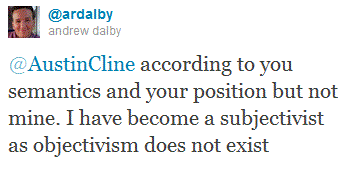
I witnessed a Twitter spat (which I want to call Twat, but had better not) between P.Z. Myers and a statistician called Andrew Dalby. P.Z. had posted a video depicting dreadful intimidation of Irshad Manji by Muslim fundamentalists, pointing out the deep distinction between militant theists and militant atheists. Incredibly, blind to the evidence of his own eyes, Dalby tweeted this:

Once again, my gast is flabbered by someone in the ongoing debate between believers and non-believers. Displaying breathtaking bigotry against a whole raft of people, Dalby says that P.Z.'s post shows that 'the atheists are just the same sort of bullies as the fundamentalists'. So that post is the equivalent of instigating a riot, or demanding someone be executed, or demanding that a book be banned. It's a remarkable claim, and Dalby doesn't appear to be a theist, so much as someone who thinks he's found a way to be superior to both atheists and theists. P.Z. called his lack of critical assessment stupid, to which he replied:


...which made me giggle. Never a good thing to proclaim one's own genius, I find. Or perhaps that's just me, since my inability to 'out intellectual' and 'out science' people has been proved regularly! He followed up with this gem:

That deserves a ROFL. Does he mean lecturers in statistics at Oxford University are automatically correct in any discussion, regardless of the subject? I mean, sure, in a discussion on statistics, P.Z. should probably defer, but in this discussion? It's not clear what relevance this factoid has to Muslim fundamentalism, or handbagging for that matter! Anyway, back to the Twitter spat, and Dalby offers:

So apparently Santayana (and only Santayana?) is foundational to humanist principles? Santayana is all well and good, and wrote much that modern day atheists would agree with, but he was famously sympathetic to Catholicism (presumably because of his background) and few modern day atheists would agree with him on that score. Of course, many theist thinkers would disagree with him on that score too! A pointless appeal to bogus philosophical authority, then. Toleration of religious belief does not entail its immunity from criticism.

I wasn't sure what had upset Dalby so much about P.Z.'s post, but it became clear in his follow up tweets:


The bit that Dalby does not like appears to be this:
...there might be much to admire in her [Manji's] work, as she’s another theist who has taken a step away from the dogma and tribalism of fundamentalism, but she hasn’t yet had the courage or intellectual integrity to take another step and free herself of the folly of faith.

So the accusation of a lack of courage and intellectual integrity is beyond the Pale, Dalby thinks, and it's wrong to tell people what to believe and that they are inferior or wrong. You will notice that he is pragmatically self-refuting here, since, among other things, he is telling P.Z. it's wrong to tell people they're wrong. Of course it's not, and we would not have morality if it were, since our morals not only guide us in our behaviour but we also feel they have a prescriptive effect on others, as Dalby demonstrates. It then becomes clear how this muddle headed thinking arises:


Oh dear; radical scepticism rears its ugly head and we're heading for the barren plains of relativism, where no-one is right and no-one is wrong. Because he's not sure what's true, nothing is true. This would be a strange philosophy if anyone lived by it, but of course no-one does.

Well, obviously objectivism exists as much as any idea does - he presumably means there is no objective truth. An unsustainable pomo position, as the exchange demonstrates, since his own entreaties would have no weight, if it were true. A tweeter called Austin Cline calls him out:


To which, of course, he has no answer, other than 'thinking is always bad for us'! It's lucky we're not all lecturers in statistics at Oxford University, else none of us would think. The ultimate source of his anger is clear, I think, from this tweet:

If there's one thing that new atheists have achieved, it's a wider acceptance that religion and faith are not privileged over other beliefs. Folk such as Dalby demonstrate that even many non-believers cling to an unthinking acceptance of this privilege that religion and faith demand. Of course we tell each other what to think about many things, and there is no good reason to exclude religion and faith from that list of things.

But finally, the outrageous equating of good faith criticism from atheists with genuinely extreme religious bullying has to be called out for the bogus comparison it is. When these sorts of befuddled accusations stop, then it might be that we're getting somewhere in reducing religious privilege.

Read more »

Tuesday, 3 January 2012

The Tall Tales of Hoffmann

"Hic!"
I'm not sure if this Hoffmann's first love was Olympia, the automaton, (or was it Ophelia? She's certainly no automaton.) or if his further loves were Antonia and Giulietta, but there is more than a whiff of the old Hoffmann about this New Oxonian. It's as if some gnu atheist Lindorff has gone off with his Stella,  leaving him drunk in the tavern crying into his beer, "Muse whom I love, I am yours!". I've been that drunk too, though in humbler company than Hoffmann. He certainly loves the Muse, but perhaps he has spent too long musing while nimbler, more successful courtiers of Stellar Street have taken the plaudits and bouquets. That seems to be part of the complaint (h/t Screechy Monkey):
Part of that has to do with (as I suggested) a record that goes back long before most Americans had heard of Richard Dawkins. Some of us older and old atheists remember what a lonely battle that was. Many who came to the movement since 2000 will not. And that is precisely the pojnt. Without saying jealousy is involved, there are many (not just me) who know that the Dawkins revolution could not have taken place without th almost invisible work of many of my associates in and out of the academy over many many years. On the one hand, we need to be grateful that the New Atheists have been successful in garnering support; on the other hand, and I know this from experience, nothing ensured the death of a book in this country before 1995 like putting the word atheism or humanism in the title. So, there were laborers in the trenches.
But in his latest offering he is far from a-musing, letting off at every gnu he can think of, like a drunk sending texts to former lovers. He starts off with the usual suspects and regurgitates well-worn non-arguments against the Four Horsemen (three of whom he might call Gnu Oxonians?). Interesting that he seems to admire Hitchens the most ("the only true intellectual and by far the best-read of the group"), since Hitch's arguments were always the worst of the four, even if his polemics were the best. More ire is aimed at the gnu bloggers who dare to offer an opinion on religion that has not been informed by years of study in the Divinity School at Harvard. He starts with Jerry Coyne, quoting him comparing religion to leprechauns in their compatibility with science, to which he responds:
Just a flash: While leprauchauns didn’t copy the books that were turned into the books that led to the science Dr Coyne eventually studied, monks and rabbis did. Why does the perfectly reasonable opposition to religious craziness have to descend to this caricaturing of the history of religion?
Strange, isn't it, that religion has morphed into the history of religion? What a befuddled argument. It's difficult to know what Hoffman's point is here. Is it that a deep and complex history justifies an ontology? But Coyne doesn't deny religion's history. It's as if he thinks the involvement of religious people in the history of science invalidates the Conflict Thesis, but none could be that dumb. Leprechauns don't exist so they couldn't have copied early science books, so Hoffmann's comparison doesn't work. Coyne, on the other hand, is pointing out that religion is a superstition, like leprechauns, not that religion doesn't exist, or, even more foolishly, that the history of religion doesn't exist or isn't complex. Hoffmann's argument wouldn't pass muster at infant school, sadly, let alone any philosophy department.

A Gish Gallop of mud-flinging follows, aimed at PZ Myers ("If ever atheism got dumber and less impressive, it is in the work of this dissolute insult- monger"), Greta Christina ("She sees everything as a weird sexual joke"), Ophelia Benson ("...has turned her once-interesting website (I used to contribute regularly) into a chat room for neo-atheist spleen"), Eric MacDonald ("doesn’t seem to know bloody anything about the academic study of religion") and Jason Rosenhouse ("I sometimes wonder why people whose only contribution to blogdom consists of sentences like “Most religious rituals leave me beyond cold,” find themselves titillating?"). Like one or two other misguided critics of new atheism, Hoffmann is often pragmatically self-refuting!

But Hoffmann has an illustrious history, if not an illustrious future, so I do wonder what has got under his skin so much about people who aren't guilty of the things he thinks they're guilty of. Apart from the self-confessed jealousy above, he gives a clue to one of his concerns in a comment below his latest rant:
The new atheists don’t oppose the study of religion. Not true: in fact the famous “Pinker Intervention” at Harvard in 2006 prevented religion from becoming a part of Harvard’s core curriculum, on the premise there was no difference between theology and religion-studies, though Harvard was the first university in America to introduce such study in the 1930′s, apart from its Divinity School. Read all about it here: http://www.somareview.com/godandmanatharvard.cfm Stephen Pinker (who is far more considerate of religion in general) is not the issue here, btw; a number of the newbies have gone on record as saying that the study of theology does not belong in a university, though in some places like Harvard, Yale, and Chicago, this would mean closing down their divinity schools where the study of religion is alive and well. That’s half the problem: the other half is that rank amateurs like the newbies have already pronounced their verdict on such study by mixing up the objectives. Frankly if this confusion is any indication of the state of their information, they’d better hold off on the God thing for a few years. If you want to see the nadir of this imbecilic conversation, here you go:http://www.newstatesman.com/2011/06/dawkins-myers-religion-faith

Interesting. The New Statesman piece compares religion to knitting, which is presumably what upsets Hoffmann, but this is nothing more than Myers's view of what religion's status should be in society, not a judgement of its historic worth, I think. Despite people like Dawkins and Hitchens regularly supporting the study of religion, he genuinely believes they don't, and his evidence is the "Pinker Intervention" and a throw away remark from one of the more strident new atheists. I'm not familiar with the background to the Pinker story, so it would be good to hear some more about this other than what Hoffmann's written, cloaked in dense references as it is ("Pinker Intervention" throws up just one link on Google, to Hoffmann's piece).

So maybe his concern is that divinity schools should not be closed down? But opposition to divinity schools is not opposition to the study of religion, so it's still not clear why he is so exercised about this. In the piece he links to, about the study of religion at Harvard, he says:
In short, all the wrong reasons for studying religion—because it is popular, widespread, and personally significant—triumph over the good reasons for studying it.
I confess, though, that I'm not clear from the piece what the good reasons are for studying it. I could guess at a few. Hoffmann does say earlier:
But religion puts itself forward as something that ought to be studied in its own right, not because in doing so the student learns to value its influence or validate its claims, but so that the student will be able to evaluate it within a particular analytical frame of reference. And it is in providing that context that Harvard excels.
This may be true, but it does not go any way to justifying separate divinity schools - religion can still be studied in its own right without that - so I'm still left struggling to understand the nature of Hoffmann's complaint, once again. Unless he thinks that the only frame of reference that is sufficient for good religious study is in divinity schools? Maybe, but he would have to be clear why he thinks this, or it's just special pleading for religion; something that new atheists are (obviously) against.

I dare say he has other complaints; if only he could write clearly, without so many distracting straw men and errors of fact, then we might have a better chance of understanding them. Maybe one day he'll sober up and tell us fellow drunkards what he means.

Read more »

Friday, 4 November 2011

Misunderstood Presentations or Misrepresentations?


I've now seen the Q & A for the Coyne-Haught Symposium, and it's a relief to see that this is where the missing scientism 'argument' appears, rather than in John Haught's presentation.

In answer to a question asking if Haught would consider not pre-supposing God before looking at his own beliefs (a good question), he ignores this and says that Coyne thinks that:
There's only one explanatory slot for everything.
But this is a bizarre misunderstanding, or wicked misrepresentation, of what Coyne said, and clouds Haught's thinking throughout the Q & A. This is perhaps the explanation for Haught's remarkable decision to try to suppress the video of the event. Because Haught starts by making such a disastrously wrong assessment of what Coyne has said (and is apparently disturbed by this figment of his imagination), he quickly runs down cul-de-sacs. He obviously considers Coyne's position to be one of scientism, but that isn't it at all. He never said there could only be one layer of explanation for phenomena (there usually is), he never said that science is the only way of knowing. The question on the table is, are science and religion compatible? Haught needs to address Coyne's case that they are not, rather than pursue his imaginary demons.

Layered explanation, which Haught is proposing, is fine. All that people ask is that arguments and evidence are presented for any particular explanation offered. Even if we have a phenomena with layers of explanation that doesn't mean we simply adopt any layer that anyone proposes; we must have a reason to consider the layer a viable explanation. We can only go on argument and evidence, not wishful thinking, at least if we are being scientific. This is not scientism, but science. To describe Coyne's ideas as scientism is an abuse of the English language.

But even if Coyne were guilty of scientism, it's still an inadequate argument to place to the assembled throngs. Scientism doesn't then mean that theology tells us something real about the world. An argument has to be made to show that, and Haught doesn't offer us one. He says:
There is no contradiction between a theological way of understanding the universe and a scientific way.
Don't say it, show it! - contra Coyne. This really is a hopeless response from Haught.

Haught is then asked where he sees the evidence for a loving God. Here he distinguishes between publicly accessible, scientific evidence, and transformative evidence - the overwhelming encounter with something that is so true and so good that it carries you away. So, he's talking about subjective experience here, and I'm rather surprised that he can't see that this is fatal to his contention that science and religion are compatible. Every inch of his tall frame seems to be denying the truth that science tells us, even if we allow that his revelations carry some weight as evidence.

Oddly he also says although this is evidence too, it's not something you can get your mind around. Well, how does he then? It's this sort of doublespeak that will be the death knell for theology, I think.

In a discussion on Occam's Razor, Haught again makes the mistake of noting that different understandings can have explanatory value, and therefore his understanding has explanatory value. It's very odd to see a senior academic making such a basic error. He needs to show that his understanding has explanatory value with argument and evidence, not just by logical compatibility. Almost anything can be logically compatible with a set of phenomena, but it doesn't follow that scientific explanations and theological explanations that are logically compatible with the same phenomena are then compatible. Maybe that's another of Haught's errors.

This was a disappointing end, since Haught didn't address any of Coyne's arguments about the methodology of the two disciplines, which to my mind are the source of claims of incompatibility. His hand waving insistence that his beliefs about the world are compatible with science flew in the face of the rest of what he said. A very odd performance.

Read more »

Thursday, 3 November 2011

Coyning It


Jerry Coyne starts by pointing out the various pointers to a conflict between science and religion, such as organisations like the Templeton Foundation who search for a resolution to the problem, how scientists are more likely to be atheist, how more people in the US believe in angels than in evolution. The suggestion here is, I think, that there is an incompatibility which gives rise to these activities and beliefs.

I think this is fine as an indication of a problem, but it doesn't show that science and religion's incompatibility is true any more than people acting and believing that science and religion are compatible makes that true. If everyone in the world but me agreed that science and religion were compatible, I think I would still think they weren't (although it would make me pause!).

Coyne then moves onto a description of scientific methodology, which he characterises as 'qualified common sense'. 'The first principle is that you must not fool yourself..'. Religion on the other hand is based on 'dogma, authority and revelation'. He notes that religious ideas have changed because of scientific advances in our understanding of the world around us (such as evolution) and secular morality. And for the better - our treatment of women and gays, for example.

This is stronger ground for Coyne. To my mind there is a fundamental incompatibility between the methods of religion and the methods of science that is almost bound to result in differences. Now, it's possible that they don't; it may be that dogma, authority and revelation are different ways of finding out the same thing as scientific methodology uncovers. The problem with this view is, it never has. On every occasion that science has come up against religious 'knowledge', the scientific knowledge has won out. So, the religious might offer that dogma, authority and revelation are a way to uncover knowledge that science cannot uncover. Again, this is possible, but the evidence suggests otherwise, because we have a history of divergent beliefs about anything that cannot be shackled in some way. How do we shackle our beliefs? Well, the scientific method is the best way, and so far, the only reliable arbiter we've discovered.

Coyne says that in science, faith is considered a vice, but in religion, a virtue.

Maybe this is a little too broad brush? I understand what he means, but there's a danger of making the same mistake that Clifford made, in The Ethics of Belief (1877) when he says:
It is wrong always, everywhere, and for anyone, to believe anything upon insufficient evidence.
I think William James shows in The Will to Believe (1896), that this is a practical impossibility, and a moment's thought confirms this. We are a social animal, and one of the reasons for our seemingly exponential advance in recent times is our ability, well in advance of other animals, to pass knowledge on to our offspring, and to share knowledge. This process is impossible without an element of faith in the institutions that supply this knowledge. Certainly as children we aren't in a position to gather evidence; trust in our nearest and dearest seems to be built into us without any need for evidence. One might speculate that evolution has determined that a propensity to trust without evidence when we are children has been a successful evolutionary ploy. Not surprising, if that's so, that this also spills over into our adult life. We conduct our daily lives through many trivial acts that are not fully evidenced, since we have to get on and it's impractical to gather evidence for every minor thing one does. Maybe this is equivocating between faith as trust, and faith as believing without evidence, but it seems to me there are sufficient occasions when we really do not have any evidence to discount Clifford's as a general rule.

Coyne's rule is better, however, because it notes that in science, faith is considered a vice. This, it seems to me, allows us to sanction the rule, since it lets us have faith in our every day lives as a pragmatic necessity. But in matters of scientific import, it is not fit for purpose.

Coyne continues and notes that in religion there is no way of knowing you are wrong.

A key point, this. Two religious ideas have no method, in principle, of resolving which one is right.

Coyne notes that methodological naturalism has led to the view that metaphysical naturalism is true. There's no God, just material processes, and that works. He lists a number of areas about the cosmos where religion could have got reality right, but didn't, such as special creation, Adam and Eve, the Flood and so on. He wittily observes that falsified scientific claims are discarded, but falsified theological claims are made metaphorical. Religion does make existence claims, and the Nicene Creed is used as an example. He points out that the answers to the bigger questions haven't been answered by religion, because they do not agree with each other.

And as I wrote above, there is no method of reconciling different beliefs in principle.

Coyne quotes Haught as saying that "the transience and expected death of the cosmos defy our attempts to state clearly what the 'point' of it all may be."

Funnily enough, this is the point I make in my post on Haught's talk. however, it's worth noting that this quote from Haught's Deeper than Darwin ends with this sentence:
On the other hand, recognizing the possibility that the universe is still barely emerging from the cosmic dawn, we may take them as promissory symbols of the ultimate depth into which all things are being drawn.
...so he was saying this as a set-up to this assertion. But like his talk, he seems to have nothing but wishful thinking to back up the notion. Perhaps he's left his arguments in the book.

Coyne runs through some unscientific behaviour typical of religion, such as denying that the Bible says what it appears to say, that it doesn't involve an honest search for truth, but a rationalisation of what is already believed to be true...

I'm guessing that Haught found such accusations beyond the Pale, since I'm sure he would disagree that this is what he does. I think it's certainly clear that William Lane Craig's arguments are rationalisations, since he admits he doesn't believe in god because of the arguments he puts forward. Coyne hilariously includes a quote from Haught that certainly suggests he puts wishful thinking above scientific endeavour. To say that all religion, or all theology, is guilty of this may be unsustainable, however.

...that they make stuff up, they rationalise every new scientific observation as part of God's plan, that they understand the nature and intention of God.

Coyne quotes Haught again as 'making stuff up'. Again, I'm sure Haught denies this, but it's hard to see how what he says is anything but made up. Without some method of knowing, with verification, how does Haught know? It's not clear, I should say, that the quote that Coyne uses of Haught's is referring to the hiddenness of God exactly. It's certainly true that Haught's quote on the problem of evil doesn't come close to addressing the issue.

Coyne gives a good example of fitting science around the God idea when discussing Haught on evolution, where Haught says it is a tribute to God that the world is 'an inherently active and self-creative process'. 

Before science showed it true, no theologian would propose evolution as the obvious way for a god to make the world, but afterwards it becomes a 'tribute' to him. With this sort of post hoc analysis, there really is no hope for theology.

Coyne ends, I think, with an appeal to why science and religion shouldn't be compatible, because the consequences of the poor methodology of faith are the evils of religion, some of which he lists. These are allowed to persist because of dogmatic thinking.

This is fair, I think. None of these consequences of religion are solely a problem of religion - it's people in the end who enshrine these evils, and people can ignore the dogma. But, as a matter of principle, dogmatic thinking can more easily lead to such abuses. This is the power of Coyne's presentation. I don't see that these attacks are ad hominem, since Coyne is making an argument about the incompatible methods adopted by science and religion, the abuses of method by religion, and he illustrates these using Haught's own words. Haught could, I think, complain about the quotes if they have been quote-mined, so I would encourage him to explain that in an article as soon as possible, if that's the case.

Read more »

Wednesday, 2 November 2011

Haughtiness


I here summarise and briefly analyse John Haught's presentation at the symposium he conducted with Jerry Coyne at the University of Kentucky (video above).
Is there anything of lasting value working itself out in this vast universe that science has given us recently?
Haught starts his talk with this question; he doesn't question its pertinence, but assumes we all think it important. There is an assumption that lasting value is the only value that matters or, at least, that it matters more than temporal value. But he offers no argument or evidence for this view.

He wonders if science rules out any cosmic purpose, and thus any divine presence. As one would expect, he clearly understands the traditional mind-first view of the cosmos, which has come down to us from Aristotle, featuring concentric circles from the heavens above down to Earthly matter below. And this coincides with a theological and moral order too; so higher morality is in the heavens above us, and baser morality below us. 

We aspire, like Faust, to the heavens above; but all too often, like Faust, we are pulled down to hell below.

He says that if there is an ultimate purpose, it would, by definition (by the above definition, of course!), be beyond human comprehension, because of the hierarchy. But traditional theology suggests we can be 'grasped' by the higher levels, to have an awareness of them - and this awareness we call faith. The 'only evidence' for it is the awareness of being carried away by 'something very large, very important, of ultimate value'. The language of symbol, metaphor and analogy is all that can be used to describe it. But that's a sign of the eminence of the thing we're describing. And it must be personal or it would be less than us.

He presents no evidence for his views here, other than personal revelation; there is no argument. It's simply a re-statement of the views of traditional theology. We have no reason to believe it, in fact, since we have no mechanism for distinguishing personal revelation from every day brain activity, other than science, and science gives no support to religious revelation. Further, it's clear that he understands that science threatens the theological hierarchy. As Daniel Dennett points out in Darwin's Dangerous Idea, evolution by natural selection has the effect of 'universal acid' on these ancient ideas:
Did you ever hear of universal acid? This fantasy used to amuse me and some of my schoolboy friends ... Universal acid is a liquid so corrosive that it will eat through anything ! The problem is: what do you keep it in? It dissolves glass bottles and stainless-steel canisters as readily as paper bags. What would happen if you somehow came upon or created a dollop of universal acid? Would the whole planet eventually be destroyed? What would it leave in its wake? After everything had been transformed by its encounter with universal acid, what would the world look like? Little did I realize that in a few years I would encounter an idea – Darwin’s idea – bearing an unmistakable likeness to universal acid: it eats through just about every traditional concept, and leaves in its wake a revolutionized world-view, with most of the old landmarks still recognizable, but transformed in fundamental ways.
Haught summarises briefly the cosmos according to science and it's clear he sees the disjunct between these two stories, since he asks "Can we map the hierarchical view to this new view that science has brought to our attention? Does the idea of God make sense any more?"

He urges us to be transformed by reading the New Testament. Christians believe there is an 'unspeakable, incomprehensible, infinite mystery that we call God'. It gives itself away in 'unreserved, self-emptying, self-giving love to the finite world'. This is the meaning of the Christ event. The process of self-transcendence is evolution - there is absolutely no contradiction between the two.

Again, he still hasn't presented any form of argument to reconcile science and religion, the subject of the symposium; in fact, he's made it clear that prima facie they are incompatible, and he concedes that by asking the question how we should reconcile the two views.

So how to map one to t'other? Finally Haught brings us his revelation: think of God not pushing evolution from behind, but pulling it from the future. And think of the hierarchy as an evolving story, as matter emerges, and later life, and then faith and morality. Faith is the way that the universe, now it has become conscious of itself, opens up a new future. So faith is the way we can guarantee the evolution of the cosmos into the indefinite future. 

The important thing is, that evolution is compatible with the hierarchy if we knock it onto its side, and see what is above us as what is in the future. He topples the hierarchy onto its side. And, somehow, it is faith that is required for the evolving future, and so science is compatible with religion.

Obviously, that doesn't follow, and, again, he offers no evidence or argument for his view. He doesn't address the whole point of why science threatens the hierarchy - because it shows no need for anything pushing evolution or pulling it from the future. It's what matter does when it's not being guided. Now, I can imagine arguments being posed to show that evolution is guided in some way, but Haught doesn't present any. He simply asserts his view. There is no evidence or argument presented of how faith guarantees evolution. And what he says assumes that evolution is progressive to some mysterious transcendent future, but offers no argument for that. Science suggests the cosmos will end in heat death; is that compatible with this 'hierarchy on the side' vision? I don't see how. It is, finally, an argument free talk.

This is very disappointing because in his open letter allowing the release of the above video, Haught says, addressing Jerry:
Rather than answering my point that scientism is logically incoherent–which is really the main issue–and instead of addressing my argument that the encounter with religious truth requires personal transformation...
But he doesn't make any argument that I can discern that the encounter with religious truth requires personal transformation, and he doesn't even make any argument that there is such a thing as religious truth! He just asserts it, perhaps based on the discredited mind-first view of the cosmos. To be fair, personal transformation is logically consistent with this view of the cosmos, but that's the notion that science is destroying, and he doesn't argue against that, but suggests a reconciliation that is, frankly, pure hand-waving. He doesn't explain why the 'universal acid' isn't eating its way through his theological ideas as we speak. And I see no hint of an argument that scientism is incoherent (which it may well be, but that doesn't then mean that religion is compatible with science); perhaps I missed it (was it on a slide?).

All in all, it's a poor talk, if it's supposed to be presenting some forceful arguments for the compatibility of science and religion, because surely anyone would come away more convinced that they weren't compatible!

UPDATE: Link to the slides here.

Read more »

Friday, 3 June 2011

We Are Sinners All


What to say about Jeremy Stangroom's latest flailing effort to marginalise gnu atheists? He says:
I don’t have time for the new atheist idiots right now.
Could one say, that's hardly civil or good behavior?

Or I actually don’t think many 'public intellectuals' would make a comment about folks being idiots in a blog?

Is it evidence that Jeremy doesn't have a good nature?
Karla, if you’re reading this, which I doubt, you probably know by now it’s a mistake to engage with these morons
Hmmm. Perhaps remarking that the targets of your criticism are morons is a bit... well, moronic?

Should one point out that calling gnus morons has nothing to do with [their] argument?

Should we conclude that, because he thinks I really don’t think that many public intellectuals would have said the sort of thing that Dawkins said. I don’t think I would have said it (except maybe ironically), he is calling gnus morons ironically? Or perhaps he thinks he's not a public intellectual? Well, he's certainly public.

In the comments of an earlier attack, he said:
The point here is that it has been stated quite explicitly that the new atheists do not “fall short” (though it’s not expressed quite like that, obviously) enough that they can reasonably be viewed as uncivil; and that the other side – i.e., the “accommodationists” – fall short a damn sight more often and more egregiously. I intend to show that neither of these things are true.
It's amusing that he's proving himself wrong on his own blog. And, for the record, I don't think that accommodationists "fall short a damn sight more often and more egregiously" than gnu atheists. From the start of this self-defeating accommodationist crusade, my objection has been that gnus do not fall short of acceptable standards of discourse any more than anyone else does. But they are cast by theists and accommodationists alike as if they do. I don't know the motivation for this 'othering' of gnus, but it's difficult not to conclude that it's driven, somewhat, by society's privileging of religious beliefs, over and above other beliefs. When this privileging stops, then gnus will have a lot less to complain about, civilly or otherwise. Until then, accommodationists are simply more evidence for its existence.
Enhanced by Zemanta

Read more »

Monday, 30 May 2011

Hit and Myth


R. Joseph Hoffmann has been making a lot of news in the blogosphere recently, through his intemperate attacks on gnu atheists - consider this comment highlighted by Ophelia Benson at Butterflies and Wheels:
There are no butterflies there [at B&W] anymore just gasbags like the seminally under-qualified Eric McDonald and clowns like PZ Myers, who could benefit from a reading comprehension course with an emphasis on analogies.
Calling Eric Macdonald 'seminally under-qualified' is indicative of a critical faculty that has become unhinged, and now Richard Carrier has cause to question Hoffmann's sanity:
But in private conversations about some of the problems I had with the book, Hoffmann was a complete dick to me, and wouldn't own up even to the mistakes I had actual proof he had made.
...and...
Thereby tempting me to conclude that he [Hoffmann] must be a lunatic.
This all comes in an analysis of Hoffman's book, Sources of the Jesus Tradition: Separating History from Myth. Sadly Hoffmann also supports the view of Jacques Berlinerblau that new atheists think that:
Unless you as an atheist are willing to disparage all religious people, describe them all as imbeciles and creeps, mock every text and thinker they have ever produced, then you must be some sort of deluded, self-hating, sellout, subverting the rise of the Mighty Atheist Political Juggernaut...
A straw man of dickish proportions, to be sure. I don't know what's happened to RJH, but it's worth reading about Carrier's concerns for his editorial skills. Despite that, the book's still worth purchasing, apparently!

UPDATE: Hoffmann has replied to Carrier's criticism, including this paragraph:
Hoffmann, probably
I am still not sure what “mistakes” he’s referring to other than his own, which were as substantial as his contribution was irrelevant, a long discursus on Bayes’ theorem that never once budges above pedantic lecturing to engage the literary material – the New Testament – to which its application is implied to be relevant. A cautious, or less sympathetic editor would have cut it eo ipso as being totally to the left of the topic, though Carrier shows a fleeting acquaintance with some of the methods (and limits) of conventional New Testament criticism. It does not rise to the level of convincing expertise.
One wonders why he included Carrier's chapter, in that case! He displays little sympathy, so maybe he was just being incautious.

And Carrier's reply.

Read more »

Monday, 9 May 2011

Reason-able?


Chris Mooney has been posting some excellent pieces recently, thankfully avoiding (mostly) his accommodationist nonsense. At Mother Jones he wrote The Science of Why We Don't Believe Science, detailing many studies exploring our cognitive problems. It's well worth a read to get acquainted with some of the studies exercising psychologists at the moment. In it he talks about how emotion informs and, to a degree, poisons one's pre-existing beliefs and affects how one argues.
And that undercuts the standard notion that the way to persuade people is via evidence and argument. In fact, head-on attempts to persuade can sometimes trigger a backfire effect, where people not only fail to change their minds when confronted with the facts—they may hold their wrong views more tenaciously than ever.
This is his standard retort to gnu atheism. But it's quite modest, and doesn't do the work he wants it to. I mean, obviously on many (most?) occasions people are persuaded by evidence and argument. What he means to say is that this may not be the best way when the issue under discussion triggers deep emotions. Later he says:

If you want someone to accept new evidence, make sure to present it to them in a context that doesn't trigger a defensive, emotional reaction.

Again, this, I presume (!)  is the reason for his tone trolling, but it's not doing the work he wants. I don't think any gnu denies that tone is important, and these studies indicate some reasons why a sympathetic context can work. But that doesn't mean it's the only way to get results. Ridicule also generates an emotional reaction, and that may produce results too, without evidence and argument. I can remember being persuaded as a child not to do certain things by the ridicule heaped on me by my brothers when I went wrong. There was precious little evidence and argument presented.

More recently he's blogged about a study relevant to that article, calling it Is Reasoning Built for Winning Arguments, Rather Than Finding Truth?. That title's not really accurate, as a read through uncovers. It's based on a study by Mercier and Sperber, called Why Do Humans Reason? Arguments for an Argumentative Theory. Mooney sums it up better in the final line:
When it comes to reasoning, then, what’s good for the group could be very bad for the individual–or, for the echo chamber.
An interesting finding. We have an imperfect reasoning tool in our locker. If we just reason our way around the world as individuals, disaster can strike. So, an example in the comments, the Unabomber living alone in the woods can easily go crazy because no one is there to say, “Whoa, where’d you get that idea?” A better evolutionary survival tactic is to introduce some argument. This, I guess, moderates some of the flaws in our thinking, such as cognitive bias, and is more likely to produce a better result for the genes (this is an evolutionary psychology argument). In the comments it's also made clear that like-minded groups are a problem too. Hugo Mercier pops up to confirm what he thinks the solution is:
What we’re suggesting is that in a normal debate, you try to convince the other guy when you produce arguments, but you’re mostly objective when you evaluate arguments (after all, if you’re better off changing your mind, you’d rather know about it). So a normal debate is the solution, and it has worked very well for ever. There is no need for any new thing really, just fixing institutions that don’t rely enough on genuine debate.
A pretty good addition to the argument for freedom of speech, I think. Further, it counters the accommodationist position that gnu atheists shouldn't confront the moderately religious and dismiss their beliefs. Genuine debate is what gnus demand, and these studies suggest that if moderate religionists aren't challenged, they will operate in an echo chamber that may end up radicalising their views.

No doubt accommodationists can accuse gnus of operating in their very own echo chamber, but this chamber rings very hollow indeed. In a world where atheists are outvoted and outprivileged wherever one looks, it will be a long time before it becomes a dangerous in-group. But one would have to concede that it may happen one day. O, frabjous day!
Enhanced by Zemanta

Read more »