Showing posts with label atheism. Show all posts

Sunday, 31 July 2016

Philipse on Theism - Revealed or Natural Theology?


In God in the Age of Science?: A Critique of Religious Reason, Herman Philipse examines what he considers to be the best arguments for God today. As we saw in his preface, he plans to examine Richard Swinburne's arguments for God.

In Chapter 1, though, he wants to establish 'that for religious believers, natural theology has an epistemological priority over a revelation and revelation theology' (p.3). Natural theology is the approach that Swinburne takes.

Philipse draws the common distinction between natural theology and revealed theology. Natural theology can be examined through evidence available to everyone, non-believers included. As the SEP explains, it 'aims to adhere to the same standards of rational investigation as other philosophical and scientific enterprises, and is subject to the same methods of evaluation and critique'. Philipse defines revealed theology as 'the endeavour by believers to interpret and systematize the contents of texts that are considered divine revelations, such as the Bible, the Koran, the Vedas, or the Book of Mormon' (p.3).

Richard Swinburne himself points out that there is another notion that is now considered popular, particularly among Protestants:
Religion, they will tell us, is a matter not of affirming creeds, but of a personal relationship to God. The religious man may tell us that he knows that he at any rate has such a relationship, and that he knows what he means when he says that he has this relationship; on these points he ‘cannot be mistaken’. (The Coherence of Theism, p.6)
Philipse examines perhaps the most well-known defence of this sort of position, Alvin Plantinga's Reformed Objection, in Chapters 3 and 4.

Philipse notes that most believers come to their belief because they are brought up in a religious tradition; the truths of it are a given. But these days we are exposed to scientific knowledge that often contradicts such received opinions, and are also made aware of the full diversity of other received opinions. Consequently, it is necessary to appeal to the arguments of natural theology if one aims to be rational and reasonable.

Establishing the epistemological priority of natural theology is also important so that non-believers can engage on a level playing field with believers; that is, they should both be approaching the subject using the same tools to analyse and justify their beliefs. This is not to exclude the possibility that divine revelation occurs and people may know something about God apart from natural theology. But it is to suggest that when we justify our beliefs in public discourse, we do not need to appeal to that divine revelation, and, in fact, the knowledge derived from natural theology is better in some way than other methods. For example, someone may know that they haven't murdered someone, but if accused of murder they must defend them-self in court by appealing to methods that everyone can access; simply appealing to their inner knowledge that they are innocent will be insufficient.

Philipse gives 6 reasons for thinking that natural theology has epistemological priority over revelation, which I summarise as:

(A) There are contradictions within revealed texts.
(B) Many revelations are shown by science to be untrue.
(C) Many revelations are based on sources and cultures that are not considered divinely inspired, leading to...
(D) Revelations contain nothing that could not have been established without divine assistance.
(E) Revelations contain moral norms which many of us now find unacceptable.
(F) The revelations of other religions provide a potential defeater for a believer in divine revelation.

I would endorse this list, although in my experience (A) is pretty hard to categorically establish. With a narrative like the Bible the language is ambiguous enough to prevent the establishment of a formal contradiction. Just consider Philipse's first example; the supposed contradiction between Paul describing Jesus' resurrection as spiritual rather than corporeal, as maintained by subsequent Christian tradition:
Paul seems to deny that Jesus was resurrected with his earthly or physical body, arguing that he was raised with a new, spiritual and heavenly body (sooma pneumatikon), since ‘flesh and blood cannot inherit the kingdom of God’. (p.5)
 Paul's words 'sooma pneumatikon' and 'flesh and blood' allows for multiple interpretations; see this discussion by William Lane Craig, which includes this quote from Robert Gundry:
The soma denotes the physical body, roughly synonymous with 'flesh' in the neutral sense. It forms that part of man in and through which he lives and acts in the world. It becomes the base of operations for sin in the unbeliever, for the Holy Spirit in the believer.
And 'flesh and blood' is considered synonymous with 'frail human nature'! Craig concludes that 'we have seen that Paul's evidence serves to confirm the gospels' narratives of Jesus's bodily resurrection'. So clearly he sees no contradiction here, and one might expect similar analysis from apologists on other claimed contradictions.

Generally, though, I think the accumulation of Philipse's reasons gives us good reason to doubt revelation. To counter this general conclusion, I think I would point to the vital role that testimony plays in our knowledge creation, and that biblical revelation cannot be dismissed any more than can be the many non-biblical revelations that are handed down to us. For example, we have established a sophisticated education system which pre-supposes the validity of handing down common knowledge, mostly documented in textbooks; we don't expect anyone to literally support all these 'revealed' truths.

I think, however, that we should have to justify this knowledge if it turned out that around the world we were teaching different truths from radically different textbooks. The project of science has been to universalise knowledge, so that textbooks converge. If natural theology were any better than revealed theology, one might expect it to achieve a greater convergence too. I think that, in the sense that the conclusions of natural theology are more modest than those of revealed, perhaps it does. A discussion for another time, maybe.

Read more »

Sunday, 22 May 2016

Philipse on Theism - Preface


In God in the Age of Science?: A Critique of Religious Reason, Herman Philipse examines what he considers to be the best arguments for God today.

In the preface he notes that the arguments produced in analytic philosophy of religion in the last fifty years are worthy of consideration. His reasons for addressing religion are:

  1. The world's population is growing, and the demographics are against the secularist. The non-theist minority is getting smaller and smaller, in global terms.
  2. Globalisation means that cultures are mixing more, and this brings incompatible beliefs together more. The cognitive dissonance this produces causes more religious conflicts than we have seen in the past.

He also sets out his approach; he will be considering beliefs, not rituals; he doesn't want to be accused by believers of not attacking the best cases for theistic belief, so he will consider some of the arguments of D. Z. Phillips and Alvin Plantinga. He will spend most time, however, looking at the arguments for 'bare theism' by Richard Swinburne. This is because:

  1. The monotheism that Swinburne defends is common to the three great Judaeo-Christian religions.
  2. Swinburne's strategy seems the most promising to Philipse, since Swinburne pursues a natural theological approach to the question (compared with, for example, the foundationalist approach of Plantinga). As Philipse puts it, 'If he exists, that god is a divine person with many kinds of causal powers, whose existence can best be argued for on the basis of his alleged empirically detectable doings' (p.xiii).

Swinburne eschews a proof of God, but considers his existence highly probable.

Philipse notes that many religious beliefs have been refuted by modern science, such as origin of Earth stories, which means the 'intellectually responsible believer' cannot rely solely on scripture. For the believer, three interlocking dilemmas, he says, arise:

  1. Between (a) cognitive and (b) non-cognitive interpretations of religious beliefs. For example, does 'God exists' amount to a proposition that can be assessed for truth or falsity, or not? For an interesting discussion of non-cognitive approaches (often called Wittgensteinian), see this post by Stephen Law.
  2. If (a) is chosen, then between (c) evidential/rational support for beliefs, and (d) a non-evidential/rational approach. Under (d), Philipse will consider what he thinks is the most promising approach, offered by Plantinga, of a basic warrant for religious belief.
  3. If (c) is chosen, then between (e) following a method of gathering evidence and reasons that is 'quite unlike the methods used by scientists and scholars when they investigate a factual hypothesis of existence' (p.xv) and (f) following a method like the scientific methodology.
Philipse thinks that Swinburne offers the most sophisticated solution to dilemma 3 above, and, given the title of his book, this seems to be the best place to consider religious belief 'in the age of science'.

Part 1
In Chapter 1 he argues that religious faith can only be grounded by natural theology (that is, on the basis of natural facts).

In Chapter 2  he summarises the history of natural theology.

In Chapters 3 and 4 he addresses Plantinga's 'reformed objection' to natural theology.

In Chapter 5 he investigates the type of rationality in which natural theology should engage.

In Chapter 6 he considers if religious faith can be refuted, or not.

Part 2
Chapter 7 explores the problems that analogical language introduces for the religious believer.

Chapter 8 examines the properties of the putative monotheistic god.

In Chapter 9 considers the predictive power of the god hypothesis.

In Chapter 10, he sees if theism has predictive power, can it avoid being refuted?

Part 3
Chapter 11 examines the problems that face a Bayesian like Swinburne.

Chapters 12 to 14 consider the accumulative probabilistic arguments for theism.

In Chapter 15 he assesses the argument from religious experience.

The Conclusion then attempts, based on what has been discussed, to answer the question 'which view concerning religious matters has the best credentials: theism, agnosticism, some version of atheism, or perhaps a polytheistic creed?' (p.xvi).


What I think is excellent about the book is that, like a bus driver late for his dinner, Philipse relentlessly drives the reader towards a particular destination. This destination is atheistic, of course, as might be expected (he makes no bones about arguing from this viewpoint). This is probably a weakness too, since I'm sure many a theist reader will insist on stopping the bus and heading off down another road. For example, Jim Slegle in his review of the book accuses Philipse of not just adopting an atheistic approach, but a scientistic one, and of 'taking the unreflective, knee-jerk reaction to religious claims, ‘informed’ by the biases and urban myths of contemporary culture'. This seems an uncharitable interpretation to me, especially considering that Philipse is quite open about the project of assessing god based on modern science, which approach surely Swinburne and many theists would concur, to a degree?

More reasonably, Father Andrew Pinsent suggests that in discrediting the methods of theology Philipse is in danger of discrediting the sciences of more complex phenomena, such as biology and zoology, and the humanities in general. Which would include philosophy and presumably Philipse's own book too! Well, perhaps, and I know of a few atheists who would agree that philosophy should be jettisoned too, but I still think that rational analysis of concepts allied with an acknowledgement of the power of science can yield results, even if it struggles to be falsifiable (not the defining criterion of science, in my opinion). 

Pinsent concludes that Philipse attempts too much, and that may be a valid criticism. I found his reasons for the tight focus mostly convincing, so the book should still give theists pause to consider carefully the route they have followed in the past, and the one they follow in the future.


Read more »

Sunday, 21 December 2014

Angry at God


Philosopher Stephen Maitzen has an excellent piece, called Perfection, Evil, and Morality, which will appear in a forthcoming volume edited by James P. Sterba. It details some of the reasons atheists find incompatible the existence of a perfect god with the suffering all too evident in the world around us. In particular it highlights how obligated such a perfect being would be to prevent the suffering we see. I recommend it.

One response he has seen suggests that morality has a significance in and of itself. But as he points out it's not something that needs to exist or is worth saving, because it only exists because suffering exists. No suffering, no morality. There is no morality required in a universe populated by senseless rocks.

At the end Maitzen mentions something else that is worth highlighting; the notion that atheists complaining about the problem of evil are somehow "angry at God"; Maitzen writes:
Living in a society still dominated by an inherited theistic outlook, atheists like me are not infrequently accused of being “angry at God” and venting our anger in the form of arguments such as those I’ve offered here. The accusation is patronizing, question-begging, and false. Any atheist who can think straight knows that anger at God makes no sense. I’m no more “angry at God” than I’m angry at Santa Claus for failing to relieve me of the burden of Christmas shopping. If I’m angry at anyone, it’s at those of my fellow human beings who (to extend the metaphor) would say morally outrageous things in order to defend the Santa Claus story as true and to excuse Santa Claus for repeatedly failing to do what the story makes it clear he ought to do. 
That summarises well how absurd that particular accusation comes off to me, and I think he is right to blame some of this on an 'inherited theistic outlook'. It still puzzles me that theists don't see how abhorrent their attitude to suffering is. For just one example, consider the discussion thread here. A theist called CodyGirl824 (I presume not a Poe) says, in response to an atheist discussing the problem of evil:
The fact that only humans are capable of evil, because evil requires formulation of intent and acting on that intent. So every evil act is an act of free will. Without free will, there can be no evil. If God were to choose to "prevent" every evil act of any and every human being, He would take away all free will, since God can't just intervene when an evil act is about to occur without obliterating that evil-doer's free will, and the consequences thereof. Without free will, there can be no love. Love is God's purpose in creation. (The Bible tells us so). So we people of faith understand perfectly why there is evil in the world as it exists. As we learn from the metaphorical, allegorical, mytho-poetic narrative of Adam and Eve, all acts of evil are acts of disobedience of God. We really do have all of the atheists' and naturalists objections covered. They simply refuse to recognize this fact.
...and continues in much the same vein despite her many errors being pointed out repeatedly. A sterling job done by her responders on that thread.

Now, to be fair, we cannot judge all theists on one rather obtuse example, but the appearance of callousness in this response does seem to recur in many a theist's response to the problem. What I find callous is the acceptance of suffering in their accounts, when we are taught, and perhaps know, that we should ameliorate it. They are explaining why suffering is necessary, when we (surely) know that it's not.

At least, a suffering-free world appears to be logically possible, and it is surely what is anticipated in heaven, or what existed before this vale of tears was supposedly created. One would expect our world to reflect its maker, if its maker were perfect, and it's simply not. This doesn't strike me as a particularly difficult notion to grasp, and repeated attempts at theodicy suggest that many theists do grasp it.

In the end something must give; their god's perfection, or the wrongness of suffering. Too many refuse to give up their god's perfection.

Read more »

Wednesday, 31 July 2013

The Problem of Theistic Philosophers of Religion


Roman Catholic Dr Tim Stanley has written a paranoid piece attacking Richard Dawkins and 'atheist trolls' who constantly mock his beliefs. He writes:
When you insult my faith you go right to the heart of what makes me me. When you're trying to convince me in 140 characters of sub-GCSE philosophical abuse that God doesn't exist, you're trying to take away the faith that gets me up in the morning, gets me through the day and helps me sleep at night. You're ridiculing a God without whom I suspect I might not even be alive, and a God that I prayed to when my mother was going through cancer therapy. You're knocking a Church that provides me with compassion and friendship without asking for anything in return – perhaps the greatest, most wonderful discovery of my adult life. You see, people don't generally believe in God for reasons of convenience or intellectual laziness. It's usually fulfilling a deep need – filling a soul with love that might otherwise be quite empty and alone. In short, when you try to destroy someone's faith you're not being a brilliant logician. You're being a jerk.
Well, maybe not so paranoid. He has a point, does he not? If Stanley is typical of theists, and I suspect he may be, then they invest much more emotionally in their faith than non-believers do in their belief systems. Attacking their beliefs is an attack on them, if they identify so closely and emotionally with them. This is not to say that non-believers are not passionate about science, or truth, or rationality, or even humanism, but they appear to be typically less emotionally invested in them. They might 'pray' to science to help their mother get through cancer therapy, but that prayer would lack the personal element that marks out theism.

Stephen Law has written in his book Believing Bullshit about the emotional factor in forging people's beliefs:
...you might harness the emotional power of iconic music and imagery. Ensure people are regularly confronted by portraits of Our Leader accompanied by smiling children and sunbeams emanating from his head (those Baghdad murals of Saddam Hussein spring to mind). Ensure your opponents and critics are always portrayed accompanied by images of catastrophe and suffering, or even Hieronymus-Bosch-like visions of hell. Make people emotional dependent on your own belief system. Ensure that what self-esteem and sense of meaning, purpose and belonging they have is derived as far as possible from their belonging to your system of belief. Make sure they recognise that abandoning that belief system will involve the loss of things about which they care deeply.
Such practices have been part of atheistic ideologies, of course, but they are the bread and butter of religion.

So it seems obvious to me that theists operating in philosophy are going to struggle to do philosophy when it touches on their faith beliefs. If such a philosopher ring-fences their faith beliefs, and has a heavy emotional investment in them, this automatically biases their work, and the less bias a philosopher can bring to their analysis, the better the philosophy. I questioned the coherence of 'Christian Philosophy' here, whilst accepting it as a term for philosophy conducted by Christians. This does not mean that I think Christians, or theists, cannot be good philosophers. Clearly they can. But just as scientists use the scientific method to counteract the problems even the best of them have investigating reality, so it would benefit philosophers to adopt practices that counteract their biases. This also applies to non-believers, but more so to believers.

Paul Draper and Ryan Nichols have a piece in the latest issue of The Monist, called Diagnosing Bias in Philosophy of Religion. Ryan Nichols writes about it here, for those who want to read some more about it. The abstract says philosophy of religion is:
... too partisan, too polemical, too narrow in its focus, and too often evaluated using criteria that are theological or religious instead of philosophical. Our diagnosis is that, because of the emotional and psychosocial aspects of religion, many philosophers of religion suffer from cognitive biases and group influence.
The piece investigates some evidence that supports my intuitions about theistic philosophers. I don't think it's an open and shut case, but it is suggestive, I think. As per the abstract, they discuss four symptoms of poor health in philosophy of religion:
[I]t is too partisan, too polemical, too narrow in its focus, and too often evaluated using criteria that are theological or religious instead of philosophical.
Partisanship seems obvious, on both sides. The polemicism they worry about includes the sort of language that is often used: the language of conflict and opposition. On focus, they write:
Typically, religion is unreflectively equated with some form of theism or even classical theism, and atheism is equated with naturalism or even physicalism, ignoring the broad and plausible territory between those extremes. Alternatives like "generic theism" (that is, theism combined with a rejection of all alleged special revelations), pantheism, ietsism, and deism are rarely mentioned, and when they are mentioned they are usually dismissed as positions that very few people hold, which is not only spectacularly false, but hardly an appropriate constraint on philosophical inquiry. Even worse, it is often just assumed that the only viable forms of theism are Muslim, Christian, or Jewish.
This is very true. William James dismissed Islam as a live option for belief and, of course, in a similar way most religious believers do not take other religious beliefs as seriously as those they have faith in. I mean, they do not invest the time and emotional energy in the many religious beliefs from around the world that theists in those countries take as seriously as their own. This means that many possible philosophical positions are dismissed out of hand because of pre-existing beliefs. This is a problem for everyone, not just believers, of course, but one would expect a religious believer's emotional investment to make it a bigger problem for them.

Then they point out that too often positions are criticised based on religious beliefs, such as incompatibility with scripture:
Reinforcing such behavior is the fact that the motto of one of the premier journals in the field is "faith seeking understanding." This motto echoes the belief of some of the most influential philosophers of religion (e.g. Plantinga 1984) that philosophers who happen to be Christians should take the truth of Christian doctrines (as they happen to interpret them) as a starting point for philosophical inquiry.
They look at psychological studies to see if they support these contentions. They note that for confirmation bias:
...the strongest effects were among sophisticated, smart participants, and participants with strong prior commitments about the issues.
So if stronger prior commitments are reflected in those with more emotional investment in a belief, they would suffer the strongest confirmation bias:
We have several reasons to think that similar results are sure to be found when the above experiments are replicated with arguments about religion, especially when using philosophers of religion as participants. First, philosophers are emotional creatures like other humans. Second, professional philosophers of religion would score high on tests of sophistication about arguments in philosophy of religion as opposed to control participants. Third, many religious philosophers of religion, having committed their whole lives to a body of religious doctrine, have strong emotions about their religious beliefs. The last two observations set religious philosophers of religion apart from other groups of  philosophers —from, say, four-dimensionalist metaphysicians.
I think there is some truth to this, although there seem to be many controversies in philosophy that raise high emotions and are not exclusively religious. Consider the existence of objective morals, the free will debate and the hard problem of consciousness, for example. But many theists, like Stanley, make a point of highlighting the importance of their faith, suggesting it is more deeply held than non-belief. I'm inclined to agree with them. If a theist holds this position then they would have to agree, if they accept the studies cited, that they are more prone to certain biases. Draper and Nichols continue:
There are good reasons to believe that the emotional attachments that many religious philosophers have to their religious groups are exceptionally strong. 
Among the group memberships a professional philosopher might have, few if any compete with religion for social, emotional, behavioral, and cognitive importance.
If religious philosophers of religion have social and psychological tendencies at all similar to those found in religious people in general, then symptoms like excessive partisanship and narrowness of focus, and perhaps even the blurring of religious and philosophical criteria of evaluation, are to be expected.
Echoing Stanley's sentiments, they point out:
The attachment system operates in Christianity, for example, by making Jesus, God, or Mary functional attachment figures and fictive kin.
For religious persons, including religious philosophers of religion, who are attached to God the Father and who have an emotional conviction that their Father loves them, reading an argument that their Father does not exist primes negative emotional responses (whether above or below levels of conscious awareness).
They caution:
Bias is no doubt a problem in all areas of philosophy, but given the large percentage of religious believers in philosophy of religion, the emotional depth of religious attachments, and the strong connection between bias and the emotions, there is good reason to believe that it is much more damaging to inquiry in philosophy of religion than to inquiry in most other areas of philosophy. 
I think that most theists would agree that they have a more emotional attachment to their beliefs than non-believers, so I think they should agree with this diagnosis. Draper and Nichols make some strong recommendations to counteract any bias:
Our first recommendation is for philosophers of religion to distance themselves in every way possible from apologetics, whether theistic or atheistic.
This seems sensible, and may be why I sense that quite a few non-believing philosophers of religion are antipathetic to 'new atheism'. They may consider it too polemical, too atheistically apologetic.
Second, we recommend that philosophers of religion use argument construction less often as a method for making cases for the positions they hold, and more often as a method of testing those positions.
This is a fascinating recommendation, and a difficult one to pull off; but when a philosopher puts forward a really good argument against their own position, you know that good philosophy is occurring. I know I'm not very good at it! But I admire those who are.
A third recommendation is to make a conscious effort to allow, as J.L. Schellenberg puts it, the voice of authority to grow dim.
Indeed. Argue the case; don't defer to Aquinas or Descartes. I realise I say this in a blog citing Draper and Nichols, but then, I am no philosopher!
Finally, our fourth recommendation, which is the hardest of all to follow, is to make a conscious decision to accept genuine risk.
I really think that this is where many with faith would draw the line. The point of faith, I think, is to separate doctrine and dogma, to put them beyond risk. This is counter to this recommendation.
Even if a scientist is sure of some cherished hypothesis, testing that hypothesis by experiment is (in many though admittedly not all cases) inherently risky. Apologetics by comparison is very safe insofar as pursuing it is very unlikely to result in the apologist rejecting any of the central doctrines of the religious community he or she serves. Philosophy should be riskier - the philosopher of religion must be prepared to abandon cherished beliefs.
Theists can risk their beliefs, however, or none would ever lose their faith. Draper and Nichols compare the contrasting attitudes of Rudolf Otto and Gary DeWeese.
Otto says, "The earth disappeared from under my feet. That was the result of my studies at Erlangen. I went there not so much to quest for truth, but more to vindicate belief. I left with the resolve to seek nothing but the truth, even at the risk of not finding it in Christ" (Almond 1984, 12). Although Otto remained throughout his career a theologian by title, he was an exemplary philosopher of religion in many ways. He is famous, of course, because he wrote one of the greatest works in the history of the philosophy of religion, namely. The Idea of the Holy. It is abundantly clear that, had Otto not rejected apologetics in favor of a more philosophical approach to religious inquiry, he would not and could not have written this masterpiece.
DeWeese:
As Christian scholars we are of course free to entertain all manner of "what if" questions, some heterodox, some heretical.... While we're free to entertain such thoughts, I believe we are constrained by our faith to answer them in certain ways. If it seems to me that if a particular claim is well-argued but it contradicts a significant tenet of the faith . . . , then I should seek to refute rather than defend it.

I think theistic philosophers might argue that non-believers are as susceptible to the problems outlined by Draper and Nichols. In this piece, for example, Christian philosopher Randal Rauser considers the naturalist response to Thomas Nagel's recent book as indicative of something:
What happens if you violate naturalism? Here I’ll be brief because the fallout from Thomas Nagel’s book Mind and Cosmos has been well documented elsewhere. Just consider Andrew Ferguson’s fascinating article “The Heretic: Who is Thomas Nagel and why are so many of his fellow academics condemning him?” It is no surprise that scholars are heaping insults on Nagel, a worldclass philosopher and atheist, for daring to challenge philosophical naturalism. After all, this ain’t just mere epiphenomenalism. This is a theory that goes to the very foundations for many of these folk. Kind of like challenging the incarnation at a Christian school, eh?
I'm not sure this is a true analog with religious belief, but it may be. And if it is, then the religious will have to give up any claim to special respect for their beliefs, à la Stanley. Either they claim they have a more emotional connection to their beliefs than non-believers, and accept the psychological consequences of that, whatever they turn out to be, or they agree that non-believers can treat their religious beliefs as any other non-religious belief; Dawkins and 'atheist trolls' are free to attack them without believers claiming a 'special' identity with their beliefs.

Read more »

Saturday, 22 September 2012

Authentic Theist Calls Atheists 'Sub-human'


My attention was drawn by my friend Quine to a post by Father Dwight Longenecker, who has a blog called Standing on my Head at Patheos. Father Longenecker is an American who has travelled the long (?) road from evangelical Christianity in his childhood to Catholic priesthood in his adulthood, via the Isle of Wight.

I cannot link to the actual post, which was originally here, because it has been taken down. The piece was called The Authentic Atheist, and went like this:


Not surprisingly, the bigoted nature of this did not go down well with many people, including some right-thinking theists. I responded to the last section by posting this comment:
It’s interesting that we could assert “These are the authentic theists. They plod through life eating, working, shopping, breeding and sleeping, and God never leaves their consciousness. Members of this sub-species may be sparkling sophisticates or ill-bred boors. They may be the decent and moral folks next door, or they could be despicable murderers. In a frightful way, it doesn’t matter. If they exist, perhaps they have bred and spread like the alien bodysnatchers, and exist in our midst like spiritual zombies—indistinguishable in the teeming mass of humanity except to those few who see them and tremble.”, and it would have as much traction as the original. Which is to say, none. (‘Spiritual zombies’ is amusingly ambiguous.)
My point was to draw attention to the bigoted nature of the Father's comments. In this short piece, he inspires prejudice against a group of people that he calls 'authentic atheists', describing them as a 'sub-species'. To say the same about 'authentic theists' would clearly be bigoted, I hoped he would see, and unjustifiable.

The priest was dissatisfied with the response the post received, so deleted it and all the comments. This is bad netiquette, imo, but since it's his blog, he has that right. He explained that the snippet had been taken out of context; as we can see from the screencap, it's an extract from a forthcoming book. Well, fair enough, but who took it out of context?

Once again my friend Quine uncovered an earlier piece that throws some light on this passage. Apparently written in 2003 and called In Search of the Authentic Atheist, in this he says something similar about the 'authentic atheist', and then talks about 'truly secret Atheists' (if we forgive the typo). Next he says:
My imagination is too vivid. I am spinning stories and jesting to make a point. Because people laugh and cry I'm sure all humans have souls, even if they neglect them.
So if we are being charitable, these characterisations are not meant to be taken seriously. Ha ha, he's just jesting. He's drawing attention to the hilarious stereotypical views some have of atheists. Well, that's all right then; the context is all, and we were too quick to judge him a bigot.

Unfortunately, the article continues with:
But if my hunch is right that some people never give God a thought, then they are the best evidence that such a thing as an atheist might exist after all. If such people exist then we are witnessing a radical and tragic decline in the human race, for it is sub-human to exist without a god of any kind. Real religion is a universal part of the human condition. In every culture and language — from primitive tribesmen who grunts at the stars to sophisticated technicians who grunt at computer screens — the troublesome religious instinct persists in a most stubborn and triumphant way.
So the Father sticks his neck out and calls it sub-human to live without a god. Of any kind! Literally, he would judge a person more human if they worshipped a god of any kind. They could worship the Flying Spaghetti Monster, or Satan, and they would be more human than an atheist. Remember, it's a god of any kind, so evil ones are preferable to none at all. But in the absence of an irrational worship of an invisible being,  a person becomes sub-human, a spiritual zombie, Father Longenecker thinks.

The Father commits Hume's classic 'is-ought' fallacy when he declares that how things have been in human society so they should be. 'Real' (not sure why he qualifies religion with this adjective) rape and murder are a universal part of the human condition, but we don't think it should be, I hope he agrees. He wonders where the 'universal, tender and mysterious instinct to fall on our faces and before our immense and intimate maker' comes from, but, of course, this is a far too simplistic view of humanity. Religious behaviour is extremely diverse, and appears to spring from a number of our evolved features. To reduce it to the features of the Father's favourite religion enfeebles humanity.

This is reminiscent of Cormac Murphy-O'Connor's comments that atheists are 'not fully human', so is perhaps to be expected from a Catholic priest. It's not enough that the Church promotes the repression of women around the world, denies rights to homosexuals, and protects child abusers within its ranks. Now, one of its representatives wants to draw atheists as 'sub-human'. Well, in light of their other crimes, this is small beer, and perhaps it's a good sign that they are aiming at atheists now, rather than persecuting heretics of any hue (remember, he's happier with folk who worship gods of any kind).

Nevertheless, I'd like Father Longenecker to wind his neck in and start treating everyone as a human being.

Read more »

Friday, 24 February 2012

As Good as Gnu


Julian Baggini has complained about new atheists before, saying:
In any case, my [negative] opinions are not so much about these books as the general tone and direction the new atheism they represent has adopted. This is not a function of what exactly these books say, but of how they are perceived, and the kind of comments the four horsemen make in newspaper articles and interviews. All this, I think, has been unhelpful in many ways. In short, the new atheism gets atheism wrong, gets religion wrong, and is counterproductive.
He goes on to attack new atheism because it is anti-theistic, and parasitic on god-belief, whereas he proffers an atheistic world view. It seems obvious to me that these two are not in conflict with one another, and Baggini is simply mistaking his distaste for new atheism's political goals with a pertinent point. Later he says:
The practices of religion may be more important then the narratives, even if people believe those narratives to be true.
But those practices are not more important than the belief that the narratives are true, as his own investigations have shown, in a piece called The myth that religion is more about practice than belief:
My own research shows that the vast majority of Christians appear to take the orthodox doctrine at face value.
But now he makes another tone attack on a certain type of atheist, and one can only conclude he means the new atheists, given his form. He cites this article by Jeffrey Myers, to illustrate how atheists protest about being called out for their tone, and then says:
Accusing someone of being aggressive, nasty or shrill can be a neat way of avoiding the meat of the matter while also appearing to occupy the moral high ground. That's true, but tone does matter, and it's often more connected with substance than it might seem.
But the linked piece doesn't say that tone does not matter. It says "Our tone does not matter". This is a vital distinction, and gets to the nub of how very wrong Baggini is on this issue. Myers points out that:
Because the reality is that our tone is NOT the problem. Our tone doesn't matter. Because it doesn't matter how polite we are, how eloquent we are, how articulate or respectful we are. It is not our tone that theists reject - it is our existence.
And Baggini and other accommodationists should know this, because they themselves are regularly accused of the same crimes as the new atheists - just read the comments section to Baggini's attempts to bridge the gap between theism and atheism in The Guardian. In this latest article, Baggini notes:
"Tone" actually crops up in two guises in this debate. It not only refers to the mode of argumentation but also to the alleged way in which many atheists are "tone deaf" to religion.
Fair enough, it is 'alleged'. But is it true that 'atheists' are tone deaf?

(And which ones? Is that a trait that they have as a group? As often when it comes to this sort of accusation, no evidence is linked to support Baggini's position. To be clear, I don't doubt that the occasional atheist might make a tone-deaf pronouncement. I object that atheists are characterised as a group with this clumsy stereotype, and I object that the four horsemen, and gnus, are too)

In fact, the opposite is true, is it not? It is many theists who are tone deaf to atheistic writing because they respond no differently to Julian Baggini's supposedly nuanced approach than they do to Richard Dawkins's supposedly tone-deaf approach. Consider these comments:
Julian Baggini
I think one of the biggest obstacles to progress here is your inability to resist your obsessive-compulsive desire to use space in your own articles to denigrate religious belief and instead use them to propound the primacy of your own atheist ones. A lot of religious people may draw from that that your claims of respectful discussion are somewhat akin to a wolf in sheep's clothing. CatholicAndy
The most troubling thing about this piece is the aggressive idea of 'acceptable' religion; as if giving an ultimatum to all religious believers. Baggini doesn't reveal which authority gave him the right to define how religion should be in the 21st century, nor does he give any consideration to libertarian values, like the freedom of expression or belief.
With this article Baggini, despite all his claims to occuyping a middle ground, has shown himself to be as intolerant and supremacist as the militant atheists he claims to descry. iphedia
And there are many more - there we have it in black and white.

Russell Blackford wrote an excellent piece on this a while back:
The problem is likely to be that a lot of discussion of tone is just not very intelligent - how many reviews of The God Delusion have you read that show a tin ear for Dawkins' control of tone? Many reviews don't show any sensitivity at all for the varied tones: the humour; the quiet thoughtfulness and introspection; or the comical intoxication with language itself in Dawkins' famous denunciation of the Old Testament deity. Generally speaking, the reviewers just don't "get" it. But the cure for that isn't less discussion of Dawkins' tone; it's more intelligent discussion of Dawkins' tone. A hackneyed adjective such as "strident" doesn't cut the mustard.
Spot on. Dawkins's writing and pronouncements are thoughtful and witty and insightful - maybe not as profound as some of our better philosophers, but he's not talking to academia. He's talking to the general public, and his tone is entirely appropriate for that. The cry from gnu atheists is not that tone is unimportant, it's that the tone argument is being used dishonestly and prejudicially against them.

The response to Baggini's own writing shows that to be true. Whether he likes it or not, he's as good as gnu in the eyes of many a theist.

Read more »

Thursday, 26 January 2012

Can't We Enjoy the Best Bits?


Alain de Botton has a handsome new book out called Religion for Atheists, and he has launched  a little website puffing it. I've never been too keen on de Botton's writing, but his heart is often in the right place. This book gets a stinking review from the rather pusillanimous accommodationist Terry Eagleton, who says:
What the book does, in short, is hijack other people's beliefs, empty them of content and redeploy them in the name of moral order, social consensus and aesthetic pleasure. It is an astonishingly impudent enterprise. It is also strikingly unoriginal.
From Eagleton's description of the book, I find myself agreeing with him on de Botton's project, which is a pretty sorry state of affairs, given Eagleton's daft opinions on matters of faith. The ad campaign for the book is particularly patronising. Consider these:

Click to enlarge

St Botolph's
The straw man de Botton is railing against is that atheists cannot enjoy the cultural aspects of religion because we, I suppose, are blinded by our hatred of all things religious. This doesn't apply to me. I'm quite happy rambling around the countryside visiting old churches; I attend the occasional service without heckling the vicar; I have theist friends; I sing carols and celebrate Christmas. Atheists cannot operate in most countries without participating in many religious events, and inevitably enjoy some of them. It's a bizarre misrepresentation of them that they do not enjoy the 'best bits'. Even arch new atheist Richard Dawkins makes it clear he likes certain manifestations of religious life:
I actually love most of the genuine Christmas carols. I can't bear Jingle Bells and Rudolph the Red Nosed Reindeer and you might think from that that I was religious, that I can't bear the ones that make no mention of religion. But I just think they are dreadful tunes and even more dreadful words. I like the traditional Christmas carols.
And he seems to have a soft spot for the King James bible too. So de Botton's target is close to non-existent. It appears that de Botton pats the religious on the head and says: 'There, there; you're completely mistaken, but carry on because we have no way of producing awe-inspiring songs, architecture or rituals without believing something that is untrue, so have at it; the more untrue things you believe the more inspired you'll be, and the more I'll have to enjoy!'.

But even if it were true that atheists were humbugging their way through the festive season and studiously ignoring all ecclesiastical architecture, would this make de Botton's case any more sound? His point is that, regardless of an ideology's truth, we can encourage it, or at least condone it, because of the good things it gives us. I really don't think that will wash. For example, would pictures from this ad campaign justify National Socialism?

Click to enlarge

Now, just to be clear about this: I'm not comparing religion with Nazism here. I'm simply pointing out that there are more important matters at stake than simply enjoying some of the side effects of a particular phenomenon. In fact, it's crass to reduce such an important world-changing phenomenon to a sideshow of amusements, particularly when that phenomenon is causing the harm it is.

Read more »

Wednesday, 25 January 2012

Are Atheists Bullies?


The recent kerfuffle at UCL prompted by overly sensitive religious sentiment has caused a number of folk to say that atheists are bullies, often comparing them to religious fundamentalists. At RichardDawkins.NET there was a rather incoherent poster called Griswold Grim who made the 'bullying' claim, but he never substantiated it, beyond railing against ridicule.

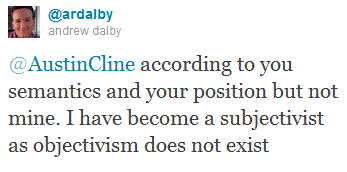
I witnessed a Twitter spat (which I want to call Twat, but had better not) between P.Z. Myers and a statistician called Andrew Dalby. P.Z. had posted a video depicting dreadful intimidation of Irshad Manji by Muslim fundamentalists, pointing out the deep distinction between militant theists and militant atheists. Incredibly, blind to the evidence of his own eyes, Dalby tweeted this:

Once again, my gast is flabbered by someone in the ongoing debate between believers and non-believers. Displaying breathtaking bigotry against a whole raft of people, Dalby says that P.Z.'s post shows that 'the atheists are just the same sort of bullies as the fundamentalists'. So that post is the equivalent of instigating a riot, or demanding someone be executed, or demanding that a book be banned. It's a remarkable claim, and Dalby doesn't appear to be a theist, so much as someone who thinks he's found a way to be superior to both atheists and theists. P.Z. called his lack of critical assessment stupid, to which he replied:


...which made me giggle. Never a good thing to proclaim one's own genius, I find. Or perhaps that's just me, since my inability to 'out intellectual' and 'out science' people has been proved regularly! He followed up with this gem:

That deserves a ROFL. Does he mean lecturers in statistics at Oxford University are automatically correct in any discussion, regardless of the subject? I mean, sure, in a discussion on statistics, P.Z. should probably defer, but in this discussion? It's not clear what relevance this factoid has to Muslim fundamentalism, or handbagging for that matter! Anyway, back to the Twitter spat, and Dalby offers:

So apparently Santayana (and only Santayana?) is foundational to humanist principles? Santayana is all well and good, and wrote much that modern day atheists would agree with, but he was famously sympathetic to Catholicism (presumably because of his background) and few modern day atheists would agree with him on that score. Of course, many theist thinkers would disagree with him on that score too! A pointless appeal to bogus philosophical authority, then. Toleration of religious belief does not entail its immunity from criticism.

I wasn't sure what had upset Dalby so much about P.Z.'s post, but it became clear in his follow up tweets:


The bit that Dalby does not like appears to be this:
...there might be much to admire in her [Manji's] work, as she’s another theist who has taken a step away from the dogma and tribalism of fundamentalism, but she hasn’t yet had the courage or intellectual integrity to take another step and free herself of the folly of faith.

So the accusation of a lack of courage and intellectual integrity is beyond the Pale, Dalby thinks, and it's wrong to tell people what to believe and that they are inferior or wrong. You will notice that he is pragmatically self-refuting here, since, among other things, he is telling P.Z. it's wrong to tell people they're wrong. Of course it's not, and we would not have morality if it were, since our morals not only guide us in our behaviour but we also feel they have a prescriptive effect on others, as Dalby demonstrates. It then becomes clear how this muddle headed thinking arises:


Oh dear; radical scepticism rears its ugly head and we're heading for the barren plains of relativism, where no-one is right and no-one is wrong. Because he's not sure what's true, nothing is true. This would be a strange philosophy if anyone lived by it, but of course no-one does.

Well, obviously objectivism exists as much as any idea does - he presumably means there is no objective truth. An unsustainable pomo position, as the exchange demonstrates, since his own entreaties would have no weight, if it were true. A tweeter called Austin Cline calls him out:


To which, of course, he has no answer, other than 'thinking is always bad for us'! It's lucky we're not all lecturers in statistics at Oxford University, else none of us would think. The ultimate source of his anger is clear, I think, from this tweet:

If there's one thing that new atheists have achieved, it's a wider acceptance that religion and faith are not privileged over other beliefs. Folk such as Dalby demonstrate that even many non-believers cling to an unthinking acceptance of this privilege that religion and faith demand. Of course we tell each other what to think about many things, and there is no good reason to exclude religion and faith from that list of things.

But finally, the outrageous equating of good faith criticism from atheists with genuinely extreme religious bullying has to be called out for the bogus comparison it is. When these sorts of befuddled accusations stop, then it might be that we're getting somewhere in reducing religious privilege.

Read more »

Friday, 24 September 2010

Nouvelle Atheism

Eurobarometer Poll 2005 Percentage of those wh...Image via Wikipedia
Caspar Melville followed up his poorly argued piece on new atheism with a report on the debate that took place between Marilynne Robinson, Roger Scruton and Jonathan Rée, with Laurie Taylor chairing. I'm reproducing here the comment I made on RD.NET.


What a waste of an evening that sounds. Accommodationists sitting round chundering about tone whilst slagging off new atheists in an even worse tone. Maybe one day they will actually come up with some action points that aren't self-defeating.
I presume Melville misspelled accommodationist because someone here did? I realise this is pedantic, but can we please get this right? M & M, like the chocolates, not one M.
I suppose it [accommodationist] means that I am prepared to debate with people who have views that are different from mine, including those who have religious belief and those who liked the film Amelie. If this is what it means, then I am, and proud of it.
No, that's not what it means, else Dawkins would be one and everyone who posts on this board. Sheesh; how do these people get paid employment? There are two meanings:
  1. An advocate of NOMA.
  2. A tone troll; someone who waffles on about tone (which is important), but doesn't present any evidence to back up why the tone they prefer is the best one, and constantly falls foul of her own tone rules. For an example, see the You're Not Helping debacle.
I suppose if you think that this really is some kind battle [sic] – between religious believers (all in one camp) and atheists (all in another) you could believe that, but I don't (in fact I think this is very dangerous view).
Plainly not, with milquetoasts about!
I'm suspicious of arguments that sound like they have discovered the Truth. They always sound too much like dogma for my taste, and if the non-believing gang is against anything, surely it's dogmatism?
Exactly; the problem with accommodationists is they are telling people what to do, based on nothing but, well, dogma, apparently. That doesn't go down well amongst genuine sceptics.
Subsequently Steve Zara made this point:
For people like Melville to moan because the arguments of theology aren't addressed in detail by people like Richard is like someone saying that complaints about the UK's national eating habits are absurd because the fine and rare dishes served at The Savoy aren't being considered. The "fine dishes" (actually a form of homeopathic cuisine - the plates look empty) of theology aren't what the vast majority consume. When people want to try and understand and deal with religion, they have to confront the everyday reality of religion.
Very true, but the problem with faitheists, accommodationists is their lack of substantive argument. It is perhaps only to be expected. Atheism itself is pretty empty, being a lack of belief; attacking it from another atheistic viewpoint has always seemed a pretty pointless occupation. So this allusion suggested to me another for those of an accommodationist bent - that of Nouvelle Atheism - a tiny serving of the right ingredients that doesn't satisfy.
Enhanced by Zemanta

Read more »

Sunday, 29 November 2009

Waterloo at Wellington for Theists


Another debate organised by Intelligence Squared, this time at Wellington College in Berkshire. The motion was 'Atheism is the new fundamentalism', proposed by Richard Harries, former Bishop of Oxford and Charles Moore, opposed by A C Grayling and Richard Dawkins. Moderated by Anthony Seldon, headmaster at the school. He's a professor at the College of Teachers. Who teaches them, one wonders. This one was streamed online, so I won't go into too much detail; I think it should be available to watch very soon.

EDIT: watch the debate here.

Outside the venue

Celeb watch; two sightings. Seventies chanteuse, Lynsey De Paul (who'd have thought?) and Jeremy Paxman.


Richard Harries

The very *motion* is an ad hominem response to atheism, in my opinion; rather than address the arguments, cast 'new' atheism (they tend to qualify the atheism) as the new fundamentalism, and consequently dismiss it as worthless. This implicit notion fed through to both Harries' and Moore's opening statements, which addressed what fundamentalism is, and why it's a bad thing (no argument from me there), but also name-called Richard Dawkins, sitting bemused opposite them. Harries called him an 'attack dog' and Moore described a scene in which 'Commandant Dawkins' would have theists all gunned down, presumably for daring to object to rational argument.

A C Grayling

The tenor of both presentations was that atheism, as represented by Dawkins, adopted a *certainty* about the truth that was not justified. I think Harries called it "not allowing for the great 'perhaps'". This seems very odd to me, because faith in god is surely about banishing doubt from one's belief - I blogged on this some time back, prompted by an article by a Catholic priest.


Charles Moore

For me, this is a straw man; whilst new atheist scientists consider that the Christian God is almost certainly non-existent, they cannot discount any god's existent, nor the existence of Russell's teapot, and Dawkins corrected them on this point. Harries made the point that The God Delusion doesn't mention the 'balance of probabilities', but chapter 4 includes quite a discussion on this. Interestingly, Grayling as a philosopher seems less bound by this scientific principle, and happily confirmed his certainty about God's non-existence. This I could only agree with if he's talking about some concept that suffers from non-cognitivism. Which might apply to God.

Richard Dawkins

After many demonstrations of good sense from Grayling and Dawkins, Harries was left grasping at the value of the numinous, as if this was the heart of the matter. Moore complained that such debates never analysed the more complicated ideas that were at issue (this after a question on consciousness, I think). A pretty vacant comment, after he had spoken for a motion that 'atheism is the new fundamentalism', an approach that is *calculated* to dismiss the arguments of one's opponents.

The final score: 363 for, 1070 against, 85 don't knows. Predictable from the feeling I got inside the hall.

Oh, and I said to Jeremy Paxman in the moving throng on the way out, 'Can I ask you how you voted?'. 'Well, there you are then', he replied, cryptically. I should have pressed him, but I imagine he gets fed up with that in public.

Read more »