Showing posts with label new atheism. Show all posts

Sunday, 10 August 2014

Some Good Old New Atheists


I've written previously that New Atheists are not new, despite their current negative reputation in the media, which appears to be driven by an overweening respect for religion. I've listed examples of older atheistic writing by luminaries such as David Hume and Bertrand Russell which show that a healthy disrespect for many religious ideas is nothing new.

In a recent edition of Philosophy Now's quarterly magazine, Barbara Smoker, (who pre-dates Dawkins et al by a number of years!) writes on the mystery of existence (behind a paywall), but on the way talks about her atheism. For example:
My years of mental turmoil before managing to rid myself of childhood theistic indoctrination entailed sufficient search – through thinking, reading, listening and debating – to last me for life. We are not expected to keep a lifelong open mind on such hypotheses as the existence of Santa Claus and the Tooth Fairy, so why should an exception be made in the case of God? That hypothesis, like those other stories for children, is merely asserted, without due evidence, by dissembling, or deluded, authorities.
Strident.

She mentions two priests who wrote about their atheism. Jean Meslier (1664-1729) wrote a Testament that was only discovered after his death. In it he writes:
Perhaps you will think, my dear friends, that in such a number of fake religions in this world my intention was at least to exclude from that number the Catholic religion, which all of us profess, and which we say to be the only one which teaches pure truth, the only one which acknowledges and worships the true God as it should, and the only one who leads men on the true way to salvation and eternal happiness. But open your eyes, my dear friends, open your eyes and get rid of everything that your pious and ignorant priests, or your mocker, self-seeking doctors, show zeal in telling you and in having you believe, under the fake pretext of the infallible certainty of their would-be sacred and divine religion. You are not more beguiled nor more abused than those who have been abused and beguiled the most. You are not less in error than those who have been the deepest in it. Your religion is not less vain or superstitious than any other; it is not less fake in its principles, nor less ridiculous and absurd in its dogmas and maxims. You are not less idolatrous than those whom you are not afraid to blame and condemn for their idolatry. The ideas of pagans and yours only differ by their name and appearance. In one word, everything your doctors and priests preach with so much zeal and eloquence about the splendour, the excellence and the holiness of the mysteries that they make you worship, everything they tell you so solemnly about the certitude of their alleged miracles, and everything they recite with so much self-confidence concerning the magnificence of the rewards of heaven, and touching the dreadful castigations of hell, are nothing but delusions, errors, lies, fictions and impostures. 
'Nothing but delusions, errors, lies, fictions and impostures'. That could have been written by Dawkins.

Then Smoker mentions Joseph McCabe (1867-1955), a priest turned atheist who wrote much on the dangers of religion. In his pamphlet From Rome to Rationalism, published in 1897, he explains why he left the church. Here he talks about faith in God:
The majority of men, little addicted to introspection, can give no reason, or only mutter a few superficial and crudely assimilated phrases, when asked for the motive of this, their fundamental belief. A theologian would say that God has provided a mysterious power, called faith, that links securely the minds of the unthinking majority to their belief. A more matter-of-fact observer would see either that they never reflect on the fact that they take this traditional doctrine with little or no proof, or that, from an instinctive feeling of the difficulty of the problem, they readily acquiesce in the most superficial arguments, or, from a confusion of the provinces of faith and reason, they consider it unlawful to indulge in speculation on the problem at all. But the more reflective, and their number is legion now, know that faith - the acceptance of a doctrine on divine authority - necessarily presupposes a knowledge of God, acquired and verifiable by rational methods.
It's plain that he sees a number of different forms of faith (as I recently discussed). McCabe writes well on the moral argument:
On the one hand, we have the inherited experience of innumerable ancestors and the deeply impressed associations of our early training pointing out certain lines of conduct as moral; on the other hand, we have the consciousness of our connection with a society from which our life derives half its happiness, the knowledge that each immoral act and habit tends to undermine a state of society which it is our supreme interest to support and develop. A mind withdrawn from the influence of religion feels no more than this; but this covers the whole ground of the moral code, and it is all we have to explain in conscience. We need no higher legislator to classify our actions, and to impose upon us a sense of obligation to abstain from immorality.
On Catholicism he writes:
But Roman theology is a masterpiece of ingenuity in exegetics. From Christ’s simple words, “Whose sins you shall retain they are retained,” the whole hideous system of the Confessional is evolved; from a medicinal remark of James comes the curious dogma of Extreme Unction; from some strong language of the sorely-tempted Paul is pressed Original Sin and Baptismal Regeneration; from the farewell supper of Christ the extraordinary doctrines of the Eucharist and the Mass, with all their complicated ceremonies; and the Immaculate Conception is proved from a stray remark in the Genesis version of an old Babylonian legend. Scripture must not be taken alone, they tell us; tradition embodies revelation with equal authority. But what is tradition? From the heterogeneous contents of the writings of the Fathers what are we to choose as revealed? Well, the Pope is infallible; but it turns out that even he has no inner revelation or positive assistance in the matter; he must be convinced from Scripture and tradition like ourselves, and it is extremely difficult sometimes to see the connection between his dogmatic conclusions and the scriptural data he alleges for them.
More stridency! Sadly, he paid somewhat for his apostasy:
With the sword of Damocles overhead, I have pursued my inquiry to the end, and avowed my convictions. And for that I stand before the world branded as a criminal by the Church of Rome. My dearest friends have abandoned me as though I were stricken with leprosy, if they did not indeed turn upon me with bitter and insulting language, for I was an apostate, and my word availed nothing against my calumniators. And this is an age of light and freedom and Christian charity. May the days soon come in which men will agree to differ on intellectual questions, and unite in social activity; when social ostracism will not be the inevitable consequence of honesty.
Every time people stand up against religion, a prejudice, perhaps born of an ingrained and unwarranted respect for religion, rears its head, and so those who dare to state their objections to religious institutions and thought come to be demonised. This is to be the fate of the new atheists, despite the fact that there is nothing about their statements and tone that is peculiar to them, as these extracts from venerable, older, non-believers show.


Read more »

Tuesday, 9 July 2013

Andrew Brown Struggles to Contain his Contempt!

The writing of Andrew Brown often comes across as contemptuous, airily dismissive and lacking in nuance. To be charitable, I assumed this was a fault in his writing; after all, being contemptuous, airily dismissive and lacking in nuance is the sort of criticism he regularly levels at Richard Dawkins and any other 'new atheists' who offend him.

I have to take this back, however; his writing is not at fault. It turns out that his articles brilliantly capture his entire aspect:


Brown looks like someone has left a turd in the seat across from him, but it's only the mild-mannered moderate wing of new atheism, Daniel Dennett. Imagine if it were Dawkins himself! All four horsemen might make him faint; a photo of Hitchens could stand in for the great man and no doubt out-think Brown.

To be fair, upon seeing this video Brown realised what it showed:


It's strange that someone does not see the problem of contemptuously condemning contempt. Among many other things that upset him about Dawkins, it is his contempt for religious beliefs that he finds troubling:
The really extraordinary thing is ... that he supposes that displays of naked contempt are the way to win over agnostics.
Not for the first time, Andrew Brown is guilty of hypocrisy.


Read more »

Sunday, 21 April 2013

What Does it Matter What One Believes?


As a 'new atheist', Richard Dawkins has been subjected recently to a campaign by right-on lefties who want to stifle criticism of Islam. Their unfortunate modus operandi is to devalue the notion of Islamophobia; the reprehensible practice of unfair discrimination against Muslims.

Maybe first was Nathan Lean on Salon.com, who said, with nothing to support it other than new atheist criticism of Islam:
The New Atheists became the new Islamophobes, their invectives against Muslims resembling the rowdy, uneducated ramblings of backwoods racists rather than appraisals based on intellect, rationality and reason.
He even immediately followed this crass accusation with an example proving himself wrong:
"Islam, more than any other religion human beings have devised, has all the makings of a thoroughgoing cult of death,” writes Harris, whose nonprofit foundation Project Reason ironically aims to “erode the influence of bigotry in our world.”
Go figure. Murtaza Hussain produced a febrile piece on the usually more temperate Al-Jazeera website sensitively titled Scientific racism, militarism, and the new atheists that included this on Dawkins's fellow horseman Sam Harris:
Harris engages in a nuanced version of the same racism which his predecessors in scientific racism practiced in their discussion of the blanket characteristics of "Negroes". 
New atheists, of course, are the nasty and militant ones for objecting to the baleful influence of Islam, not Hussain for accusing of racism Harris and everyone who has been tarred with the new atheist brush. Go figure.

Then liberal commentator Glenn Greenwald tweeted this nonsensical article approvingly and got into a spat with Harris himself, who understandably thought that someone of a liberal persuasion would object to Hussain's wild speculations and mistaken inferences:
I’ve had pleasant exchanges with Greenwald in the past, so I wrote to him privately to express my concern. As you will see, I came right to the point. I was simply outraged that he would amplify this pernicious charge of racism so thoughtlessly. However, I am even more appalled by his response. The man actually has thought about it. And thinking hasn’t helped.
Other faitheists and theists have taken the opportunity to jump on the bandwagon: the laughable Theo Hobson, a mythicist called Neil Godfrey, and, one of the usual culprits, Andrew Brown, suggests Dawkins should stop pouring scorn on the Muslim belief in creationism:
However, this is where Dawkins' scorn does some real damage, even among people who have never otherwise heard of him. Because there is a self-consciously oppositional culture among young poor Muslims, who feel themselves stigmatised and disadvantaged, they can tend to embrace creationism simply because they know it's wrong by the lights of the majority. Dawkins' dismissal of Muslim creationism as "alien rubbish" was not only found as a YouTube clip on the EDL website for a while, but also used in the propaganda of Harun Yahya, the Turkish creationist and self-publicist. The emotional logic is clear: if this rich, sneering white man is against it, it must be good for disaffected young Muslims who feel that they are themselves treated as "alien rubbish".
The logic here is stunningly thoughtless; presumably Brown thinks Dawkins should continue to ridicule Christian creationism (Brown did, after all, call creationists in Northern Ireland a 'crank group' and compared them to saucer-cultists and leprechaunists), but refuse to ridicule Islamic creationism? But that would indeed be discriminating against Muslims unfairly. To pull one's punches against one religion would be simply unfair on its congregation, who deserve, and should expect, to have their beliefs exposed to the same ridicule and scorn as everyone else's.

Today Dawkins tweeted about Mehdi Hasan who, apart from being a pretty good journalist in other respects, I understand, also believes in a winged horse. This is a belief worthy of ridicule; and scientific ridicule at that, since evolution shows that mammals have four limbs and such a horse is usually depicted as having six limbs. Oh, but of course it's a magic horse from heaven, so evolution is irrelevant, believers would say, which just increases the risibility of the belief for anyone who doesn't believe in magic horses from heaven.

So far, so Dawkins. But then Labour MP Tom Watson, stalwart of the anti-Murdoch campaign, replied:


On the face of it, Watson thinks that pointing out someone's silly belief makes one a 'gratuitously unpleasant man'. Watson, a man not known for his tenderness, thinks Dawkins could 'try a little tenderness'! Well, that certainly made me laugh. However, I guess Watson saw what a daft thing this was to say, so he changed his focus to Dawkins's second sentence:


His first complaint was clearly about Dawkins's tone, but now he straw-mans Dawkins by translating "And New Statesman sees fit to print him as a serious journalist" to "people with faith cannot contribute to civic society with their journalism".

This is dishonest, but does show something important; the reason Watson feels free to defend the winged horse belief is because it's a religious belief. And, possibly more importantly given the recent hysteria, a Muslim belief. If Dawkins was ridiculing saucerists or leprechaunists, I doubt Watson would intervene. This is supported by a later tweet:
This is not what Dawkins said, of course, but it does raise interesting questions of how much one's beliefs might discredit one. Plainly in society today, religious beliefs that are worthy of ridicule are nevertheless protected from ridicule because they are religious. Religious beliefs, particularly Christian ones, are given credibility by society's attitudes to them. They are still afforded platforms in the press and television media, including the BBC; religious leaders bypass democracy and are allowed a central role in law-making; the Church of England is central to the UK's constitution. Given this, it would bring the entire establishment into disrepute if Dawkins's attitude became the norm, in Parliament, the press and the broadcast media. But that is really the aim of the so-called new atheism; to strip religion of its privileged position, and let its ideas swim in the free marketplace of ideas.

Add to this the unfortunate conflation by left-wingers of Islamophobia with valid criticism of Islam, and we can see why Watson felt the need to intervene. He is a political animal, and prioritises protection of Muslim individuals because he sees politics as more important than religion. On this he may be right, and his aims are laudable. It seems plausible that some racists do adopt the pose of Islamic criticism as a route to the othering of Muslims. Sadly, these recent articles are attacking the wrong target, so they will make the task of combating genuine Islamophobia more difficult.

Interestingly, Watson actually thinks that what one believes should disqualify one from the public forum; this is what he said about shock jock Glenn Beck:
The Glenn Beck show in no way achieves those vitally important aims. That type of journalism is dangerous and can have wide-ranging negative effects on society. The kind of material broadcast by Glenn Beck is not unique; a number of other "shock jocks" operate in the States. However, none has displayed intolerance on such a frequent and irresponsible scale as Glenn Beck. It is vital that that kind of "news" is not made or broadcast in the UK. However, the proposed acquisition of BSkyB by News Corp means that there is an increased threat of its becoming a reality. (my emphasis)
Now to be fair, Watson is attacking the content of Beck's journalism here, not his beliefs directly. But the content is informed by Beck's beliefs, and I think Hasan's recent interview with Dawkins shows that his beliefs clearly influence his contributions to the public forum (negatively). My feeling is that it is fair to point out when someone believes something ridiculous; Bill Maher has curious ideas about vaccines, Michael Shermer is way too libertarian for my liking, and Sam Harris is just plain wrong on gun law and, probably, moral objectivity. Does this discredit their other pronouncements? Yes, I think it does to a degree, but not necessarily fatally; it depends on the belief. Some beliefs are just sillier than others. Creationism is sillier than the (still silly) theistic evolution. Winged horses are sillier than golden plates, even.

Given that, I think it's fair to wonder aloud if a reputable organ like the New Statesman should publish Hasan as if he were a serious thinker, which I think a serious journalist should be.

Look at it this way; Dawkins is suggesting that if Mehdi Hasan believed in alien lizards, like David Icke, the New Statesman would not continue to publish his journalism without comment. Does Hasan's credibility suffer by his beliefs? I think, like Beck's, and Icke's, it does.

UPDATE:

Blimey, true to form Andrew Brown writes another incoherent piece with the Islamophobic slur in the URL, in which he says "On Sunday afternoon [Dawkins] was at it again, wondering why the New Statesman employs an imaginative and believing Muslim". Dawkins did not wonder that, of course, as anyone who reads the tweet can see. Brown's attack is confused - he wants to call Dawkins Islamophobic but admits:
Anyone who follows him knows he is an equal opportunities bigot who is opposed to Christians of every colour as well.
So a person is a bigot now even if they don't discriminate in their opprobrium! Someone contact the OED. As I say above, the insidious effect of this sort of nonsense is that language becomes debased and we cannot identify genuine bigots for what they are.


Read more »

Thursday, 2 February 2012

Religious Goggles


Richard Dawkins has written a piece on Salman Rushdie's non-appearance at Jaipur, linking it to Nick Cohen's new book - You Can't Read This Book: Censorship in an Age of Freedom. The article is excellent, and the last quote from Nick Cohen is bang on the money about the many accommodationists who complain about "Richard Dawkins and his ilk":
The complaints boiled down to a simple and piteous cry: “Why can’t you stop upsetting them?”
Some have compared faith to a drug, and it does seem to me that, just as some people don the beer goggles at the end of an evening in the pub, some set aside their reading glasses and replace them with 'religious goggles' when they read the new atheists. The goggles are available in a variety of styles, for believers and non-believers alike.

Ophelia Benson has been discussing a case which I think illustrates this inability some have to see vocal atheists in a reasonable light because of these goggles; the blogger in question misrepresents the atheist desire for theists to see the error of their ways as an insistence that theists 'convert' to atheism. During the course of his piece he conflates proselytising with forced conversion, and so pronounces it 'evil'. Accommodationists often compare new atheists to religious fundamentalists, which betrays a similar goggle-induced error. I would be surprised if anyone did not want others to agree with them; at least, I'm sure most of us think that, which, seen through some accommodationist goggles, becomes evil proselytising, on a par with the most aggressive religious fundamentalism. But the goggles are only worn, apparently, for religious discourse; similar arguments on political or cultural matters are enthusiastically joined. It's a genuinely barmy misfire of the brain, I think.

It's all the more infuriating because I think some incoherent accommodationist posturing might be coming from a good place. That good place is the value of diversity and a distrust of conformity to some all enveloping 'truth'. Through Mill, Orwell and Isaiah Berlin, for example, the Western tradition has become wary of an authoritarianism which tries to force an idealised truth on people for their own good. All fine and dandy - I value a diversity of opinion and debate too, as a method for uncovering the truth, finding better ways of living and resisting totalitarianism. But that doesn't mean that there are many truths, and we should all be relativists. And, more to the point, no-one is a relativist on most matters under discussion in the public square. It mainly rears its head when people reach for the religious goggles.

Coincidentally another 'accommodationist' of sorts, Julian Baggini, has just had an article published arguing his position against some critics of religion (I think it's safe to say he means 'Dawkins and his ilk'). He doesn't appeal to diversity or multiculturalism, but draws an analogy between religion and the family, to support a softly-softly approach:
I think there is a lesson here for atheist critics of religion. No one wants outsiders trying to break up their families, even when they recognise all its faults. Too often we heathens play the role of over-invasive social services, sometimes quite literally worried about child protection. But if we think a religion is a problem, we might do better to take on the role of family therapists, trying to lead them to see that certain members are behaving in unacceptable ways. Sometimes that does mean challenging false beliefs, but it never means treating doctrines as though they were free-standing claims that can be dissected irrespective of the role they play in the family dynamic. This approach won't necessarily make us the most welcome of guests, but it might mean we at least get a hearing at the table, and find some allies there.
The family analogy seems plausible to me, and goes some way to explain resistance to argument. I'm not sure this is any different to other families, however, such as political or footballing ones, and he wouldn't be shy about arguing with those beliefs, would he?

Leaving that aside, sure, many people don't want outsiders to break up their families. But some do, and for good reason. They're vulnerable and not in a position to assert their autonomy. If such people exist, then it would be our duty to intervene. The problem with disallowing a more vocal expression of disagreement with religion is that you are placing the value of this notional family above the individuals in it. That's not fair on them, in my opinion.

I approve a multi-faceted approach to combating harmful beliefs, and I've yet to read an accommodationist piece that has argued persuasively, with evidence, to make me think that vocal criticism of religion should not be one of those facets.


Read more »

Wednesday, 25 January 2012

Are Atheists Bullies?


The recent kerfuffle at UCL prompted by overly sensitive religious sentiment has caused a number of folk to say that atheists are bullies, often comparing them to religious fundamentalists. At RichardDawkins.NET there was a rather incoherent poster called Griswold Grim who made the 'bullying' claim, but he never substantiated it, beyond railing against ridicule.

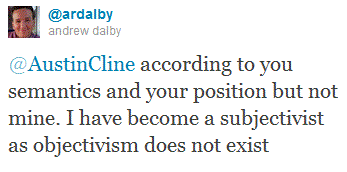
I witnessed a Twitter spat (which I want to call Twat, but had better not) between P.Z. Myers and a statistician called Andrew Dalby. P.Z. had posted a video depicting dreadful intimidation of Irshad Manji by Muslim fundamentalists, pointing out the deep distinction between militant theists and militant atheists. Incredibly, blind to the evidence of his own eyes, Dalby tweeted this:

Once again, my gast is flabbered by someone in the ongoing debate between believers and non-believers. Displaying breathtaking bigotry against a whole raft of people, Dalby says that P.Z.'s post shows that 'the atheists are just the same sort of bullies as the fundamentalists'. So that post is the equivalent of instigating a riot, or demanding someone be executed, or demanding that a book be banned. It's a remarkable claim, and Dalby doesn't appear to be a theist, so much as someone who thinks he's found a way to be superior to both atheists and theists. P.Z. called his lack of critical assessment stupid, to which he replied:


...which made me giggle. Never a good thing to proclaim one's own genius, I find. Or perhaps that's just me, since my inability to 'out intellectual' and 'out science' people has been proved regularly! He followed up with this gem:

That deserves a ROFL. Does he mean lecturers in statistics at Oxford University are automatically correct in any discussion, regardless of the subject? I mean, sure, in a discussion on statistics, P.Z. should probably defer, but in this discussion? It's not clear what relevance this factoid has to Muslim fundamentalism, or handbagging for that matter! Anyway, back to the Twitter spat, and Dalby offers:

So apparently Santayana (and only Santayana?) is foundational to humanist principles? Santayana is all well and good, and wrote much that modern day atheists would agree with, but he was famously sympathetic to Catholicism (presumably because of his background) and few modern day atheists would agree with him on that score. Of course, many theist thinkers would disagree with him on that score too! A pointless appeal to bogus philosophical authority, then. Toleration of religious belief does not entail its immunity from criticism.

I wasn't sure what had upset Dalby so much about P.Z.'s post, but it became clear in his follow up tweets:


The bit that Dalby does not like appears to be this:
...there might be much to admire in her [Manji's] work, as she’s another theist who has taken a step away from the dogma and tribalism of fundamentalism, but she hasn’t yet had the courage or intellectual integrity to take another step and free herself of the folly of faith.

So the accusation of a lack of courage and intellectual integrity is beyond the Pale, Dalby thinks, and it's wrong to tell people what to believe and that they are inferior or wrong. You will notice that he is pragmatically self-refuting here, since, among other things, he is telling P.Z. it's wrong to tell people they're wrong. Of course it's not, and we would not have morality if it were, since our morals not only guide us in our behaviour but we also feel they have a prescriptive effect on others, as Dalby demonstrates. It then becomes clear how this muddle headed thinking arises:


Oh dear; radical scepticism rears its ugly head and we're heading for the barren plains of relativism, where no-one is right and no-one is wrong. Because he's not sure what's true, nothing is true. This would be a strange philosophy if anyone lived by it, but of course no-one does.

Well, obviously objectivism exists as much as any idea does - he presumably means there is no objective truth. An unsustainable pomo position, as the exchange demonstrates, since his own entreaties would have no weight, if it were true. A tweeter called Austin Cline calls him out:


To which, of course, he has no answer, other than 'thinking is always bad for us'! It's lucky we're not all lecturers in statistics at Oxford University, else none of us would think. The ultimate source of his anger is clear, I think, from this tweet:

If there's one thing that new atheists have achieved, it's a wider acceptance that religion and faith are not privileged over other beliefs. Folk such as Dalby demonstrate that even many non-believers cling to an unthinking acceptance of this privilege that religion and faith demand. Of course we tell each other what to think about many things, and there is no good reason to exclude religion and faith from that list of things.

But finally, the outrageous equating of good faith criticism from atheists with genuinely extreme religious bullying has to be called out for the bogus comparison it is. When these sorts of befuddled accusations stop, then it might be that we're getting somewhere in reducing religious privilege.

Read more »

Tuesday, 3 January 2012

The Tall Tales of Hoffmann

"Hic!"
I'm not sure if this Hoffmann's first love was Olympia, the automaton, (or was it Ophelia? She's certainly no automaton.) or if his further loves were Antonia and Giulietta, but there is more than a whiff of the old Hoffmann about this New Oxonian. It's as if some gnu atheist Lindorff has gone off with his Stella,  leaving him drunk in the tavern crying into his beer, "Muse whom I love, I am yours!". I've been that drunk too, though in humbler company than Hoffmann. He certainly loves the Muse, but perhaps he has spent too long musing while nimbler, more successful courtiers of Stellar Street have taken the plaudits and bouquets. That seems to be part of the complaint (h/t Screechy Monkey):
Part of that has to do with (as I suggested) a record that goes back long before most Americans had heard of Richard Dawkins. Some of us older and old atheists remember what a lonely battle that was. Many who came to the movement since 2000 will not. And that is precisely the pojnt. Without saying jealousy is involved, there are many (not just me) who know that the Dawkins revolution could not have taken place without th almost invisible work of many of my associates in and out of the academy over many many years. On the one hand, we need to be grateful that the New Atheists have been successful in garnering support; on the other hand, and I know this from experience, nothing ensured the death of a book in this country before 1995 like putting the word atheism or humanism in the title. So, there were laborers in the trenches.
But in his latest offering he is far from a-musing, letting off at every gnu he can think of, like a drunk sending texts to former lovers. He starts off with the usual suspects and regurgitates well-worn non-arguments against the Four Horsemen (three of whom he might call Gnu Oxonians?). Interesting that he seems to admire Hitchens the most ("the only true intellectual and by far the best-read of the group"), since Hitch's arguments were always the worst of the four, even if his polemics were the best. More ire is aimed at the gnu bloggers who dare to offer an opinion on religion that has not been informed by years of study in the Divinity School at Harvard. He starts with Jerry Coyne, quoting him comparing religion to leprechauns in their compatibility with science, to which he responds:
Just a flash: While leprauchauns didn’t copy the books that were turned into the books that led to the science Dr Coyne eventually studied, monks and rabbis did. Why does the perfectly reasonable opposition to religious craziness have to descend to this caricaturing of the history of religion?
Strange, isn't it, that religion has morphed into the history of religion? What a befuddled argument. It's difficult to know what Hoffman's point is here. Is it that a deep and complex history justifies an ontology? But Coyne doesn't deny religion's history. It's as if he thinks the involvement of religious people in the history of science invalidates the Conflict Thesis, but none could be that dumb. Leprechauns don't exist so they couldn't have copied early science books, so Hoffmann's comparison doesn't work. Coyne, on the other hand, is pointing out that religion is a superstition, like leprechauns, not that religion doesn't exist, or, even more foolishly, that the history of religion doesn't exist or isn't complex. Hoffmann's argument wouldn't pass muster at infant school, sadly, let alone any philosophy department.

A Gish Gallop of mud-flinging follows, aimed at PZ Myers ("If ever atheism got dumber and less impressive, it is in the work of this dissolute insult- monger"), Greta Christina ("She sees everything as a weird sexual joke"), Ophelia Benson ("...has turned her once-interesting website (I used to contribute regularly) into a chat room for neo-atheist spleen"), Eric MacDonald ("doesn’t seem to know bloody anything about the academic study of religion") and Jason Rosenhouse ("I sometimes wonder why people whose only contribution to blogdom consists of sentences like “Most religious rituals leave me beyond cold,” find themselves titillating?"). Like one or two other misguided critics of new atheism, Hoffmann is often pragmatically self-refuting!

But Hoffmann has an illustrious history, if not an illustrious future, so I do wonder what has got under his skin so much about people who aren't guilty of the things he thinks they're guilty of. Apart from the self-confessed jealousy above, he gives a clue to one of his concerns in a comment below his latest rant:
The new atheists don’t oppose the study of religion. Not true: in fact the famous “Pinker Intervention” at Harvard in 2006 prevented religion from becoming a part of Harvard’s core curriculum, on the premise there was no difference between theology and religion-studies, though Harvard was the first university in America to introduce such study in the 1930′s, apart from its Divinity School. Read all about it here: http://www.somareview.com/godandmanatharvard.cfm Stephen Pinker (who is far more considerate of religion in general) is not the issue here, btw; a number of the newbies have gone on record as saying that the study of theology does not belong in a university, though in some places like Harvard, Yale, and Chicago, this would mean closing down their divinity schools where the study of religion is alive and well. That’s half the problem: the other half is that rank amateurs like the newbies have already pronounced their verdict on such study by mixing up the objectives. Frankly if this confusion is any indication of the state of their information, they’d better hold off on the God thing for a few years. If you want to see the nadir of this imbecilic conversation, here you go:http://www.newstatesman.com/2011/06/dawkins-myers-religion-faith

Interesting. The New Statesman piece compares religion to knitting, which is presumably what upsets Hoffmann, but this is nothing more than Myers's view of what religion's status should be in society, not a judgement of its historic worth, I think. Despite people like Dawkins and Hitchens regularly supporting the study of religion, he genuinely believes they don't, and his evidence is the "Pinker Intervention" and a throw away remark from one of the more strident new atheists. I'm not familiar with the background to the Pinker story, so it would be good to hear some more about this other than what Hoffmann's written, cloaked in dense references as it is ("Pinker Intervention" throws up just one link on Google, to Hoffmann's piece).

So maybe his concern is that divinity schools should not be closed down? But opposition to divinity schools is not opposition to the study of religion, so it's still not clear why he is so exercised about this. In the piece he links to, about the study of religion at Harvard, he says:
In short, all the wrong reasons for studying religion—because it is popular, widespread, and personally significant—triumph over the good reasons for studying it.
I confess, though, that I'm not clear from the piece what the good reasons are for studying it. I could guess at a few. Hoffmann does say earlier:
But religion puts itself forward as something that ought to be studied in its own right, not because in doing so the student learns to value its influence or validate its claims, but so that the student will be able to evaluate it within a particular analytical frame of reference. And it is in providing that context that Harvard excels.
This may be true, but it does not go any way to justifying separate divinity schools - religion can still be studied in its own right without that - so I'm still left struggling to understand the nature of Hoffmann's complaint, once again. Unless he thinks that the only frame of reference that is sufficient for good religious study is in divinity schools? Maybe, but he would have to be clear why he thinks this, or it's just special pleading for religion; something that new atheists are (obviously) against.

I dare say he has other complaints; if only he could write clearly, without so many distracting straw men and errors of fact, then we might have a better chance of understanding them. Maybe one day he'll sober up and tell us fellow drunkards what he means.

Read more »