Showing posts with label philosophy. Show all posts

Saturday, 3 February 2018

Aristotle at the Seaside

© http://www.visitthepast.co.uk/blackpool-tower-from-north-pier
In 1868 the South Jetty in Blackpool was opened in an attempt to keep the hoi-polloi away from the genteel North Pier; it was “the first major commitment of resources to pleasing this more plebeian public” (quoted in Chant, 2008, p.156).  This charming sentiment marks a new start for the seaside holiday, with activity-based attractions vying with the rather more sedentary approach favoured before that time. The new pier offered cheap pleasure cruises and all day dancing. A brief examination of secondary sources on Aristotle (384–322 BCE) suggests he might not value the more robust pleasures on offer; for example, Jonathan Barnes says Aristotle thinks that:
To flourish, to make a success of life, requires engagement in intellectual pursuits.  (Barnes, 2000, p.125)
...and Carolyn Price, answering the question “What is the best way to use one’s leisure?”, concludes that Aristotle’s answer is “intellectual reflection” (Price, 2008, p.19).

The South Jetty was later renamed the Central Pier and a new pier, the Victoria (now called the South Pier) was opened in 1893; as its regal name suggests, this was also aimed at the more upmarket clientele, and it banned dancing. So Blackpool had the North Pier and the Victoria Pier for what might be considered the higher pursuits, and the Central Pier for the more vulgar seaside attractions. A late Victorian textile worker may well have stood on the promenade at Blackpool and wondered at the two to one overprovision of Aristotelian diversions to Epicurean ones. Although perhaps it’s unlikely the worker would have thought so classically. (Very briefly, Epicurus, 341–270 BCE, favoured activities that felt good for promoting well-being (Price, 2008, p.27), so he and Aristotle oppose each other in a centuries old dialogue between the active and contemplative ways of life, that continues today.)

A class-based analysis of Aristotle’s philosophy of leisure is also suggested by these developments at the seaside, in addition to his rather rude dismissal of the ‘vulgar’ mass of men in the Nichomachean Ethics (1095b19-20). I shall discuss this more later, after considering support for the views quoted above from Aristotle’s own writings.

For Aristotle, eudaimonia, or human flourishing, is the ultimate objective of human life – the state to which we all aspire – and this is inextricably linked to certain activities, specifically leisure, which have no aims but themselves:
‘For, let me emphasise once again, leisure is the foundation of all that we do. Both leisure and work are necessary, but leisure is to be preferred to work, and is its aim.’ (Politics 1337b33-34, in Price, 2008, p.32)
So leisure is our aim, but what sort of leisure? To answer this, Aristotle asks: what is our function? He thinks that things, animals and humans have functions, and, that the expression of each thing’s distinctive function is the activity which perfectly expresses its being, and that activity must be valued as an end in itself. For example, a good hammer would be one that hammers nails well. In the Nicomachean Ethics he applies this ‘function argument’ to human beings:
‘What then might the human function be? Simply living seems to be something that we share with plants. But what we are looking for is something distinctively human. (...) What remains is the exercise of reason. [...] So the function of a human being is to engage in activities that use or are governed by reason.’ (Nicomachean Ethics 1097b33-1098a8, in Price, 2008, p.32)
He concludes that a good man would be one that reasons well, so it’s safe to assume that this teleological view of the world is what would drive his judgement on leisure activities, and this supports the quotes above, from secondary sources, that he would most value intellectual pursuits. With this in mind, we can consider how he would have viewed some seaside holidays, ancient and modern.

In antiquity, seaside Roman villas were popular with high born citizens at leisure. In Pliny the Younger’s (61–c.112 CE) description of his villa on the West coast of Italy at Laurentum, he says:
Round the corner is a room built round in an apse (...)  with one wall fitted with shelves like a library to hold the books which I read and read again. (...) When I retire to this suite I feel as if I have left my house altogether and much enjoy the sensation: especially during the Saturnalia (...) for I am not disturbing my household’s merrymaking nor they my work. (Pliny the Younger in Radice, 1969, in James, P, and Huskinson, J., 2008, pp91-93)
The whole piece emphasises the villa as Pliny’s sanctuary, with phrases such as ‘profound peace and seclusion’ and ‘retreat’ included. This conforms to the Roman idea of otium – leisure – in opposition to negotium, the business and public duties of everyday life. Even if he was exaggerating the contemplative aspect of his villa for public consumption, we can conclude that the Roman ideal for leisure, among the upper echelons of Roman society in which Pliny moved, was intellectual reflection. It’s evident that he also finds something about the seaside situation conducive to reflection – he remarks on how the rooms integrate with the villa’s surroundings.

Further evidence for this intellectual leisure ideal can be found in mosaics found in Roman villas; many images from classical mythology are depicted to give the impression of a cultured property owner, reflecting highbrow interests. In the seaside Romano-British villa at Brading, for example, amongst many other mythical characters we find an unusual roundel of Medusa:
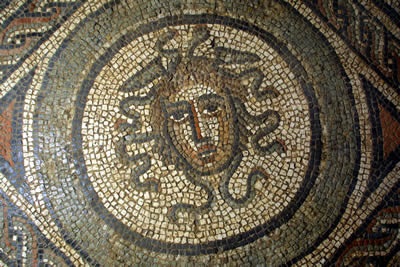


(Image from Roman Villa DVD, 2008)

Mosaics of Orpheus, Bacchus and other Roman gods and goddesses fill the rooms. And many similar characters and scenes from mythology have been found in the ruins at Pompeii. Because of this preponderance of scholarly subjects, Aristotle would find much to approve of in a visit to a Roman villa. The signs are not all one way, however; the Brading mosaics perhaps include the depiction of a gladiator, referring to the games put on in large stadia to entertain the masses in Roman cities. This might not meet with Aristotle’s approval so readily.

For a later seaside example, let us consider the introduction of sea bathing in the eighteenth century. Bathing doesn’t appear to meet the requirements for Aristotle’s ideal leisure activity – it’s not a uniquely human activity nor could it be said to be solely enjoyed for its own sake. The humoral system was the prevailing theory of medicine for many centuries, and the practice of sea bathing arose at a time when this theory still had some credibility, and perhaps as a consequence doctors began to recommend a medicinal dunking for some of their patients. Its persistence in popular culture is notable; bracing sea air and the benefits of paddling in ice-cold Atlantic waters were recommended to me by my mother in the 1960s!

It’s not really the case that bathing per se is health-giving, but empirical enquiry shows that vigorous activity of any kind promotes health. A contradiction is suggested here in Aristotle’s philosophy; we have an activity that promotes well-being but which isn’t, apparently, the ideal leisure activity. This can be resolved by observing that Aristotle would probably not dismiss bathing as worthless; it has medicinal value, even if it’s not the ultimate reason for being, so it cannot be the most valuable leisure activity.

Returning to the battle of the piers in nineteenth century Blackpool, Aristotle does rather dismiss the simple pleasure-seeking (dancing, games) in which many indulge:
To judge from the lives that men lead, most men, and men of the most vulgar type, seem (...) to identify the good, or happiness, with pleasure; (Nichomachean Ethics, 1095b14-16)
And because the vulgar lead a life pursuing pleasure, and are ‘slavish in their tastes’ (Nichomachean Ethics, 1095b19-20), it follows that this cannot be the epitome of what it is to be human, Aristotle reasons. In the Politics, however, we can deduce some value from play:
So we need to consider what we should do with our leisure. (...) Rather, play is needed by those who are hard at work and who need to rest from their labours, for the point of playing is to rest. Work involves labour and exertion, and so we should make room for play at the right times, applying it as a kind of medicine. (Politics, 1337b35-43, in Price, 2008, p.32)
The nineteenth century saw an explosion in concentrated populations of labour, thanks to the industrial revolution; this would have generated a demand for an antidote to the lives of drudgery led by most people week in and week out. The technology of the industrial revolution, such as railways and funfairs, together with the means to power them, helped to satisfy this demand. Scenes like this, photographed at Blackpool Central Railway Station in 1937, became commonplace:


  (Chant, C., Figure 4.18, 2008, p.154)

Since society was comparatively free (no slaves!), Aristotle could have predicted that this explosion of work would lead to a burgeoning of leisure activities that are, in his terms, medicinal rather than ideal (in his view). Dancing, fun fairs, bathing, crazy golf are all valid leisure activities from this viewpoint, and Aristotle would see the value in them. As a consequence, at Blackpool we see a move from a gentle, contemplative, middle class seaside holiday, for folk looking for the intellectual life of leisure, to a more active, pleasure-seeking, working class seaside holiday. And, for a more modern example, in the twentieth century we see a similar evolution in the resort of Benidorm. A quaint and peaceful Spanish fishing port, popular with the well-to-do, develops into a destination for the ‘fun-loving’ Brits, seeking sun, sea, sand and sex. Whilst Aristotle might have denigrated what the masses sought out, I think he would concede some value in them.

Despite these developments, Aristotle’s ideal was still part of popular culture. In 1918 Fred Gray produced this postcard, making explicit the contrast between workers’ everyday lives and their putative escape:


  (Chant, C., Figure 4.17, 2008, p.152)

The couple at the bottom, on an improbably deserted beach, may well have achieved eudaimonia. It’s to be hoped, for Aristotle’s sake, that the gentleman puffing on a cigarette is pondering the human condition; but the lady with a book open on her lap is surely fulfilling the ideal, once she stops posing. Sun bathing became fashionable in the twentieth century, and shortly after acquired a healthy connotation, with news that vitamin D from the sun was an important contribution to health. From this time, for our purposes, it can be compared to sea bathing – a valuable medicinal activity without being Aristotle’s ideal. Before that, he may well approve of folk simply lying on the beach, cogitating or reading like the couple above.

To consider a more recent, but perhaps atypical, seaside activity, I shall look at the Mods in the 1960s, when I was freezing my toes in Ilfracombe. The Mods were a teenage subculture defined by their fashion, music taste and leisure choices, and, because of those choices they often clashed with another subculture, the Rockers. Trips to the seaside on the Mod’s trademark Lambretta scooters regularly resulted in clashes with their arch enemies, and if Aristotle noticed that their leisure time was spent “going to clubs, taking amphetamines, dancing to certain types of music” (Jones and Danson Brown, 2008, p.188), he might not be surprised that this didn’t result in a sense of well-being, since they aren’t the activities that he would identify as the best way to spend one’s spare time. The Who’s rock opera Quadrophenia is a paean to the disturbed youth of that period; the hero is mentally ill and this is reflected in the film’s use of the seaside location. However, a line in the song “Bell Boy”, from the Quadrophenia album, suggests a link to Pliny the Younger’s more obviously healthy experience of the seaside location:
A beach is a place where a man can feel/He’s the only soul in the world that’s real. (quoted in Jones, N. and Danson, R., 2008, p.193)
This sentiment also harks back to Fred Gray’s postcard depiction of the beach (above), and points to a unique quality that the beach may have which helps us to achieve well-being.

To conclude, we’ve seen how Aristotle would find much to value in seaside holidays down the ages, even if he might not think it all ideal. The modern vogue is moving away from his ideal of intellectual reflection, catering as it does for entertainment of the masses, although many still value the thoughtful life. The basis for Aristotle’s analysis, founded on what a human being is, might be a naturalistic fallacy, and since modern science has shown that there is no need to posit a teleological life, his conclusions could be attacked. Further, I cannot agree with his attitude to the mass of humanity. But even if we have no ultimate purpose, it’s important to create our own purposes, and so Aristotle’s ideas still intrigue, and can inform our own choice of seaside holiday.

Bibliography:
Barnes, J. (2000) Aristotle: A Very Short Introduction, Oxford, Oxford University Press.
Price, C. (2008) ‘Aristotle and Epicurus on Leisure’, in Brunton, D.  (ed.) Place and Leisure (AA100 Book 4), Milton Keynes, The Open University, pp. 10-34
James, P. and Huskinson, J. (2008) ‘Leisure in the Roman Villa’, in Brunton, D.  (ed.) Place and Leisure (AA100 Book 4), Milton Keynes, The Open University, pp. 65-96
Faire, L. (2008) ‘Dressing for the Beach’, in Brunton, D.  (ed.) Place and Leisure (AA100 Book 4), Milton Keynes, The Open University, pp. 131-145
Chant, C. (2008) ‘Technology and the Seaside: Blackpool and Benidorm’, in Brunton, D.  (ed.) Place and Leisure (AA100 Book 4), Milton Keynes, The Open University, pp. 147-168
Brunton, D. (2008) ‘The Healthy Seaside’, in Brunton, D.  (ed.) Place and Leisure (AA100 Book 4), Milton Keynes, The Open University, pp. 169-182
Jones, N. and Danson, R. (2008) ‘Seaside Music: The Beach Boys and the Who’, in Brunton, D.  (ed.) Place and Leisure (AA100 Book 4), Milton Keynes, The Open University, pp. 183-204
Aristotle (2001) Nicomachean Ethics (trans. W.D. Ross), The Basic Works of Aristotle, New York, The Modern Library, pp. 935-1126.
‘Roman Villa’ (2008) (AA100 DVD), Milton Keynes, The Open University
‘The Seaside’ (2008) (AA100 DVD), Milton Keynes, The Open University
Brunton, D. (2008) ‘From Greece to the Middle East to Europe: The Transmission of Medical Knowledge’, in Danson Brown  (ed.) Cultural Encounters (AA100 Book 3), Milton Keynes, The Open University, pp. 151-189

Read more »

Saturday, 9 June 2012

Christian Philosophy


In William Lane Craig's latest newsletter, talking about a recent visit to Hungary, he says:
A senior Norwegian philosopher joined me for lunch one day to share his story. He told me that he had long been a Christian, but his faith was completely privatized. As a professor of philosophy at a secular university, he never told his students that he was a Christian nor did he make any attempt at all to integrate his Christian faith with his discipline. He then fell into a deep depression, which lasted about two years. During that low time, unable to do any productive work, he began to listen to my Defenders podcasts, which he came across on the internet. As a result of listening to the class, he came to realize that he could do Christian philosophy, an idea which had never crossed his mind. Coming out of the depression, he decided to change everything in his teaching. He now announces to his students that he is a Christian and that he will offer a Christian perspective on the philosophical issues under discussion in his classes. He makes no apologies for taking this bold approach. He not only has Intro level classes of around 350 students, but he also supervises Ph.D. students in philosophy at this secular Norwegian university! Can you imagine the impact that will have on the future of the university environment in Norway?
I was puzzled why doing 'Christian philosophy' had 'never crossed his mind. Never? This seems an odd thing to say, since plainly there are Christians out there doing it, such as William Lane Craig himself, Alvin Plantinga, Richard Swinburne and Wes Moriston. The philosophy I've studied has included elements of what I would call 'Christian philosophy', such as Aquinas and Anselm. I couldn't imagine why the thought of doing Christian philosophy would never cross a Christian philosopher's mind.

So, I thought I would ask him directly. Guessing from this list of speakers, I sent an email to Ralph Henk Vaags, an assistant professor at the University of Agder in Norway, and he confirmed in a friendly email that the story was about him. In response to my query wondering why he never thought to do Christian philosophy, he said:

It is not my view that we can come to philosophy with empty sheets. We created a worldview, and have opinions about right and wrong, true or false, etc. before we became professional philosophers. I am no exception (though I was not a Christian when I come to philosophy). Our worldview will be challenged when we enter the field of philosophy, and if we are open and listen to the arguments, things can really change. I become a Christian through philosophy.
When I got a position in philosophy, holding lectures and writing philosophical books, etc. I regarded religious faith and professional philosophy as two separate fields, and we should not mix them. Of course, my answers to philosophical questions were consistent with my religious beliefs, but I regarded this as irrelevant to my teaching and philosophical research at the university. Religious convictions were my private section. What happened after my period of depression was that I became open to the possibility of doing Christian philosophy today. Listening to dr. Craig’s lectures was an important opener for me. Through his lectures I became convinced that I should do Christian philosophy too, and I could do it without stepping outside the philosophical circle. My research later has confirmed and support this decision.

No doubt we don't come to philosophy with empty sheets; but assumptions and axioms can change, subject to evidence and argument, and that is surely the point of philosophy. Which seems to me anathema to Christianity, or any religion that demands adherence to a dogma.

Of course, this reply doesn't really answer my query; it rather re-states what puzzles me (and makes me wonder how he came to be a Christian):
Of course, my answers to philosophical questions were consistent with my religious beliefs, but I regarded this as irrelevant to my teaching and philosophical research at the university.
Why would anyone regard one's own beliefs as irrelevant to one's teaching and philosophical research? I do think that is odd. Of course one must endeavour to be even handed in philosophical teaching and research, but that doesn't mean one has no opinion; quite the opposite, I would say. A philosopher should state a position and defend it.

Professor Vaags founded the Institute of Christian Philosophy in 2008. In an interview on that website, he says this about Christian philosophy:
If we already have an idea of what philosophy is or should be, we could then say that Christian philosophy is a philosophy that is developed in harmony with a Christian interpretation of life or a Christian worldview. How a Christian interprets life is very much conditioned by the person who does the interpretation. However, certain things are central beliefs within the Christian faith, as for example that God exists, that God is a Trinity, that Jesus raised from the dead and that we are saved through our faith in Jesus Christ. Variations related to this type of beliefs are relatively small.
So it is those central beliefs that could be wrong, by Professor Vaags own admission, if he is doing philosophy correctly. To be fair, in his letter to me he says:
I still make a distinction between religious faith and philosophy, because I am open to the possibility of regarding Christian philosophy as a bad philosophical project – even if Christianity is true. We cannot reduce Christianity to philosophy. The difference is that I am now doing Christian philosophy as a professional philosopher. That means Christian philosophy has to play by the rules of philosophy, and only those. 
I'm not exactly sure what that first sentence means; he's open to Christian philosophy being a bad philosophical project 'even if Christianity is true'? Christian philosophy seems descriptive in the sense that naturalist philosophy is descriptive of philosophy informed by naturalism, but one can be a naturalist and entirely open to naturalism being false in a way that a Christian is not open to Christianity being false. In that sense, this term 'Christian philosophy' is oxymoronic.

He has plainly had some pushback from colleagues (and maybe students?); again from the interview:

Q. But isn’t this to mix philosophy and religion – more specifically Christianity? How can one combine a Christian faith with philosophy? I thought that philosophy is about reason, not about faith...A. There are some who see a problem here. There is skepticism among my philosophy colleagues. Several significant philosophers, however, see it differently. There are of course challenges, as it is for any philosophy or interpretation of life, but this is not something special for a Christian philosophy. 

Hmm. Returning to WLC's newsletter, Craig says:
Can you imagine the impact that [offering the Christian perspective] will have on the future of the university environment in Norway?
I would be surprised if it has much effect. For centuries philosophers and scientists have studied and taught from the Christian perspective, and all that has happened is that naturalism has become a more prominent position amongst those who think deeply about the world. It's a fair criticism of enquiry that what it uncovers is tainted by pre-existing beliefs, but that criticism cannot be levelled against the evidence that supports views that are counter to the prevailing view. That Christians have searched for centuries for evidence to support their view, but failed, doesn't make Christianity false, but it certainly counts against it. That the evidence disproves Christian beliefs is surely the final nail in the coffin, or stone in the tomb entrance.

Thanks again to Professor Vaags for taking the time to respond.

Read more »

Friday, 3 September 2010

Philosophy is Dead; Long Live Philosophy?

Stephen Hawking NASA 50th (200804210008HQ)Image by nasa hq photo via Flickr

Stephen Hawking writes in his new book, The Grand Design:
Where did all this come from? Did the Universe need a creator?
...
Traditionally these are questions for philosophy, but philosophy is dead. Philosophy has not kept up with modern developments in science, particularly physics. Scientists have become the bearers of the torch of discovery in our quest for knowledge.

The philos won't like that. I'm also not sure that it's quite fair. I think there's still a place for philosophising, but, as with Dennett, it must be anchored in as good an understanding of modern science as can be managed by one person. That is the challenge for modern philosophy, IMHO.
Enhanced by Zemanta

Read more »

Saturday, 7 August 2010

Nature and Supernature


There is a common disjunct between scientists, philosophers and theologians about the purview of science; can science pass judgement on matters religious? Massimo Pigliucci has attacked Jerry Coyne in a blog post comparing a comment of Coyne's from 2007 to a more recent one:
Science simply doesn't deal with hypotheses about a guiding intelligence, or supernatural phenomena like miracles, because science is the search for rational explanations of natural phenomena. We don't reject the supernatural merely because we have an overweening philosophical commitment to materialism; we reject it because entertaining the supernatural has never helped us understand the natural world.
A typical acknowledgement of Hume's analysis Of Miracles; that no evidence *could* be presented that a reasonable person *should* accept for a miraculous event. Compare with:
Anybody doing any kind of science should abandon his or her faith if they wish to become a philosophically consistent scientist.
Pigliucci considers this 'naive and pretentious', perhaps because of the 'philosophically' that Coyne has added. Coyne is a scientist and not a philosopher, like Pigliucci. He thinks Coyne is overreaching too, I think. And he also sees a contradiction with the first statement. So is there a contradiction? It's something that has given me some trouble over the years, so I'm hoping to be able to organise my thoughts on the subject in this piece.

Philosophical naturalism is almost *forced* onto non-theists, since there appears to be nothing else for them to adopt, but I don't really like it; it's an unhelpful concept. In fact, Hume's point renders *naturalism* unfalsifiable, just as much as supernaturalism, for if one could prove naturalism false one would presumably have to provide some evidence for supernature which, as Hume shows, we cannot. I see no great need for a *philosophical commitment* to materialism either; I would think immaterialism *could* be part of reality - we just have no evidence for it, but could have, surely? I think Carrier argues quite convincingly along these lines. But he defines the supernatural as immaterialism, which doesn't seem right to me either; consider these points by commenter bart_klink:
In fact, multiple studies on the effect of intercessory prayer have been published in respected journals, for example this one. What if this study showed a (huge) effect of prayer? And what if other studies confirmed these results? A naturalistic explanation would be very improbable indeed. The most reasonable conclusion would be that some supernatural force, probably (a) God, did interfere in our world.
Other examples could easily be given. What if, after saying some Christian prayer, water could be really turned into wine? This also could be scientifically demonstrated, one could even do chemistry experiments. Again a natural explanation is very unlikely and a supernatural one, presumably the Christian God, is likely. Or what if it could be scientifically demonstrated that the mind could function in separation form the brain, as many people of faith claim? The experiment is not hard to set up, but the results would be hard to explain naturalistically, and a supernatural explanation would be reasonable.
But this is very problematic; if prayer showed a huge effect, a naturalistic explanation would be very improbable? Compared with what? If water was turned to wine, would a natural explanation be very unlikely? Compared to what? Even if one did accept a supernatural explanation as reasonable (again, how??), why would one then 'presume the Christian God'? If one is accepting a magical effect, then one is allowing for *anything* to be possible, in principle, so there could be any number of magical explanations, regardless of the Christian God.

Last Thursdayism is often cited as an example of something that science cannot pronounce on, and that's true. But the reason it's true is because methodological naturalism would be invalidated, since evidence would be meaningless. But what would that mean? Simply that we would have *no way* of determining the nature of reality, and this would apply to theists as much as atheists. We would all simply have literally no reason to believe anything.

So I think if someone is claiming that the supernatural exists, in the way that it is commonly claimed to work -that is, a separate realm that can interface with the natural and allows for the breaking of the accepted laws of nature - that, to me, is simply self-refuting, because it disallows the possibility of establishing any reason to believe. I mean, if you believe that, you will believe anything can happen, so you have no reason to prefer *any* explanation to any other. One's beliefs are therefore arbitrary.

However, going back to my dislike of naturalism as an ontology; I really don't see why one has to commit to a particular ontology just because you accept that evidence is required to believe something - quite the opposite, in fact. One's ontology is necessarily a moveable feast because of that. So, for example, I think it's possible to imagine a reality which includes gods within it, and allows for their interaction with us. And of course that's partly what theists believe in. And we can test for *that*. So far the tests show there aren't any of these much vaunted gods interacting with us.

I don't see these ideas as a contradiction; just two different scenarios for what actually exists. I see Coyne's second statement as saying something along the lines of:

1) A scientist will use evidence to determine what *is*.
2) If a scientist posits the supernatural, he is disallowing that evidence can be used to determine what *is*.
3) So, he would have no reason to believe.

Alternatively,

1) A scientist will use evidence to determine what *is*.
2) If a scientist posits the God as part of reality, interacting with us, then tests would show what *is*. None show the existence of God, or gods.
3) So, he would have no reason to believe. 

Either way, if a scientist believes despite not having any reason to believe, he's being philosophically inconsistent. I think!

UPDATE: A lot of interesting further discussion has arisen from Pigliucci's post, in the comments section.


I think Pigliuci's position is a natural (whoops) follow-on from Hume's observation that a reasonable person *cannot* accept evidence for the supernatural, therefore, as he keeps saying, science can have no position on it. This seems fair enough, but I think this natural follow on needs more analysis, in line with what I say above.

If a person posits a worldview including a supernatural realm, which effectively means they think it's possible for *anything* to happen in the natural world, they are positing a world where evidence is meaningless, because:

1) Magic could happen at any time, rendering laws, regularity and induction unreliable, and
2) Re supernatural events - belief in these *must* be arbitrary, since there is no way to distinguish between supernatural claims.

I think it's hard to argue that these beliefs are *compatible* with the scientific project, and as such a scientist who believed them would be philosophically inconsistent. At the risk of putting words in his mouth, Pigliucci would probably agree that they're incompatible with science but not 'philosophically' inconsistent, since the supernaturalist will ignore the above when being scientific - iow, assume science is just a tool to determine the putative *natural* world. *If* that's his position, I think it's wrong, just because the above two consequences render the use of the tool of science problematic, as well.

One more thing; a number of commenters have made the assertion that certain things are supernatural, because they violate the laws of nature; e.g. Pigliucci "Ghosts can be thought of as supernatural entities (they violate the laws of nature), so they are no different from gods, in my book.". To my mind, this is unhelpful. We don't *know* all the laws of nature, so we can never say this about a discovered phenomenon. Obviously, if someone says "Imagine something that violates the laws of nature.", then one could assign that to the supernatural, but that is not about something real.

Read more »

Monday, 2 November 2009

Ruse's Seven Deadly Sins


A simply appalling piece from arch-faitheist Michael Ruse in today's Guardian. Not for the first time, I find it hard to understand how an intelligent, educated man (certainly more intelligent and educated than me) could commit such howlers to print. Consider:
First, non-believer though I may be, I do not think (as do the new atheists) that all religion is necessarily evil and corrupting.
Fail no. 1. I don't know a new atheist who thinks that; perhaps a reference to where all the new atheists say that or write that would be in order? The closest I can see is Hitchens saying that religion poisons everything; not the same thing, of course, as any 10 year old could surely see, let alone a philosopher.
Dawkins and company are ignorant of such claims and positively contemptuous of those who even try to understand them, let alone believe them. Thus, like a first-year undergraduate, he can happily go around asking loudly, "What caused God?" as though he had made some momentous philosophical discovery.
Fail no. 2. Just because a first-year undergraduate can ask the question doesn't mean *it has been answered*. The argument is about the inconsistency of the uncaused cause claim. It rests on nothing existing without a cause (we don't know that) and then uses *that* as a foundation for a single uncaused cause, which (guess what?) is shaped like their god, that they've been rabbiting on about for years. Who'd have thunk it? A 10 year old child could see the problem with this logic, let alone a philosopher.
...how dare we be so condescending?
Fail no. 3. Treating claims seriously is not being condescending. Hand waving away atheists who object to religious claims as spoil sports and then claiming some kind of Kuhnian epistemological equivalence *is* condescending. A 10 year old child could surely see this?
I can explain their faith claims in terms of psychology; they can explain my lack of faith claims also probably partly through psychology and probably theology also. (Plantinga, a Calvinist, would refer to original sin.)
Fail no. 4. Which is the more likely explanation? The psychological, or the Calvinist? Or the Scientologist? Or the Pastafarian? Come on, don't be so *patronising*. A 10 year old child could *make up* a possible explanation, but that wouldn't make it valid, as she would surely understand.
I just keep hearing Cromwell to the Scots. "I beseech you, in the bowels of Christ, think it possible you may be mistaken."
Fail no. 5. *What* does this tell us? To *where* does this lead us? Knowledge is *tentative* and *doubtful*. What does faith require? Banishment of doubt. What do religions teach? Certainty, through divine knowledge. You've guessed it; a 10 year old child could see the contradiction, let alone a philosopher.
If, as the new atheists think, Darwinian evolutionary biology is incompatible with Christianity, then will they give me a good argument as to why the science should be taught in schools if it implies the falsity of religion? The first amendment to the constitution of the United States of America separates church and state. Why are their beliefs exempt?
Fail no. 6. And sinister with it. Is he seriously suggesting that *if* science showed the falsity of religion then secularism would dictate it should not be taught? That it should be suppressed? Unfortunately this is the logical conclusion of allowing epistemological equivalence between knowledge derived scientifically and other 'knowledge', betrayed by his last line; 'Why are their beliefs exempt?' Until fools masquerading as martyrs abandon this nonsensical position then religious knowledge will be allowed to continue in its unjustified position of privilege. Many religions explicitly declare the falsity of religious knowledge; *just not their own*. How does Ruse choose the most valid body of knowledge from the cornucopia available to him? I suggest a 10 year old child could see the problem in Ruse's position, let alone a philosopher.

But, of course, the point of secularism is to protect the right of people to believe what they like, not to introduce thought-crime. If some facts imply the falsity of *anything*, then those facts should still be taught, but the pupils allowed to come to their own conclusions. *That* is surely the aim of the First Amendment?
But don't worry. In the God Delusion, we have a message as simplistic as in The Genesis Flood. This too will solve all of your problems. Peace and prosperity await you in this world, if not the next.
Fail no. 7. And finally, it's the rank dishonesty that shocks. As if TGD claims to 'solve all of your problems'. A 10 year old child could read the book and understand *that*, but not, apparently, Michael Ruse.

Read more »