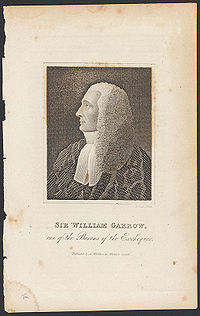
It told the tale of the early career of Sir William Garrow, a little known barrister of Georgian times, whose combative style practically invented the adversarial system. Justice for defendants was rarely served at that time - they often had no representation, and when they did matters of fact could not be disputed and the jury could not be addressed directly. Thief-takers were common and unscrupulous. Punishments were extremely harsh.
With clever and witty counsel, Garrow achieved justice for many lowly defendants. Without him we may not have many of the features that seek to ensure *fairness* in the application of the law. His case transcripts can be read online at the Old Bailey archive. Well worth a browse.
The final episode was a timely depiction of a trumped-up charge brought by the state against an innocent individual - a state seeking to hold on to undemocratic powers at the expense of its citizens. The parallels with the authoritarian actions of the present government were palpable. I suspect this case wasn't based on a real life case, but I could be wrong (I couldn't find it in the online archive). It seemed to me a call from the creators for us all to take more seriously the curbs on our civil liberties being introduced under the guise of protection from terrorism. We must stand up at some point and fight these, before we become as bad as those we are fighting.
The BBC should be making more shows like this. Bravo.
EDIT: An interview with creator Tony Marchant here reveals that Garrow was responsible for coining the term 'innocent until proven guilty'. A remarkable man indeed. A pity that principle has become muddied recently.
What a weird article from Bill Maher. Throughout 'it's' is spelt 'its'. That's not the worst thing about it, but it's not a good sign. It's a response of sorts to this letter from Michael Shermer.
It's a textbook example of how to get an issue wrong. He says he's a reluctant (fundamentalist?) spokesperson on anti-vaccination, and others are more qualified - is he qualified *at all*? - but then ploughs on regardless. Here's the perfect recipe for scare-mongering a potentially controversial issue.
1) Find something that you know nothing about, but about which you have a vague sense of unease. Vaccination - check
American diet - check 2) Make sure that lots of people share this sense of unease. Anti-vax polls - check No-one likes their 'smartie tube' punctured - check 3) Add some known provisos or grey areas. Over-vaccination is a bad thing - check Immune system problems make vax dangerous - check 4) Cite people with personal stories to tell as credible data. Barbara Loe Fisher - check 5) Cherry pick 'experts' in the minority. Dr Russell Blaylock - check Dr Jay Gordon - check 6) Pretend you're just trying to publicise a little known problem. "I'm just trying to represent an under-reported medical point of view in this country" - check 7) Find something dangerous sounding that can be blown out of all proportion. Formaldehyde - check Mercury - check 8) Insist you and your cohorts are not anti-whatever it is. "Anyway, Ms. Fisher is someone who says she is not "anti-vaccine," but just has a lot of questions about the long term effect of using a lot of vaccines." - check 9) Exaggerate for effect. "Is it worth it to get vaccines for every bug that goes around? Injecting something into my bloodstream? I'd like to reserve that for emergencies." - check "If one side can say anything and its not challenged, then of course dissent becomes heresy in the minds of many." - check "There are consequences to vaccines and antibiotics. Some people want to study that, and some, it seems, want to call off the debate." - check "Ms. Fisher said 'If we want to create a society that is dependent on shots for immunity -- the same way we are getting dependent on prescription drugs, antibiotics, and surgery -- this is the path we should keep going down.'" - check 10) Deny there is a conspiracy, whilst implying there is one. "In fact, when Howard Dean asked me that, my response was "I wouldn't call it a conspiracy." Any more than there's a conspiracy for the Pentagon budget to be obscenely bloated and operated largely for the corporate welfare of defense contractors." - check "Is it conspiracy theory to believe that American medicine too much treats symptoms and not root causes of disease? " - check 11) Disingenuously spread misinformation thanks to one's high profile job. Chat show - check Twitter - check Huffington Post - check
And stir. And stir again. Whatever any experts say, do *not* go back and change the ingredients. That would be too scientific, and wouldn't serve the agenda.
Two more things shock me about this article. One is how *parochial* his attitude is; he needs to get out and about and away from the particular obsessions that Americans have; no doubt there are some reasons to be paranoid in the States, and no doubt there are issues with 'big pharma' the world over. But that isn't an excuse for pretending one knows better than the scientific community, when one doesn't. The second is the suggestion that scientists want to close down any argument surrounding vaccinations. I see no evidence of that; just authorities concerned about know-nothing slebs endangering people's lives.
There seem to be a lot of articles like this recently. In summary they say something like this:
I want to draw your attention to the evil new atheists that swarm among us.
They refuse to entertain doubt about their beliefs. They are rampant ego-maniacs. They loudly proclaim that anyone who doesn't believe what they say will go to the dogs. Their philosophy leads to conflict and depravity. They are pre-occupied with sex. They are rude and dismissive of opposing views. They are dogmatic and closed-minded. They meet up and worship their community leaders. They follow their leaders religiously. They want to teach our children what to think. They want to direct government policy to their own ends. They want to tell other people they're wrong. They organise and form lobby groups. They want to sell their books. They want people to read their books. They demand money from their followers for merchandise.
You and I as pious theists understand that such behaviour should be the sole province of the religious.
For some strange reason, the things of which they accuse the new atheists are more accurate descriptions of *religious* behaviour. Even if any of it were true (and often it isn't), why do they complain about behaviour in which they indulge?
A simply appalling piece from arch-faitheist Michael Ruse in today's Guardian. Not for the first time, I find it hard to understand how an intelligent, educated man (certainly more intelligent and educated than me) could commit such howlers to print. Consider:
First, non-believer though I may be, I do not think (as do the new atheists) that all religion is necessarily evil and corrupting.
Fail no. 1. I don't know a new atheist who thinks that; perhaps a reference to where all the new atheists say that or write that would be in order? The closest I can see is Hitchens saying that religion poisons everything; not the same thing, of course, as any 10 year old could surely see, let alone a philosopher.
Dawkins and company are ignorant of such claims and positively contemptuous of those who even try to understand them, let alone believe them. Thus, like a first-year undergraduate, he can happily go around asking loudly, "What caused God?" as though he had made some momentous philosophical discovery.
Fail no. 2. Just because a first-year undergraduate can ask the question doesn't mean *it has been answered*. The argument is about the inconsistency of the uncaused cause claim. It rests on nothing existing without a cause (we don't know that) and then uses *that* as a foundation for a single uncaused cause, which (guess what?) is shaped like their god, that they've been rabbiting on about for years. Who'd have thunk it? A 10 year old child could see the problem with this logic, let alone a philosopher.
...how dare we be so condescending?
Fail no. 3. Treating claims seriously is not being condescending. Hand waving away atheists who object to religious claims as spoil sports and then claiming some kind of Kuhnian epistemological equivalence *is* condescending. A 10 year old child could surely see this?
I can explain their faith claims in terms of psychology; they can explain my lack of faith claims also probably partly through psychology and probably theology also. (Plantinga, a Calvinist, would refer to original sin.)
Fail no. 4. Which is the more likely explanation? The psychological, or the Calvinist? Or the Scientologist? Or the Pastafarian? Come on, don't be so *patronising*. A 10 year old child could *make up* a possible explanation, but that wouldn't make it valid, as she would surely understand.
I just keep hearing Cromwell to the Scots. "I beseech you, in the bowels of Christ, think it possible you may be mistaken."
Fail no. 5. *What* does this tell us? To *where* does this lead us? Knowledge is *tentative* and *doubtful*. What does faith require? Banishment of doubt. What do religions teach? Certainty, through divine knowledge. You've guessed it; a 10 year old child could see the contradiction, let alone a philosopher.
If, as the new atheists think, Darwinian evolutionary biology is incompatible with Christianity, then will they give me a good argument as to why the science should be taught in schools if it implies the falsity of religion? The first amendment to the constitution of the United States of America separates church and state. Why are their beliefs exempt?
Fail no. 6. And sinister with it. Is he seriously suggesting that *if* science showed the falsity of religion then secularism would dictate it should not be taught? That it should be suppressed? Unfortunately this is the logical conclusion of allowing epistemological equivalence between knowledge derived scientifically and other 'knowledge', betrayed by his last line; 'Why are their beliefs exempt?' Until fools masquerading as martyrs abandon this nonsensical position then religious knowledge will be allowed to continue in its unjustified position of privilege. Many religions explicitly declare the falsity of religious knowledge; *just not their own*. How does Ruse choose the most valid body of knowledge from the cornucopia available to him? I suggest a 10 year old child could see the problem in Ruse's position, let alone a philosopher.
But, of course, the point of secularism is to protect the right of people to believe what they like, not to introduce thought-crime. If some facts imply the falsity of *anything*, then those facts should still be taught, but the pupils allowed to come to their own conclusions. *That* is surely the aim of the First Amendment?
But don't worry. In the God Delusion, we have a message as simplistic as in The Genesis Flood. This too will solve all of your problems. Peace and prosperity await you in this world, if not the next.
Fail no. 7. And finally, it's the rank dishonesty that shocks. As if TGD claims to 'solve all of your problems'. A 10 year old child could read the book and understand *that*, but not, apparently, Michael Ruse.
I attended this event tonight, at the Methodist Central Hall in Westminster. The motion was 'The Catholic church is a force for good in the world', proposed by Ann Widdecombe and the Archbishop of Abuja. Against were Christopher Hitchens and Stephen Fry. Moderation by Zeinab Badawi. My journalistic skills are not good, so I apologise for any failures in recall, and any misrepresentations; this is as I remember it, but I am not impartial. The event was filmed, so it will hopefully be on Youtube before too long. Apologies also for the poor quality of the piccies from my mobile phone!
My wife spotted the large organ
We did a bit of sleb spotting, but the only one worth reporting, that we saw, was Derren Brown; look:
That is him, honest
A good atmosphere in a packed hall; the antagonists entered...
l to r: the Archbish, AW, CH and SF. Yeah, really
An initial poll showed roughly 600 for and 1000 against the motion before the start of the proceedings.
The Archbishop started off, with a rather waffly preamble, re-stating often that the Church was a force for good, and that he had spent his life in the institution and had become more convinced of it as time went on. Referred to the many good works done by Catholics around the world, in health and social care, and education. He kept it light; not very convincing, but came over as a pleasant and humorous guy. He did mention that one or two mistakes had been made by the Church, for which apologies were appropriate.
Christopher Hitchens followed, and attacked mercilessly. I've seen a few Hitch debates online, but this one didn't include any of his usual rhetorical gambits. Instead he took the ball passed by the Archbishop and ran with it brilliantly; he insisted that any representative of the Church should start any such discussion with a long list of apologies; he ran through many of them, such as the Crusades, the Inquisition and the Holocaust; the torture of Galileo and anti-semitism. He continued relentlessly with modern day problems, such as childabuse and their obsession with condoms. He pointed out that the Holy See had lifted the excommunication on Richard Williamson, a holocaust denying bishop. He left the floor with a buzz going around the room at the ferocity of the attack.
Ann Widdecombe won a cheer from the Catholic supporters by accusing Hitchens of a gross misrepresentation of the Church. She scoffed at Hitchens' examples of Catholic bad behaviour - the sack of Constantinople, for goodness sake, she laughed. Time does heal, apparently. She despaired at the constant harping on about child abuse, and that the Church should be judged on such matters according to the morality of the time (!). She talked about the billions raised by the Church and used for good causes around the world, through the 1 billion Catholics. Talked about the many health care facilities run by Catholics - a very high percentage apparently. Talked about the many Catholics persecuted by the Nazis and how many churches harboured Jews during that war. All in all, a combative effort from the Tory firebrand.
Stephen Fry started by hoping that he marshalled his facts well, since this was a subject that really *mattered* to him. He was *passionately* against the motion. He ironically agreed with AW's notion that we can dismiss such historical events as the Crusades and the Inquisition as being too long ago, but then spoke beautifully about the echos of history in *all* of us, and in that very room. He pointed out that history was clearly of major importance in her Church, through the notion of Apostolic succession, so she could hardly scoff at events 800 years ago. In the square mile, where we sat, the Church had burnt people for distributing Bibles in English. This point was very well made. If AW wanted the church to be judged by the mores of the time, for slavery, torture and child abuse, for example, whence absolute morality? He attacked the idea that he was considered by her Church to be morally evil, just for being him. He objected to being called a pervert by sexually dysfunctional churchmen! It was a tour de force to which I can hardly do justice.
I'll mention two questions in the Q & A; a woman asked the panel about the 10 commandments -that these were surely a great work of the Catholic church (surely shome mishtake?). Hitchens pointed out the egotistic nature of the first three (or four?) commandments. The Archbishop scored a bit of an own goal by telling us that his father converted to Catholicism, but was already aware of the ethical commandments through his previous African religion; "Exactly!", shouted someone in the crowd. A chap asked Ann Widdecombe how a woman could be an MP but not a priest; not for the first time, AW said that the theology was too complex for such a discussion (and such fools, it was implied) but basically a woman could no more stand in for Jesus Christ than a man could stand in for the Virgin Mary. This doesn't so much explain her point but rather re-state the problem. Why, indeed, could a woman *not* stand in for Jesus Christ? A priest doesn't have to do anything gender specific. Or does he? I think we should be told.
The atmosphere was quite frenetic all night, with a lively audience; in the closing statements, AW scolded Fry for calling the Archbishop sexually dysfunctional. Perhaps that was a little harsh. The outgunned Archbishop said that he had resisted preaching all night, and that most of the preaching had come from the other side. I think I have to agree with this; the Archbishop didn't sermonise, and spoke calmly - the emotion was certainly emanating from Hitchens and particularly Fry. But this emotion was backed by great reason, evidence and good sense. I think it was Mackie who said that emotion backed by reason was virtue. A virtuoso performance, then. By contrast the theists were rather subdued.
A further poll at the end revealed a massacre of the not-so-innocents; some 200 for and 1700 against, I think.
This proves nothing, of course; debates are usually won by the best debater, or by the vagaries of the audience mix, not by the truth-tellers; although, IMO, the truth-tellers did win on this occasion. A ray of hope from the night; both Hitchens and Fry issued challenges to the Catholic Church that they *can* clean up their act, and at least partially atone for their past crimes. One or two Catholics in the audience seemed very keen to take this to heart. Let's hope that many do.
To declare similarity between Judaism and Islam on the basis that their practitioners fast or pray is to betray an astonishing superficiality that does not do justice to either faith.
I think this is right. Unfortunately he follows this up with:
More importantly, the instinctive desire to find commonalities between faiths fundamentally undermines the whole point of interfaith dialogue in the first place, which is to learn how to respect those whose faith is profoundly different from your own.
I have a difficulty with this; why should one respect those whom one profoundly disagrees with? Respect means to esteem or regard highly. It's certainly *possible* to respect someone with different views, but is this always a desirable state of affairs? Should Churchill have respected Hitler and his views? ("Hitler is a monster of wickedness, insatiable in his lust for blood and plunder. But I respect his megalomaniacal views." - OK, I added the last bit - would he have said that?) I would suggest not.
The rabbi concludes:
There are profound differences in how various faiths conceive of God and instruct their adherents to behave. Honest interfaith work takes as its point of departure that I will never truly understand the faith of the other, nor will I necessarily see any reflection of my own faith in that of the other.
This certainly seems a possibility, but quite a counsel of despair; will we never understand each other? There is a way out; consider all beliefs in the cold light of reason and evidence, and eliminate those that don't stand up to scrutiny.
Different faiths cannot all be conveniently collapsed into a basic common language. This is neither possible nor desirable.
Neither possible nor desirable? Is it really not desirable we should understand each other?
Most importantly it is unnecessary. We already have a common language: our humanity.
This is a tacit admittance that interfaith dialogue amounts to 'let's agree to disagree'. Fair enough; it also concedes, I think, that some form of humanism is our only hope for common agreement. I have to say I agree. Nice to see a churchman admitting this!
Simon Blackburn writes well on Respect and Religion; he recognises that respect is sometimes used as a synonym for *tolerate* (although this is probably incorrect usage):
We can respect, in the minimal sense of tolerating, those who hold false beliefs. We can pass by on the other side. We need not be concerned to change them, and in a liberal society we do not seek to suppress them or silence them. But once we are convinced that a belief is false, or even just that it is irrational, we cannot respect in any thicker sense those who hold it—not on account of their holding it. We may respect them for all sorts of other qualities, but not that one. We would prefer them to change their minds.
I quite like that formulation; one cannot respect someone on account of their holding a belief with which one disagrees. This still leaves us open to respecting them on account of their character and other beliefs. But if they are foolish on many matters, then one would lose one's respect for them. This is surely normal behaviour, and justifiable.
Respect - Our world is a diverse world. To communicate and grow we must respect one another's beliefs, values, attitudes and faiths.
No. Not unless one agrees with them. If one respected a belief, one would agree with it, surely? If one assumes that this means *tolerate* not *respect*, then one can agree to a *small* degree. But even then, one does not, in practice, tolerate everyone's beliefs. We don't tolerate racism, sexism and homophobia. Tony Blair doesn't. He doesn't respect the Pope's beliefs on homosexuality, quite rightly.
So why is he promoting something for kids that he doesn't practice himself?
I've been following the debate between presuppositional apologists and others (including the odd Christian) over at Premier Forums, and I thought I would write a little on the subject, in the hope of clarifying my own thinking about it.
To start with, as a sceptic, I'm still in the position where I can evaluate different world views and tentatively indicate which is currently preferred. I'm not committed to any world view, and am open to persuasion. So far, given our human condition, it seems *necessary* to maintain a tentative position. That *could*, in principle, entail preferring a theist world view (it doesn't at the moment!).
(It's noted, though, that provisionality, on the face of it, would seem to rule out a lot of theist world views, which demand *commitment* - Kierkegaard's leap of faith. Doubt is frowned upon, even though acknowledged at times.)
Many theists insist that the sceptic *must* declare a world view. This strikes me as transparently rhetorical; anyone can imagine how a person could be sceptical, non-committal and honestly ignorant, and they *should* address *that* position, not any number of straw men positions they would prefer to attack. However, this is part of their tactic, since they are interested in showing the impossibility of the contrary view, and to deny any criticism of their assumptions. See this, from a presup:
No, God is not on trial, WE ALL ARE. It is obvious to me that evidence doesn’t win the day with atheists, so I choose to argue for the impossibility of the contrary and from a position of accountability.
This is not entirely unreasonable (well the evidence bit is!); as Sherlock Holmes said:
How often have I said to you that when you have eliminated the impossible, whatever remains, however improbable, must be the truth?
Unfortunately for the presuppositionalist, I think we can see that they haven't eliminated the impossible.
Consider a typical demand from a presuppositionalist:
...how do YOU account for the universal, abstract, invariant laws of loigc [sic] according to YOUR worldview?
Little defence of his own world view, since he understands that his world view begs the question. So straight onto the attack. Your world view begs the question, you make assumptions too. Again, I think this is fair enough, to a degree; we do not have a sure foundation for any epistemology - philosophers have wrestled inconclusively with this knotty problem for centuries, and I'm not about to challenge their (lack of) conclusions! Although it's plain that many are satisfied that we can have *tentative* knowledge, through the comfort we have derived from the scientific method.
So let's consider the claims of two possible world views. The presuppositionalist might say:
I presuppose that God provides the foundation for logic/induction/reason.
I can now justify my use of logic/induction/reason and apply these to the evidence to determine reality.
The atheist world view, because God provides this foundation for logic etc, is impossible.
Unfortunately for the presup, number three is criticising the atheist world view according to his own world view - an external criticism. A typical atheist could then say:
I presuppose that logic/induction/reason is a brute fact.
I can now justify my use of logic/induction/reason and apply these to the evidence to determine reality.
The theist world view assumes a god; please provide the evidence for that, and I will evaluate it (little to no evidence for a god, therefore no god is proved).
There is no *internal* problem with the first two steps of the two world views, if we agree that presuppositions are necessary; which I think is hard to argue against. But it doesn't mean we *have* to accept any presupposition; we are at liberty to evaluate which is the best world view for the reality we see around us.
As a sceptic, I cannot see anything compelling about the theist presuppositional position. It plainly hasn't established a reason to believe its presupposition, and it cannot offer an explanation of how this works. Logic is founded in God? God is logic? This suggests that logic *could* be something else; that there is possibly a state of affairs where 2+2=5 and things could be p and ~p. A presup *must* believe that, otherwise, if this isn't the case, and 2+2≠5 and things can never be p and ~p, then logic still just *is* a brute fact. So the God presupposition does not help.
Also, the presup must demonstrate that there is *no* world view that is possible other than theirs. This assumes that they know all other world views, and have proved them impossible; a brave and foolhardy claim. A sceptic doesn't claim to know all world views, but can analyse those of which he's aware, and tentatively prefer one.
Furthermore, it's difficult to see how one could not plug *anything* in place of God in the presuppositional world view:
I presuppose that my cat/the clouds/love provides the foundation for logic/induction/reason.
Any world view like this is internally consistent, once the presupposition is allowed, and not analysed as above. But it cannot be persuasive to the sceptic, because they *have* to choose between different presuppositions. The presup think it's a compelling argument because they demand everyone commits to a presupposition, and don't examine it. That is their fatal error. We *are* at liberty to adjust our presuppositions, which means we must be allowed to analyse them. They want to deny analysis of the God proposal to all. The sceptic, by contrast, wants *everything* to be open to analysis. Even the foundation of logic (if anyone's got any ideas).
I don't think most Christians think like this (at least, not to this extreme), and it doesn't seem like a position that's worth debating. The presup is obviously happy with their presupposition for internal reasons, and appears blind to the *sceptical* position. The debate will constantly ping pong between demands for a justification of logic, to evidence for God, and no-one will be any the wiser. Best to give the presups a wide berth! They're not for learning.