Thursday, 21 January 2010

Theidiocy


An hilarious, if it wasn't such a serious subject, Thought for the Day on January 15th from the Reverend Dr Giles Fraser, trying to make sense of theodicy in the light of Haiti. He gives a brief rundown of theodicy's history, noting Voltaire's devastating critique in Candide.
Well, I have no answer to the question of how God can allow so many innocent people to die in natural disasters, like the earthquakes of Lisbon or Haiti. And indeed, I can quite understand that many will regard these events as proof positive that religious people are living a foolish dream like the idiotic Dr Pangloss.
It does rather seem that way. At least he's honest enough to admit he has no answer; so why does he believe? Oh, hold on:
And yet, I still believe. For there exists a place in me - deeper than my rational self - that compels me to respond to tragedies like Haiti not with argument but with prayer. On a very basic level, what people find in religion is not so much the answers, but a means of responding to and living with life's hardest questions. And this is why a tragedy like this doesn't, on the whole, make believers suddenly wake up to the foolishness of their faith. On the contrary, it mostly tends to deepen our sense of a need for God.
Oh yes, he's got a gut feeling. This is one of the problems of faith. Because it is (often) impervious to the evidence in front of it, there is no resolution available, *in principle*, when one is faced with someone with a completely antithetical belief. I'm comforted a little by the fact that some theists do lose their faith because of this problem of evil.
What many believers mean by faith is not that we have a firm foundation in rational justification. Those, like Leibniz, who try to claim this are, I believe, rationalizing something that properly exists on another level. Which is why, at a moment like this, I'd prefer to leave the arguments to others. For me, this is a time quietly to light a candle for the people of Haiti and to offer them up to God in my prayers. May the souls of the departed rest in peace.
I agree that many believers do not have a firm foundation in rational justification. I would go further and say I've not come across *any* who have got such a foundation, although many claim it. It re-iterates the problem above; how are we to get *him* to reconsider his faith in the light of reason and evidence? His is the very definition of a closed mind.

And offering ineffective prayers and lighting candles is a waste of time and effort; one wonders how this is a 'good' thing? He would have used this platform better if he had urged donations and practical help.

Read more »

Saturday, 9 January 2010

Homeward Bound

Good dog

A curious article in the occasionally provocative Credo column in The Times, by philosopher John Cottingham, headlined Our restless quest for God is a search for home. Cottingham is Professor Emeritus of Philosophy at the University of Reading, an expert on Descartes, about whom he's written a number of times. That gives the game away a little about his world view, I guess. He writes:
As we struggle through life, we seem compelled to acknowledge, sooner or later, that our human good, our flourishing and fulfilment, depends on orienting ourselves towards values that we did not create. Love, compassion, mercy, truth, justice, courage, endurance, fidelity — all belong to a core of key virtues that all the world’s great religions (and the secular cultures that have emerged from them) recognise, and which command our allegiance whether we like it or not.
This is more or less true, I guess. But I could equally have written:
Love, compassion, mercy, truth, justice, courage, endurance, fidelity — all belong to a core of key virtues that all the world’s cultures (and the religions that have emerged from them) recognise...
Like many a theist he is begging the question when he states that secular cultures have emerged from religious ones. It is quite possible that homo sapiens was around for thousands of years without religion. It is *certain* that the species was around for thousands of years without the (current) great religions. Given that, it seems more probable that the great religions have arisen from humans. If he thinks otherwise, he should present evidence for why he thinks this is not the case.
We may try to go against them, to live our lives without reference to them, but such attempts are always, in the end, self-defeating and productive of misery and frustration rather than human flourishing. These facts are already, if we think about them, very striking and important ones. We are dependent and vulnerable creatures, who need, for our fulfilment, to orientate ourselves towards certain enduring values.
This would be consistent with an evolutionary benefit to, or at least a *reason* for, such virtues.
If we couple this with an awareness of the obvious fact of our human weakness, and the notorious difficulty humans experience in steadfastly pursuing the good they aspire to...
Yeah, evolution is imperfect unfortunately...
...then one is struck by the extent to which religious belief offers a home for our aspirations.
What?! Why aren't I struck by this? Why is religious belief also a home for the vices - bigotry, pride, avarice, lust and wrath?
Theism, in its traditional form found in the three great Abrahamic faiths, involves the idea of a match between our aspirations and our ultimate destiny. On this picture, the creative power that ultimately shaped us is itself the source of the values we find ourselves constrained to acknowledge, and has made our nature such that we can find true fulfilment only in seeking those values. In the much quoted words of St Augustine, “you have made us for yourself and our heart is restless until it finds repose in you”.
Flat out assertion, with no evidence. Traditional theism certainly isn't represented by the three great Abrahamic faiths in most of Asia. Why should we have any 'ultimate destiny'? Much has been written on the values about which he writes arising from evolutionary and societal sources and, as I've mentioned before, there are really insurmountable problems if one assigns the values to the source he favours.
The natural response to this — to acknowledge that creative source of goodness with joy, and to turn towards it for strength in our struggle — is so basic that it presents itself to the believer as a fundamental and necessary way of going through life. It is not a matter of scientific hypotheses about the precise macro or micro mechanisms that formed our planet or our species, but rather a necessary impulse of trust, something that, as William Wordsworth conveyed in his Lines Written above Tintern Abbey, stems from moments of vivid awareness of the beauty and goodness of the world and our place within it. It is an impulse so deep that we feel that neither abstract intellectual speculation, nor the drudgery or pain of our routine existence Shall e’er prevail against us, or disturb / Our cheerful faith that all which we behold / Is full of blessings.
This is a very real claim; that it is *natural* to have faith. The corollary is that anyone without faith is not acting naturally. Theists like to allude to this idea occasionally, but it is fundamentally flawed as an *argument* for theism; I think philosophers (like him!) call it the naturalistic fallacy. (You'd think a professor would be able to avoid such a basic error.) Simply stated, just because something is natural doesn't make it right. It may be, but we need to examine the details more closely; rational enquiry, often including science, is the appropriate response, not a lazy acceptance of our urges, and the 'rightness' of them.
Few have been more eloquent advocates of the benefits of faith: the uplifting sense of openness to beauty and goodness, and the trust that our best and deepest aspirations in life are not arbitrary flailing around in the dark, but are part of the quest for “God, who is our home”. To describe God as our “home” is to conceive of him as the ultimate source from which we come and the point of return to which our restlessness drives us — the final end where our true peace lies. Of course, the cold light of reason may compel us to turn our back on all this — that is a question to be considered. But we need to be aware of what it is we would be rejecting.
I can certainly see why many have thought this; it seemed sensible *to a degree* when I was a theist. But this paragraph is surely just a re-statement of Pascal's Wager? That argument fails completely, and Cottingham's curious article also raises unanswerable questions; what are we rejecting? No two theists seem to share the same theism. What is God? If returning to him is the purpose of this existence, what is the purpose once we are with Him? What purpose did God have in setting up this universe?

I've never been presented with any answers to these questions that even *approached* making sense, and I find it hard to believe that theists have them either, otherwise they would tell me :-), surely? If nothing Shall e’er prevail against us, or disturb / Our cheerful faith that all which we behold / Is full of blessings, then I do not envy them, and I'm happy to avoid that particular vice, since their faith is flying in the face of all the evidence around us.

Read more »

Saturday, 12 December 2009

Correspondence with John Denham

Dr Evil?

After this interview with the Sunday Telegraph, I sent an email on 16th November to John Denham, Secretary of State for Communities and Local Government.
Dear Mr Denham

I read the interview you gave to the Sunday Telegraph yesterday, on the role of faith based organisations in politics. You are quoted as saying:

"We should continually seek ways of encouraging and enhancing the contribution faith communities make on the central issues of our time.
Faith is a strong and powerful source of honesty, solidarity, generosity – the very values which are essential to politics, to our economy and our society."
If two or more faith communities made opposing claims about an issue, how would government decide which group to listen to? For example, the Catholic Church is adamant that the sin of contraception is more important than protecting people from HIV; should government listen to this honest, solidly held and generous view?

You continued:

"I don't like the strand of secularism that says that faith is inherently a bad thing to have and should be kept out of public life"

Secularism seeks to separate state and religion to *protect* private beliefs. Enshrining blasphemy laws for one particular faith, for example, would threaten the private views of the faithful of other religions. In the west, secular government has increasingly been seen as the only way to avoid persecution of religious minorities. Are you looking to limit this protection of people's private beliefs? Do you think the UK government should be more, or less, secular? Many people understand 'faith' as meaning 'believing something with insufficient evidence'. This is fine for comparatively trivial matters, such as 'which football team is the best?', but surely this is 'a bad thing' when it comes to matters of state? You may have a different definition of faith to me, so, if so, I would appreciate hearing it to better understand your comment.

I'm aware that newspapers sometimes misquote, so if that is the case here I would be grateful for any clarification you can offer.

Kind regards

Mark Jones
I received the following reply from his office:

24 November 2009

Dear Mr Jones

Thank you for your email of 16 November 2009 about John Denham’s decision to appoint a panel of advisors on faith issues. I have been asked to reply.

As Secretary of State for Communities and Local Government responsibility for the Government's engagement with faith communities lies with him. He has therefore, recruited a panel of advisors on an expenses-only basis to provide him with informed advice on relations with these communities.

The Government recognises that religious belief is of immense importance to millions of citizens, and believes that this fact should be respected. Many issues which concern governments cannot be tackled solely by regulation or spending. Governments and faith communities share an interest in the values which lead people to act the way they do. Campaigns for international development, peace, decent housing, living wages and many others have often been sustained by those of faith - not alone, but as key participants. On these issues, and others including climate change and the values of our economy, people of faith have views and values that deserve a hearing.

I hope I have reassured you on this matter.

Yours sincerely,

Marina O'Neill

Cohesion and Faiths Unit

Not being reassured I sent a reply:

Dear Ms O'Neill

Thank you very much for the response to my email of 16th November.

However, I really need a response to my specific questions; in particular you haven't responded to clarify why Mr. Denham thinks that faith is *not* an inherently bad thing to have.

I need to understand how this Government judges what is a good basis for policy, and what is not. As I said before, faith is usually defined as 'believing something with insufficient evidence'. I want to know why Mr. Denham thinks this might be a good thing, or, at least, why he thinks that Government should listen to groups *specifically* because they think this is a good thing. Because that is what this means, from your letter:

"Campaigns for international development, peace, decent housing, living wages and many others have often been sustained by those of faith - not alone, but as key participants. On these issues, and others including climate change and the values of our economy, people of faith have views and values that deserve a hearing."

To reiterate, I'm happy for you to seek advice from people who have expertise in the areas you mention, including of course people of faith, but I'm not happy for you to seek advice from people of faith simply because they are people of faith; but that appears to be what you are saying. Could you confirm this, or, preferably, deny it.

Your reply doesn't seem to extend beyond restating what Mr. Denham has said in his speech at The Methodist Church Offices, so could you confirm that it's OK for me to make this correspondence public? If I don't hear back within a couple of days I'll assume that is the case.

Kind regards

Mark Jones
I was anticipating radio silence, and sure enough there's been no reply. It would be nice to know if they have a policy on this sort of correspondence. Presumably they cannot answer every email that arrives, but a simple acknowledgement of this should be a matter of good manners.

What concerns me greatly is the possibility that Government policy could be decided after input by faith groups based on nothing but *dogma*. It is imperative that policy should be informed by *evidence*, and we see that is not the most important factor for people of faith. Their input to the public square is quite acceptable when arguing their corner with reason and evidence, but quoting revelation and unjustified authority should not be allowed.

The Chilcot report into Iraq is under way now, and there is a very real sense that the major players, Bush and Blair, invaded Iraq because of an article of *faith*, rather than reasoned argument. It's beginning to look more and more difficult to determine Tony Blair's thinking as he approached the conflict. The reason that *Parliament* voted for the conflict certainly wasn't persuasive to him. He said "...this was obviously the thing that was uppermost in my mind - the threat to the region" (not WMD). But many regimes pose a threat to their regions, and we don't invade them.

So it will be interesting to see if the inquiry can uncover how he arrived at his decision. It's difficult not to come to the conclusion he simply 'felt intuitively' that it was the right thing to do; a hallmark of *religious* thinking.

Read more »

Wednesday, 9 December 2009

Intelligent Design Shows God Was Intelligently Designed, Shock


Intelligent Design is the latest incarnation of Creationism, attempting to gain a patina of scientific integrity by doing sciencey type things, but not quite managing it. I found this document by one of its proponents, William Dembski: Ten Questions to Ask Your Biology Teacher about Design. Running through its attempts to shoehorn some God into science, it's clear that this is an excellent contribution to refuting the existence of God prior to the appearance of homo sapiens. Consider:
Proponents of intelligent design argue that they now have formulated a precise criterion that reliably infers intelligence while also avoiding Kepler’s mistake— the criterion of “specified complexity.” An event exhibits specified complexity if it is contingent in the sense of being one of several live possibilities; if it is complex in the sense of allowing many alternatives and therefore not being easily repeatable by chance; and if it is specified in the sense of exhibiting an independently given pattern. For instance, a repetitive sequence is specified without being complex. A random sequence is complex without being specified. A functional sequence, like DNA that codes for proteins, is both complex and specified, and therefore designed.
"Specified complexity" certainly seems to apply to God; how could he not be complex? His behaviour is functional, therefore, yeah, specified complexity applies.
Life is special, and what makes life special is the arrangement of its matter into very specific forms. In other words, what makes life special is information. Where did the information necessary for life come from? This question cannot be avoided. Life has not always existed.
God must have information; if not, then he has no life? Perhaps he doesn't? Nevertheless, a *being* containing no information is surely non-existent, so we must conclude that God has information. Another tick for ID.
Do any structures in the cell resemble machines designed by humans? How do we account for such structures?
Here ID wants to infer design from the machine like quality of cells. Well, there's certainly a parallel there; God makes lots of things - he's the industrial revolution and then some. An uber-factory. Tick one more up to intelligent design.
What are irreducibly complex systems? Do such systems exist in biology? If so, are those systems evidence for design? If not, why not?
IDers love their irreducible complexity, despite its pretty obvious stupidity. But let's humour them and assume that a thing can really be irreducibly complex. Would it apply to God? It would be a bit of an insult if it didn't, I would think. I suppose they might say, no, God is an extremely simple miasma, and nothing more. Is it this that they want us to worship; something less complex than the bacterial flagellum (but still capable of designing it!)? Surely not. We must all agree that God is irreducibly complex, if irreducible complexity means anything at all.
Reusable parts... By adopting an engineering approach to biological structure, intelligent design explains similar structures in terms of common design.
Excellent! God wrote about this himself, through the Bible:
So God created man in his own image, in the image of God created he him; male and female created he them - Genesis 1:27
Clearly He has reusable parts; another tick.
To refute intelligent design, it is enough to display specific, fully articulated Darwinian pathways for the complex systems that, according to intelligent design, lie beyond the reach of the Darwinian mechanism (systems like the bacterial flagellum in question 5).
Well, I have to admit I find this impossible for God. Yet another tick for His intelligent design!

Finally:
But the identity and characteristics of a designer lie outside the scope of intelligent design.
Oh well, if you say so; let's just leave it hanging there. I think we can all guess who designed God, though, can't we?


Read more »

Sunday, 29 November 2009

Waterloo at Wellington for Theists


Another debate organised by Intelligence Squared, this time at Wellington College in Berkshire. The motion was 'Atheism is the new fundamentalism', proposed by Richard Harries, former Bishop of Oxford and Charles Moore, opposed by A C Grayling and Richard Dawkins. Moderated by Anthony Seldon, headmaster at the school. He's a professor at the College of Teachers. Who teaches them, one wonders. This one was streamed online, so I won't go into too much detail; I think it should be available to watch very soon.

EDIT: watch the debate here.

Outside the venue

Celeb watch; two sightings. Seventies chanteuse, Lynsey De Paul (who'd have thought?) and Jeremy Paxman.


Richard Harries

The very *motion* is an ad hominem response to atheism, in my opinion; rather than address the arguments, cast 'new' atheism (they tend to qualify the atheism) as the new fundamentalism, and consequently dismiss it as worthless. This implicit notion fed through to both Harries' and Moore's opening statements, which addressed what fundamentalism is, and why it's a bad thing (no argument from me there), but also name-called Richard Dawkins, sitting bemused opposite them. Harries called him an 'attack dog' and Moore described a scene in which 'Commandant Dawkins' would have theists all gunned down, presumably for daring to object to rational argument.

A C Grayling

The tenor of both presentations was that atheism, as represented by Dawkins, adopted a *certainty* about the truth that was not justified. I think Harries called it "not allowing for the great 'perhaps'". This seems very odd to me, because faith in god is surely about banishing doubt from one's belief - I blogged on this some time back, prompted by an article by a Catholic priest.


Charles Moore

For me, this is a straw man; whilst new atheist scientists consider that the Christian God is almost certainly non-existent, they cannot discount any god's existent, nor the existence of Russell's teapot, and Dawkins corrected them on this point. Harries made the point that The God Delusion doesn't mention the 'balance of probabilities', but chapter 4 includes quite a discussion on this. Interestingly, Grayling as a philosopher seems less bound by this scientific principle, and happily confirmed his certainty about God's non-existence. This I could only agree with if he's talking about some concept that suffers from non-cognitivism. Which might apply to God.

Richard Dawkins

After many demonstrations of good sense from Grayling and Dawkins, Harries was left grasping at the value of the numinous, as if this was the heart of the matter. Moore complained that such debates never analysed the more complicated ideas that were at issue (this after a question on consciousness, I think). A pretty vacant comment, after he had spoken for a motion that 'atheism is the new fundamentalism', an approach that is *calculated* to dismiss the arguments of one's opponents.

The final score: 363 for, 1070 against, 85 don't knows. Predictable from the feeling I got inside the hall.

Oh, and I said to Jeremy Paxman in the moving throng on the way out, 'Can I ask you how you voted?'. 'Well, there you are then', he replied, cryptically. I should have pressed him, but I imagine he gets fed up with that in public.

Read more »

Sunday, 22 November 2009

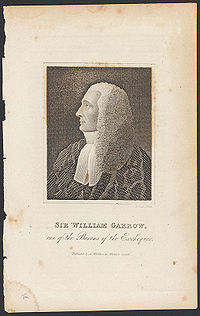
Garrow and the Gallows


An absolutely splendid series ended tonight on the BBC - Garrow's Law, created by Tony Marchant.

It told the tale of the early career of Sir William Garrow, a little known barrister of Georgian times, whose combative style practically invented the adversarial system. Justice for defendants was rarely served at that time - they often had no representation, and when they did matters of fact could not be disputed and the jury could not be addressed directly. Thief-takers were common and unscrupulous. Punishments were extremely harsh.

With clever and witty counsel, Garrow achieved justice for many lowly defendants. Without him we may not have many of the features that seek to ensure *fairness* in the application of the law. His case transcripts can be read online at the Old Bailey archive. Well worth a browse.

The final episode was a timely depiction of a trumped-up charge brought by the state against an innocent individual - a state seeking to hold on to undemocratic powers at the expense of its citizens. The parallels with the authoritarian actions of the present government were palpable. I suspect this case wasn't based on a real life case, but I could be wrong (I couldn't find it in the online archive). It seemed to me a call from the creators for us all to take more seriously the curbs on our civil liberties being introduced under the guise of protection from terrorism. We must stand up at some point and fight these, before we become as bad as those we are fighting.

The BBC should be making more shows like this. Bravo.

EDIT: An interview with creator Tony Marchant here reveals that Garrow was responsible for coining the term 'innocent until proven guilty'. A remarkable man indeed. A pity that principle has become muddied recently.

Read more »

Monday, 16 November 2009

Maher Snubs Shermer


What a weird article from Bill Maher. Throughout 'it's' is spelt 'its'. That's not the worst thing about it, but it's not a good sign. It's a response of sorts to this letter from Michael Shermer.

It's a textbook example of how to get an issue wrong. He says he's a reluctant (fundamentalist?) spokesperson on anti-vaccination, and others are more qualified - is he qualified *at all*? - but then ploughs on regardless. Here's the perfect recipe for scare-mongering a potentially controversial issue.

1) Find something that you know nothing about, but about which you have a vague sense of unease.
Vaccination - check
American diet - check
2) Make sure that lots of people share this sense of unease.
Anti-vax polls - check
No-one likes their 'smartie tube' punctured - check
3) Add some known provisos or grey areas.
Over-vaccination is a bad thing - check
Immune system problems make vax dangerous - check
4) Cite people with personal stories to tell as credible data.
Barbara Loe Fisher - check
5) Cherry pick 'experts' in the minority.
Dr Russell Blaylock - check
Dr Jay Gordon - check
6) Pretend you're just trying to publicise a little known problem.
"I'm just trying to represent an under-reported medical point of view in this country" - check
7) Find something dangerous sounding that can be blown out of all proportion.
Formaldehyde - check
Mercury - check
8) Insist you and your cohorts are not anti-whatever it is.
"Anyway, Ms. Fisher is someone who says she is not "anti-vaccine," but just has a lot of questions about the long term effect of using a lot of vaccines." - check
9) Exaggerate for effect.
"Is it worth it to get vaccines for every bug that goes around? Injecting something into my bloodstream? I'd like to reserve that for emergencies." - check
"If one side can say anything and its not challenged, then of course dissent becomes heresy in the minds of many." - check
"There are consequences to vaccines and antibiotics. Some people want to study that, and some, it seems, want to call off the debate." - check
"Ms. Fisher said 'If we want to create a society that is dependent on shots for immunity -- the same way we are getting dependent on prescription drugs, antibiotics, and surgery -- this is the path we should keep going down.'" - check
10) Deny there is a conspiracy, whilst implying there is one.
"In fact, when Howard Dean asked me that, my response was "I wouldn't call it a conspiracy." Any more than there's a conspiracy for the Pentagon budget to be obscenely bloated and operated largely for the corporate welfare of defense contractors." - check
"Is it conspiracy theory to believe that American medicine too much treats symptoms and not root causes of disease? " - check
11) Disingenuously spread misinformation thanks to one's high profile job.
Chat show - check
Twitter - check
Huffington Post - check

And stir. And stir again. Whatever any experts say, do *not* go back and change the ingredients. That would be too scientific, and wouldn't serve the agenda.

Two more things shock me about this article. One is how *parochial* his attitude is; he needs to get out and about and away from the particular obsessions that Americans have; no doubt there are some reasons to be paranoid in the States, and no doubt there are issues with 'big pharma' the world over. But that isn't an excuse for pretending one knows better than the scientific community, when one doesn't. The second is the suggestion that scientists want to close down any argument surrounding vaccinations. I see no evidence of that; just authorities concerned about know-nothing slebs endangering people's lives.

Read more »