Saturday, 16 February 2013

Homeopathy sent to Room 101

Which is nice.

Sadly, BBC iPlayer does not allow embedding, so I can only give you this link and this screenshot:


Comedian Ben Miller, a physics graduate, opted to send homeopathy to Room 101, in the BBC program based on Orwell's dystopian vision of the future:
You asked me once, what was in Room 101. I told you that you knew the answer already. Everyone knows it. The thing that is in Room 101 is the worst thing in the world. (O'Brien in 1984)
Presenter Frank Skinner said that no-one on the (production) team knew what it meant, and everyone on set appeared surprised by its stupidity and implausibility once Miller explained it to them. Comedian Jo Brand (a nurse in a former life, for goodness sake!) said "Are you rubbishing the whole of homeopathy?". To his eternal credit, Miller replied:
No, I'm not rubbishing it; it is rubbish.
Cue a round of applause. To his eternal credit, Skinner chose to put homeopathy into Room 101. (Skinner is an excellent comedian with a gift for wordplay, but sadly has a history of woo-mongering himself.)


Cheers all round!

Read more »

Tuesday, 15 January 2013

Christian Bias in the Media

Some Christians occasionally claim they are being persecuted; Andrew Copson of the BHA pointed this out on the BBC this morning when discussing the ECtHR cases:
[Christian lobby groups] have used [these cases] to whip up a narrative, a very false narrative, of Christian persecution in this country...
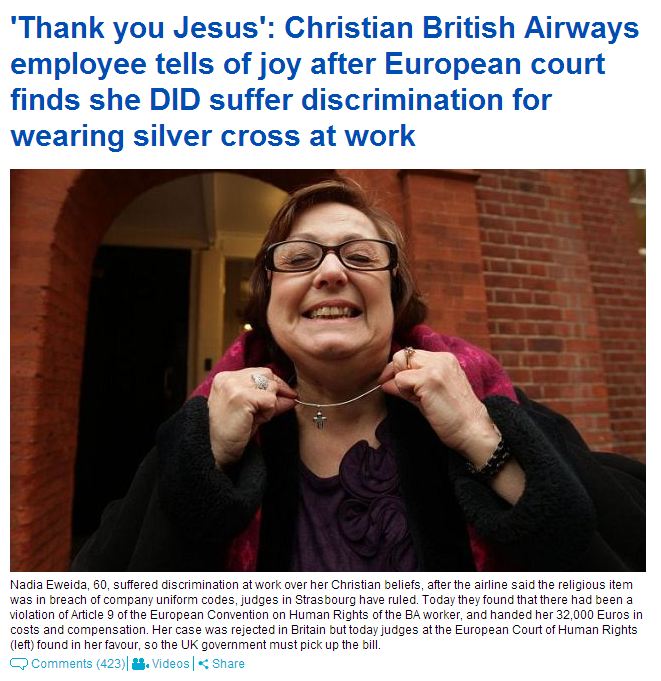
The media in the UK continues to report issues with a pro-religion, pro-Christian bias. To illustrate, consider the reporting of these cases today. Despite Christians losing three out of four, the BBC headline is BA discriminated against Christian:


It's all about the exception to the rule. This despite the analysis inside of Robert Pigott, their religious affairs correspondent, who correctly identified the real significance of the judgements:

His words:

It's perhaps more significant that Shirley Chaplin's case was dismissed, along with those of Gary McFarlane and Lillian Ladele. Today's judgement sets the legal seal on years in which traditionalist Christians have tried, and failed, to defend their values against secular ones in British courts.
The message coming from Strasbourg is that although people are entitled to hold religious views, that right is severely limited in the workplace when it comes into conflict with the rights of other people. The judgement also hands considerable discretion to employers to set reasonable policies and then insist that employees follow them whatever their religious beliefs.
Quite.

And this is not an isolated incident; Christian bias in our media is legion. Here is how this case has been reported across the UK media online:

ITN: Christian wins 'cross' battle
The Guardian: Cross ban 'infringed worker's rights'
The Daily Mail: 'Thank you Jesus'!
The Telegraph: Christians face 'lawful exclusion' from jobs
Interestingly, The Telegraph does highlight the Christian losses, but does not frame this in a context of plurality and tolerance for all, but feeds the Christian persecution complex.

It really is too much for Christians, in a country where the media continue to report religious matters like this, where there is an established church, with unelected representatives in Parliament, whose leaders are given many a soapbox from which to preach, to complain about persecution. They have their religious freedom, but balanced judgements have to be made for the good of all (not just Christians) when competing rights come into conflict with each other. That is all that has happened in the UK courts in these recent matters, as the ECtHR ruling confirms.


Read more »

Thrown to the Lions?


That Christians are being persecuted was the rather hysterical tenor of an article by Paul Diamond in the Telegraph a couple of days ago - Christians' rights: Martyred on a cross of secular liberalism. The martyr he cites is Harry Hammond, an unfortunate, but homophobic, street preacher who maybe was the victim of some injustice, back in 2002. That goes no way to showing anything more, however, than that one man was treated unfairly by the authorities in one instance. This is not an attack on religion, says Diamond, but on Christianity:
And this is not an erosion of rights for people of faith - Muslims, Hindus and Sikhs continue to be protected by the law - but for people of one particular faith: Christianity.
The assertion is that the British legal system is now antipathetic, to say the least, to Christianity:
It seems that the British legal system is intent on removing the Judeo-Christian foundation of our laws, which have served us for a thousand years, replacing them with a secular, liberal worldview which dispenses tolerance to all those who agree with it and relentless hostility, or even persecution, to those who do not.
Hmm. This hardly seems supported by the facts. But today the ECtHR has ruled on four cases of supposed discrimination against Christians, so we should have some more evidence to judge this by.

The Court's assessment starts with an excellent summary of the issues at stake:
79. The Court recalls that, as enshrined in Article 9, freedom of thought, conscience and religion is one of the foundations of a “democratic society” within the meaning of the Convention. In its religious dimension it is one of the most vital elements that go to make up the identity of believers and their conception of life, but it is also a precious asset for atheists, agnostics, sceptics and the unconcerned. The pluralism indissociable from a democratic society, which has been dearly won over the centuries, depends on it (see Kokkinakis v. Greece, 25 May 1993, § 31, Series A no. 260-A).
I rather like that reference to 'the unconcerned', an often over-looked constituency, and the recognition that freedom of thought and conscience are also a 'precious asset' for atheists et al is important. The first case they rule on is that of Nadia Eweida; British Airways refused to allow her to wear her cross visibly. Did the ECtHR consider that she had been persecuted by domestic law? In Para 92 they considered the question, and concluded:
The Court does not, therefore, consider that the lack of specific protection under domestic law in itself meant that the applicant’s right to manifest her religion by wearing a religious symbol at work was insufficiently protected.
So that's a No, then. However, they did consider that the domestic courts had made the wrong decision in this case. It's worth quoting the three paragraphs on the subject to get a sense of the balancing of competing interests involved:

93. When considering the proportionality of the steps taken by British Airways to enforce its uniform code, the national judges at each level agreed that the aim of the code was legitimate, namely to communicate a certain image of the company and to promote recognition of its brand and staff. The Employment Tribunal considered that the requirement to comply with the code was disproportionate, since it failed to distinguish an item worn as a religious symbol from a piece of jewellery worn purely for decorative reasons. This finding was reversed on appeal to the Court of Appeal, which found that British Airways had acted proportionately. In reaching this conclusion, the Court of Appeal referred to the facts of the case as established by the Employment Tribunal and, in particular, that the dress code had been in force for some years and had caused no known problem to the applicant or any other member of staff; that Ms Eweida lodged a formal grievance complaint but then decided to arrive at work displaying her cross, without waiting for the results of the grievance procedure; that the issue was conscientiously addressed by British Airways once the complaint had been lodged, involving a consultation process and resulting in a relaxation of the dress code to permit the wearing of visible religious symbols; and that Ms Eweida was offered an administrative post on identical pay during this process and was in February 2007 reinstated in her old job.
94. It is clear, in the view of the Court, that these factors combined to mitigate the extent of the interference suffered by the applicant and must be taken into account. Moreover, in weighing the proportionality of the measures taken by a private company in respect of its employee, the national authorities, in particular the courts, operate within a margin of appreciation. Nonetheless, the Court has reached the conclusion in the present case that a fair balance was not struck. On one side of the scales was Ms Eweida’s desire to manifest her religious belief. As previously noted, this is a fundamental right: because a healthy democratic society needs to tolerate and sustain pluralism and diversity; but also because of the value to an individual who has made religion a central tenet of his or her life to be able to communicate that belief to others. On the other side of the scales was the employer’s wish to project a certain corporate image. The Court considers that, while this aim was undoubtedly legitimate, the domestic courts accorded it too much weight. Ms Eweida’s cross was discreet and cannot have detracted from her professional appearance. There was no evidence that the wearing of other, previously authorised, items of religious clothing, such as turbans and hijabs, by other employees, had any negative impact on British Airways’ brand or image. Moreover, the fact that the company was able to amend the uniform code to allow for the visible wearing of religious symbolic jewellery demonstrates that the earlier prohibition was not of crucial importance.
95. The Court therefore concludes that, in these circumstances where there is no evidence of any real encroachment on the interests of others, the domestic authorities failed sufficiently to protect the first applicant’s right to manifest her religion, in breach of the positive obligation under Article 9. In the light of this conclusion, it does not consider it necessary to examine separately the applicant’s complaint under Article 14 taken in conjunction with Article 9.

So that's a Yes, the domestic authorities failed to protect Ms Eweida's right to manifest religion. I think it's plain that this is still seen as a judgement call, weighing the competing rights, but the Court decided 'there is no real encroachment on the interests of others'. Certainly it seems to me that there is very little encroachment on the interests of other individuals, although clearly the interests of the company were affected. I must say, this conclusion seems reasonable to me, and the BA relaxation of rules should really have come a lot sooner after Ms Eweida objected to her treatment. I can't even imagine what was going through the minds of her superiors when they insisted she hide her cross, displayed as unobtrusively as it was.

The second case is Shirley Chaplin. She was a nurse who had been asked to remove a cross and chain she was wearing:
The evidence before the Employment Tribunal was that the applicant’s managers considered there was a risk that a disturbed patient might seize and pull the chain, thereby injuring herself or the applicant, or that the cross might swing forward and could, for example, come into contact with an open wound. There was also evidence that another Christian nurse had been requested to remove a cross and chain; two Sikh nurses had been told they could not wear a bangle or kirpan; and that flowing hijabs were prohibited. The applicant was offered the possibility of wearing a cross in the form of a brooch attached to her uniform, or tucked under a high-necked top worn under her tunic, but she did not consider that this would be sufficient to comply with her religious conviction. (Para 98)
Here we see very clear evidence that there is no Christian persecution going on at all; other religion's manifestations were also the subject of health and safety measures.
The Court considers that, as in Ms Eweida’s case, the importance for the second applicant of being permitted to manifest her religion by wearing her cross visibly must weigh heavily in the balance. However, the reason for asking her to remove the cross, namely the protection of health and safety on a hospital ward, was inherently of a greater magnitude than that which applied in respect of Ms Eweida. Moreover, this is a field where the domestic authorities must be allowed a wide margin of appreciation. The hospital managers were better placed to make decisions about clinical safety than a court, particularly an international court which has heard no direct evidence. (Para 99)
A clear ruling that the domestic authorities in such a case must be allowed a wide margin of appreciation, so that's a No:
It follows that the interference with her freedom to manifest her religion was necessary in a democratic society and that there was no violation of Article 9 in respect of the second applicant. (Para 100)
The third case is Lillian Ladele:
She believed that same-sex unions are contrary to God’s will and that it would be wrong for her to participate in the creation of an institution equivalent to marriage between a same-sex couple. Because of her refusal to agree to be designated as a registrar of civil partnerships, disciplinary proceedings were brought, culminating in the loss of her job. (Para 102)
The Court noted that her objection was religious, and:
The Court recalls that in its case-law under Article 14 it has held that differences in treatment based on sexual orientation require particularly serious reasons by way of justification (see, for example, Karner v. Austria, no. 40016/98, § 37, ECHR 2003-IX; Smith and Grady, cited above, § 90; Schalk and Kopf v. Austria, no. 30141/04, § 97, ECHR 2010). It has also held that same-sex couples are in a relevantly similar situation to different-sex couples as regards their need for legal recognition and protection of their relationship, although since practice in this regard is still evolving across Europe, the Contracting States enjoy a wide margin of appreciation as to the way in which this is achieved within the domestic legal order (Schalk and Kopf, cited above, §§ 99-108). Against this background, it is evident that the aim pursued by the local authority was legitimate. (Para 105)
Some interesting notes there, on the same-sex marriage issue as the Court sees it. They conclude:
In all the circumstances, the Court does not consider that the national authorities, that is the local authority employer which brought the disciplinary proceedings and also the domestic courts which rejected the applicant’s discrimination claim, exceeded the margin of appreciation available to them. It cannot, therefore, be said that there has been a violation of Article 14 taken in conjunction with Article 9 in respect of the third applicant. (Para 106)
So that's another No. It's worth reading the preamble, though, to see that they are concerned that Ms Ladele lost her job over her religious beliefs, a heavy price to pay. Such consequences should not be taken lightly, and we should applaud all courts that weigh these matters conscientiously.

The fourth case is Gary McFarlane:
Employed by a private company with a policy of requiring employees to provide services equally to heterosexual and homosexual couples, he had refused to commit himself to providing psycho-sexual counselling to same-sex couples, which resulted in disciplinary proceedings being brought against him. His complaint of indirect discrimination, inter alia, was rejected by the Employment Tribunal and the Employment Appeal Tribunal and he was refused leave to appeal by the Court of Appeal. (Para 107)
Again the Court agrees that these are beliefs motivated by his religion. It's important to note that Christians are using their religion specifically to ground their homophobia. This should not be forgotten when some dismiss the evil wrought by religion through dogma.

The Court concluded:
However, for the Court the most important factor to be taken into account is that the employer’s action was intended to secure the implementation of its policy of providing a service without discrimination. The State authorities therefore benefitted from a wide margin of appreciation in deciding where to strike the balance between Mr McFarlane’s right to manifest his religious belief and the employer’s interest in securing the rights of others. In all the circumstances, the Court does not consider that this margin of appreciation was exceeded in the present case. (Para 109)
It should be noted that this is allowing that the state had not exceeded its margin of appreciation; they expressed serious concerns over the consequences suffered by Mr McFarlane. Nevertheless:
110. In conclusion, the Court does not consider that the refusal by the domestic courts to uphold Mr McFarlane’s complaints gave rise to a violation of Article 9, taken alone or in conjunction with Article 14.
So we have another No, there is no violation of Article 9:

Article 9 – Freedom of thought, conscience and religion
1. Everyone has the right to freedom of thought, conscience and religion; this right includes freedom to change his religion or belief and freedom, either alone or in community with others and in public or private, and to manifest his religion or belief, in worship, teaching, practice and observance.
2. Freedom to manifest one's religion or beliefs shall be subject only to such limitations as are prescribed by law and are necessary in a democratic society in the interests of public safety, for the protection of public order, health or morals, or for the protection of the rights and freedoms of others.

So we have a picture building that does not support the sentiments expressed by Paul Diamond in his Telegraph article. Certainly there are provisos; one case out of four shows a fault in the domestic courts, but we see from them all that these are difficult judgement calls - consider the dissenting decision on Ladele, for example (final page of judgement):
She never attempted to impose her beliefs on others, nor was she in any way engaged, openly or surreptitiously, in subverting the rights of others. (Para 7)
A person can be homophobic (that is their right), so long as it does not encroach on the interests of others.

I think it will always be the case that mistakes will be made by courts when weighing competing rights - this is the price we pay for living in a pluralistic, democratic society. But to conclude from such marginal cases that Christians, in particular, are being persecuted is simply not supported by the details of this judgement.

Read more »

Friday, 4 January 2013

Sam's Argument


Sam Harris has written a piece on American gun law called The Riddle of the Gun. He starts off promisingly:
Unlike most Americans, I stand on both sides of this debate. I understand the apprehension that many people feel toward “gun culture,” and I share their outrage over the political influence of the National Rifle Association. How is it that we live in a society in which one of the most compelling interests is gun ownership? Where is the science lobby? The safe food lobby? Where is the get-the-Chinese-lead-paint-out-of-our-kids’-toys lobby? When viewed from any other civilized society on earth, the primacy of guns in American life seems to be a symptom of collective psychosis.
Quite so. But it soon becomes plain that he may be a victim of that collective psychosis, when he says:
I am surrounded by otherwise intelligent people who imagine that the ability to dial 911 is all the protection against violence a sane person ever needs.
Is he really? I doubt anyone intelligent thinks that. Nevertheless, Sam is one of the clearest thinkers on any subject, even if he is occasionally wrong, so I think it should be fruitful to look at any argument he presents, since it is likely to be among the best the pro-gun lobby can offer. His counters to the 'liberal' position are unconvincing, to say the least, so what does he say positively in favour of guns?

He presents an argument here:
Given the level of violence in our society, the ubiquity of guns, and the fact that our penitentiaries function like graduate schools for violent criminals, I think sane, law-abiding people should have access to guns. In that respect, I support the rights of gun owners.
It's pretty splintered, but I think his argument goes something like this:

P1 We live in a society with a high level of violence.
P2 There are guns everywhere.
P3 Our prisons manufacture violent criminals.
P4 Everyone should be responsible for their own defence.
P5 The only way to defend oneself from a violent criminal in a violent society where guns are everywhere is with a gun.

C Everyone sane and law-abiding should have access to guns.

Well, I don't think this is even valid, and maybe it can be tidied up some more, but it will do for starters.

P1 he undermines himself by defending the levels of violence in US society when defending gun ownership:
Fifty-five million kids went to school on the day that 20 were massacred at Sandy Hook Elementary in Newtown, Connecticut. Even in the United States, therefore, the chances of a child’s dying in a school shooting are remote. 
He is well aware of the dangers associated with our perception of risk:
As my friend Steven Pinker demonstrates in his monumental study of human violence, The Better Angels of Our Nature, our perception of danger is easily distorted by rare events.
Now it may be that he has good reason to own a gun and to train to use it correctly, but his situation should not be used to justify a position for the rest of the population. The statistics show that Americans are unlikely to be injured by a gun, as he knows, which militates against P1. The statistic we're trying to explain and remedy, as he also knows, is the discrepancy with the rest of the developed world. It seems very plausible to me that this gap could be reduced by making it more difficult for people in the US to own guns. So the 'ubiquity of guns' is the very thing that could be addressed, not used as P2 in his argument in favour of their ubiquity.

P3 may well be true, but is hardly different to other countries.

P4, it strikes me, is obviously wrong, in a civilised society. Not everyone is capable of defending themselves so are we supposed to let the young, the old, women, the ill, the underprivileged and the just plain incompetent gun users, get shot up by violent criminals? Now, maybe I'm being unfair, and he would say the premise is more like: everyone should have the right to defend themselves. The problem is that it's obviously a universal right he's arguing for, so this will still leave a large constituency vulnerable to the mass of armed members of society.

P5 I also think is obviously wrong, and betrays a rather simplistic and shocking vision of the way a civilised society should function. Self-defence does not simply mean shooting someone before they shoot you. As he himself also points out, being armed with a gun won't necessarily act as a deterrent, but can act as an incendiary:
But, emotions being what they are, [a weapon] often doesn’t [preempt further violence] —and the owner of the weapon can find himself resorting to deadly force in a circumstance that would not otherwise have called for it. 
Yes, as a soldier in a war-zone I would think it better that I had a gun. As a civilian in the midst of violent civil unrest, I might think it better that I had a gun. In a society that had broken down a bit, I might think it better that I had a gun. But I don't think any of our societies, including the US, come close to the sort of state that requires that sort of thinking.

So I don't think Sam's argument works at all.

Some more thoughts from Sean Faircloth here, and some cautionary words from Russell Blackford here.

Read more »

Thursday, 27 December 2012

Peter Higgs Criticises Evangelical Protestants

© The Guardian
In a video interview with the Spanish paper El Mundo, Peter Higgs, the man after whom the Higgs Boson was named, has criticised that particle's epithet, 'The God Particle':
It's inviting people to confuse theoretical physics with theology, and that's not a good thing to do.
Indeed, it has nothing to do with god - the name was apparently just part of the marketing effort for this book by Leon Lederman - and does not replace any god. The god hypothesis is noticeably absent from any serious scientific papers, so the discovery of an elementary particle could not replace a concept that is superfluous.

But that has not stopped Christians from accommodating it to their philosophies. Consider this reported conversation between a believer, Larry Taunton, and an 'agnostic' unnamed particle physicist:
"As you look back on a long career, what is one thing that your study of science has taught you?"
He did not hesitate. "It has taught me that there are laws in the universe that science is powerless to explain. We understand the laws of physics, but where did the laws themselves come from? Why do they work?"
"Professor, if I understand you correctly, you are saying that just as the Higgs boson is the most logical explanation for how particles get their mass, there must also be a kind of Higgs-boson-to-the-universe, so to speak, establishing laws and making them work, yes?"
He tilted his head inquiringly. "You mean God?" I acknowledged that I did indeed mean the Almighty. If, by faith, we accept that there are immutable natural laws, why not accept the possibility of a Lawgiver? "Yes," he conceded with a smile, "I suppose you could say that."
(The conversation took place at Green-Templeton College at Oxford University, which, as the name suggests, was partly founded with money from a man dedicated to the reconciliation of science and faith.)

The logic is poor and the conclusion vacuous, but it goes to show the lengths to which believers will go to accommodate science and religion.  Higgs is reported by the Guardian to be similarly accommodating, in an article entitled Peter Higgs criticises Richard Dawkins over anti-religious 'fundamentalism':
In the El Mundo interview, Higgs argued that although he was not a believer, he thought science and religion were not incompatible. "The growth of our understanding of the world through science weakens some of the motivation which makes people believers. But that's not the same thing as saying they're incompatible. It's just that I think some of the traditional reasons for belief, going back thousands of years, are rather undermined.
"But that doesn't end the whole thing. Anybody who is a convinced but not a dogmatic believer can continue to hold his belief. It means I think you have to be rather more careful about the whole debate between science and religion than some people have been in the past."
Such a tenuous accommodation could also be made between Stalinism and faith, or National Socialism and faith, but no such link is sought. Science has something which even the most ardent believer values. The Higgs boson is enormously important in explaining reality, but has nothing to say about gods; that fact in itself suggests there is quite a difference between reality and gods.

So it's good to see Peter Higgs himself baulk at the nefarious use of the 'God Particle' meme; he also says:
There have been some evangelical protestants who go around trying to convert people...to influence people to follow them, and that I think is a bad consequence.
I would agree. It's odd, then, that he also has a pop at Richard Dawkins. The video above doesn't seem to include it, but the report says:
"What Dawkins does too often is to concentrate his attack on fundamentalists. But there are many believers who are just not fundamentalists," Higgs said in an interview with the Spanish newspaper El Mundo. "Fundamentalism is another problem. I mean, Dawkins in a way is almost a fundamentalist himself, of another kind."
To be fair, he only says 'almost a fundamentalist', but the 'almost' gets lost in the edit. As the article itself notes, the 'Dawkins is a fundamentalist too' notion is a canard that Dawkins has been at pains to refute; he holds to no sacred text, so cannot, by definition, be a fundamentalist of any kind, if a fundamentalist is defined as one who holds unerringly to a sacred text (the Wikipedia definition). Dawkins does not really concentrate his attack on fundamentalists, in my opinion, but he obviously has to spend more time refuting creationists, because it is they who threaten science education the most; if Higgs does not recognise this, he is in danger of looking sadly complacent. And one may ask what Higgs is doing simply attacking evangelical protestants, when it's plain to me that any number of apologists have used the 'God Particle' to their own ends. Should Dawkins refrain from calling out creationists if Higgs is allowed to call out evangelicals?

Of course, a looser definition of fundamentalism could be applied to Dawkins; the Oxford Dictionary of English includes this variation:
strict adherence to the basic principles of any subject or discipline
Well, on those terms, perhaps Dawkins is a fundamentalist, since he adheres strictly to the principles of science. But then, so too does Higgs in his opposition to evangelical protestants using the boson to convert people. If that is the only line any of us have to cross to be labelled a fundamentalist, maybe it is more appropriate to call Peter Higgs a fundamentalist, the man who predicted a fundamental element of the Standard Model, a 'theory of almost everything', but who still objects to evangelicals citing it as a reason to believe in their god.

Of course, he's no more a 'fundamentalist' than is Dawkins; it's a shame that he's fallen for the trite clichés that the religious and believers in belief like to propagate about those who dare to point out the errors of faith; he's effectively accusing himself of the same thing.

Read more »

Thursday, 20 December 2012

Gun Ownership and Gun Deaths

It seems intuitively obvious to me that deaths by firearm would increase according to availability of firearms, and the prevalence of gun crime in the United States appears to bear this out. But that is just one data point; do the statistics bear this out?

Well I'm no statistician, but I can just about use Excel, so here's the developed countries culled from this list and plotted:

A trend emerges, though it's a lot less emphatic without the US:


Here's the dataset:
Country/Territory Homicide by firearm rate per 100,000 pop Average firearms per 100 people
Australia 0.14 15
Austria 0.22 30.4
Belgium 0.68 17.2
Canada 0.51 30.8
Denmark 0.27 12
England and Wales 0.07 6.2
Finland 0.45 45.3
France 0.06 31.2
Germany 0.19 30.3
Greece 0.26 22.5
Ireland 0.48 8.6
Israel 0.09 7.3
Italy 0.71 11.9
Netherlands 0.33 3.9
New Zealand 0.16 22.6
Norway 0.05 31.3
Portugal 0.41 8.5
Spain 0.2 10.4
Sweden 0.41 31.6
Switzerland 0.77 45.7
Turkey 0.77 12.5
United States 2.97 88.8

It's interesting that the US makes quite a difference, but then it is currently that anomaly (gun crime in the States) that we are trying to explain, given the dreadful events at Sandy Hook. Nevertheless, it should be noted that there are difficulties comparing countries like this.

A review of the literature 1 a few years back, however, does conclude that gun deaths and gun ownership are correlated, while noting my proviso:
4. Conclusion
The available evidence is quite consistent. The few case control studies suggest that households with firearms are at higher risk for homicide, particularly firearm homicide. International cross-sectional studies of high-income countries find that in countries with more firearms, both men and women are at higher risk for homicide, particularly firearm homicide. This result is primarily due to the United States, which has the highest levels of household ownership of private firearms, the weakest gun control laws, and the highest homicide rates. Time series studies of particular cities and states, and for the United States as a whole, suggest a positive gun prevalence-homicide association. Finally, perhaps the strongest evidence comes from cross-sectional analyses of U.S. regions and states. Again, places with higher levels of gun ownership are places with higher homicide rates.
None of the studies can prove causation and none have completely eliminated the possibility that the association might be entirely due to reverse causation or omitted variables. But the available evidence is entirely inconsistent with the hypothesis that increased gun prevalence lowers the homicide rate. Instead, most studies, cross sectional or time series, international or domestic, are consistent with the hypothesis that higher levels of gun prevalence substantially increase the homicide rate.
The comparison across US States apparently providing the strongest evidence. It would be interesting to see some more literature reviews; it's interesting reading about the difficulties in data comparisons across diverse countries and regions - cultural differences and data collection methods must affect the data significantly. Nevertheless, the consistency in the results, leaves us confident in concluding there is a correlation (note the causation caution above) between gun ownership and gun deaths, which suggests reducing gun ownership might well result in a decrease in gun deaths, which is in line with my intuitions, at least.

1 Lisa M Hepburn, David Hemenway, Firearm availability and homicide: A review of the literature, Aggression and Violent Behavior, Volume 9, Issue 4, July 2004, Pages 417-440, ISSN 1359-1789, 10.1016/S1359-1789(03)00044-2.
(http://www.sciencedirect.com/science/article/pii/S1359178903000442)
Keywords: Firearm; Firearms; Homicide; Guns


Read more »

Tuesday, 18 December 2012

Queenie and Cam

After attending today's Cabinet meeting, the Queen performs her celebrated ventriloquism act on David Cameron.

Read more »